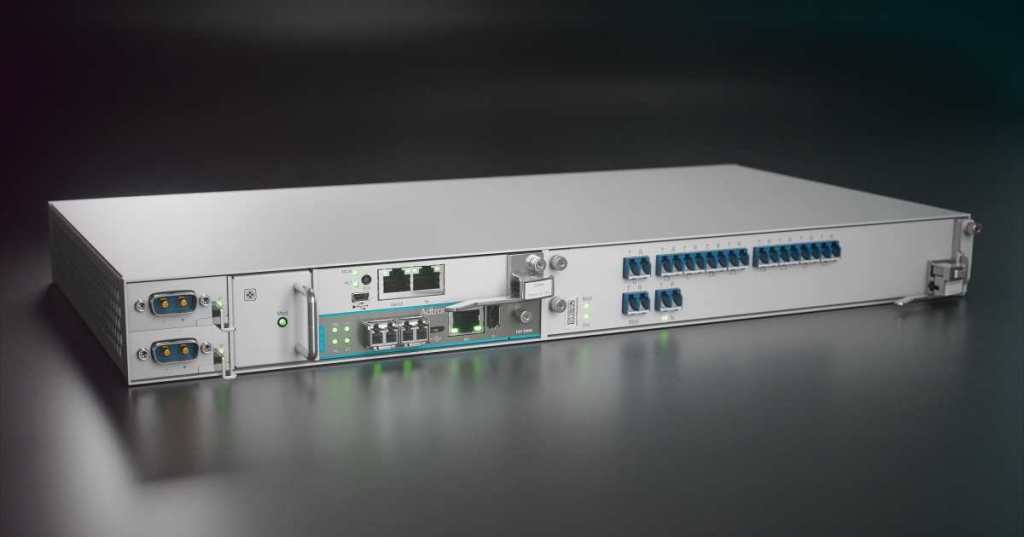
South African fixed wireless provider Comsol Networks has selected Adtran and NEC XON to expand the optical transport infrastructure underpinning its enterprise 5G network. The November 24, 2026 announcement identifies a planned capacity progression from 100 to 400 and eventually 800 gigabits per second (Gb/s). The project highlights a principle also evident in Uniti and Nokia’s 800G trial: faster access networks need sufficient capacity behind them.
Why 5G needs fiber
Fixed wireless access delivers connectivity over a radio link to a customer location. Traffic from multiple customers converges at aggregation equipment before traveling toward data centers, internet exchanges or application servers. Even when the customer connection is wireless, terrestrial fiber frequently provides the high-capacity transport between network sites. A congested backhaul can therefore limit performance regardless of the radio interface’s theoretical peak rate.
Comsol selected Adtran’s FSP 3000 optical transport platform, with NEC XON supplying the managed network service. Optical transport systems multiplex traffic onto wavelengths, allowing operators to increase the amount of information carried over installed fiber. Coherent transmission can use digital signal processing to compensate for fiber impairments. Our coverage of Ciena and Internet2’s 2,104 km optical trial illustrates how reach and interface capacity are distinct engineering variables. Comsol’s announcement does not disclose route lengths, optical modulation formats or the number of wavelengths planned.
An eightfold capacity upgrade path
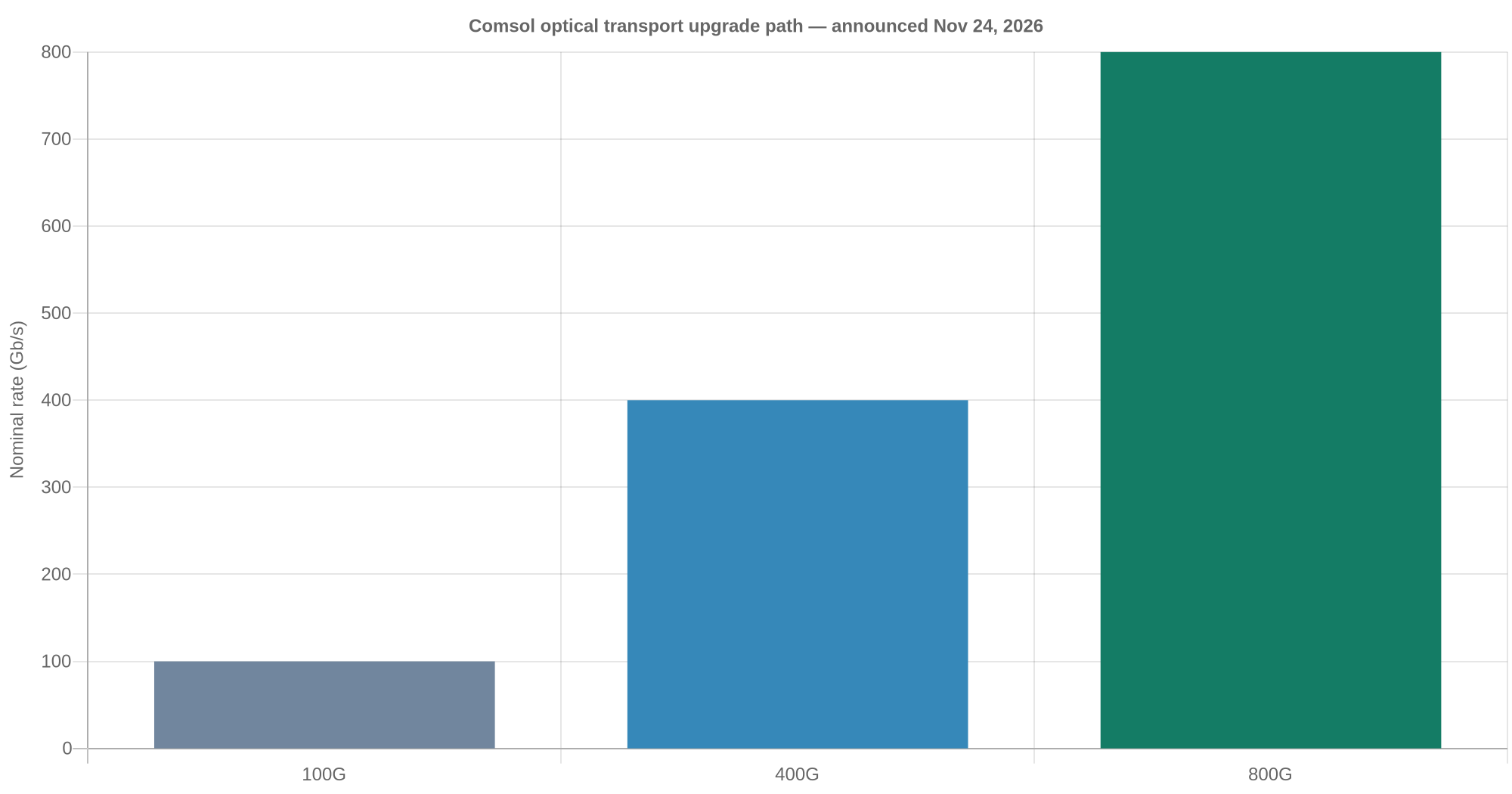
Moving from 100 to 400 Gb/s represents a fourfold nominal increase; 800 Gb/s is eight times the original reference rate and twice the intermediate option. Expressed as decimal bytes per second before overhead, the three rates correspond to 12.5, 50 and 100 GB/s. Actual application throughput depends on protocol overhead, equipment, traffic patterns and available end-to-end capacity. The upgrade path is not evidence that Comsol has already activated 800G service, nor that individual 5G subscribers will receive such speeds. The company’s approach differs from 1Finity’s 800G server network interface, which addresses a different connection boundary.
Managing optical infrastructure as a service
Under the managed optical fiber network arrangement, NEC XON assumes specialist operational responsibilities, including engineering support and lifecycle management. Comsol can concentrate more resources on customer access and service development rather than building every optical transport capability internally. NEC’s announcement confirms the partnership structure. Managed service contracts still require clear responsibility for fault isolation, restoration, monitoring, capacity commitments and service-level agreements.
The commercial terms, deployment timetable and independently measured cost savings have not been disclosed. Network operators will need to validate redundancy and optical performance as traffic grows. Related developments such as Portugal’s programmable dark fiber network demonstrate another approach to simplifying connectivity. The meaningful milestone for Comsol will be documented activation of higher-capacity services, alongside measurable reliability improvements for enterprise customers. An announced architecture creates the option to scale; it does not establish that every planned upgrade is operating.
We volunteer daily to ensure the credibility of the information on this platform is Verifiably True. If you would like to support to help further secure the integrity of our research initiative, please scan the QR code below.

For mobile scanning, open the article on another display and scan the QR code with a Bitcoin wallet. The voluntary donation amount is 5,000 sats. Verify the receiving address 3C9o19EH5HSiwEPyCTmEKzxhNCbo2X6TTb before sending.
BitcoinVersus.tech is not a financial advisor. This media platform reports on financial subjects purely for informational purposes.


Leave a Reply