
Optical transceivers convert high-speed electrical data from a switch or accelerator into light carried through fiber. A digital signal processor (DSP) conditions signals, while modulators and detectors connect the electrical and optical paths. The hardware is increasingly important as artificial-intelligence clusters exchange large volumes of training and inference data. Marvell’s October 6, 2026 Investor Day architecture, reinforced by a November 5 technology-award announcement, offers a controlled comparison of two generations of PAM4 optical connectivity: 800 gigabits per second (800G) and 1.6 terabits per second (1.6T).
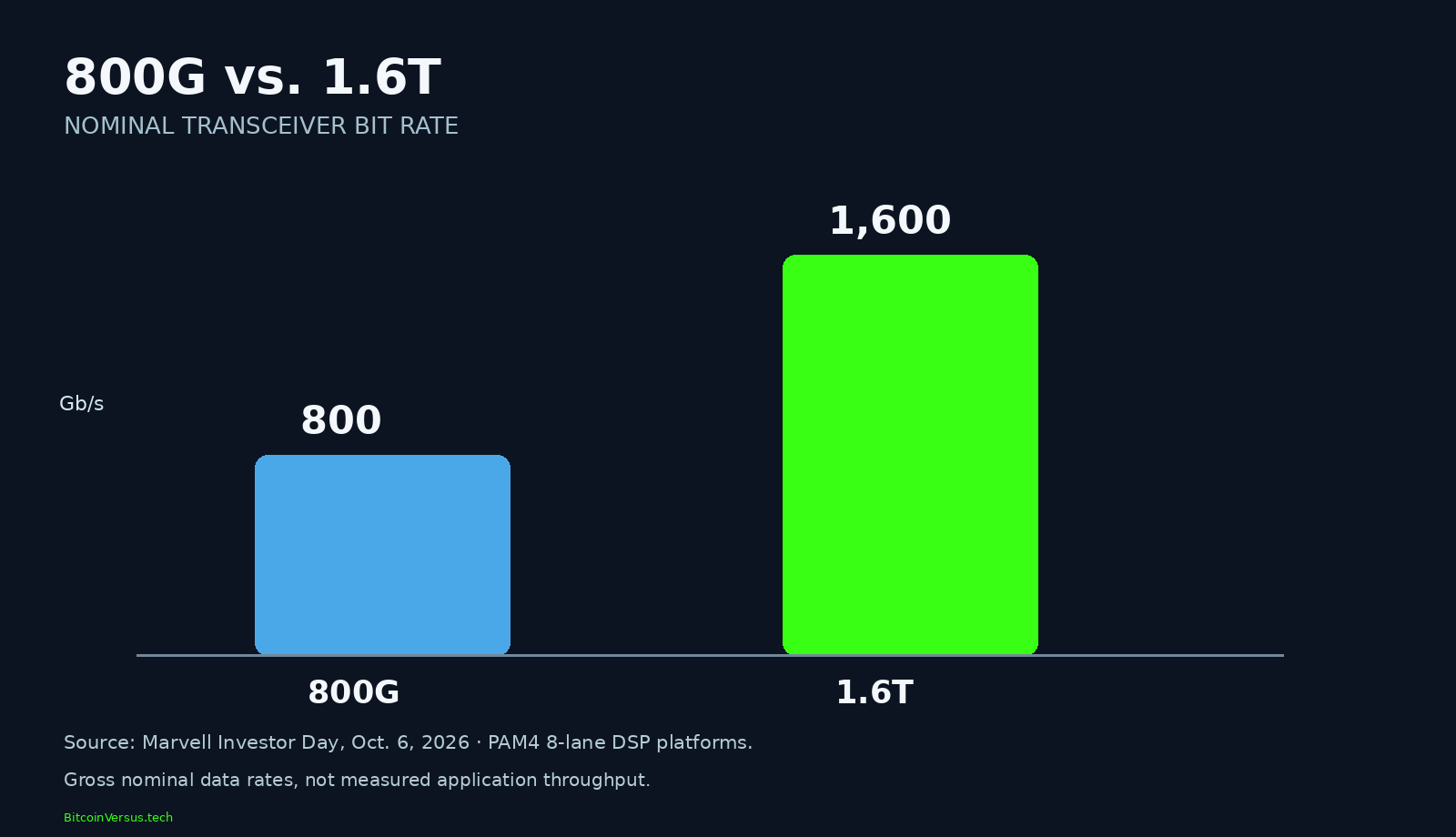
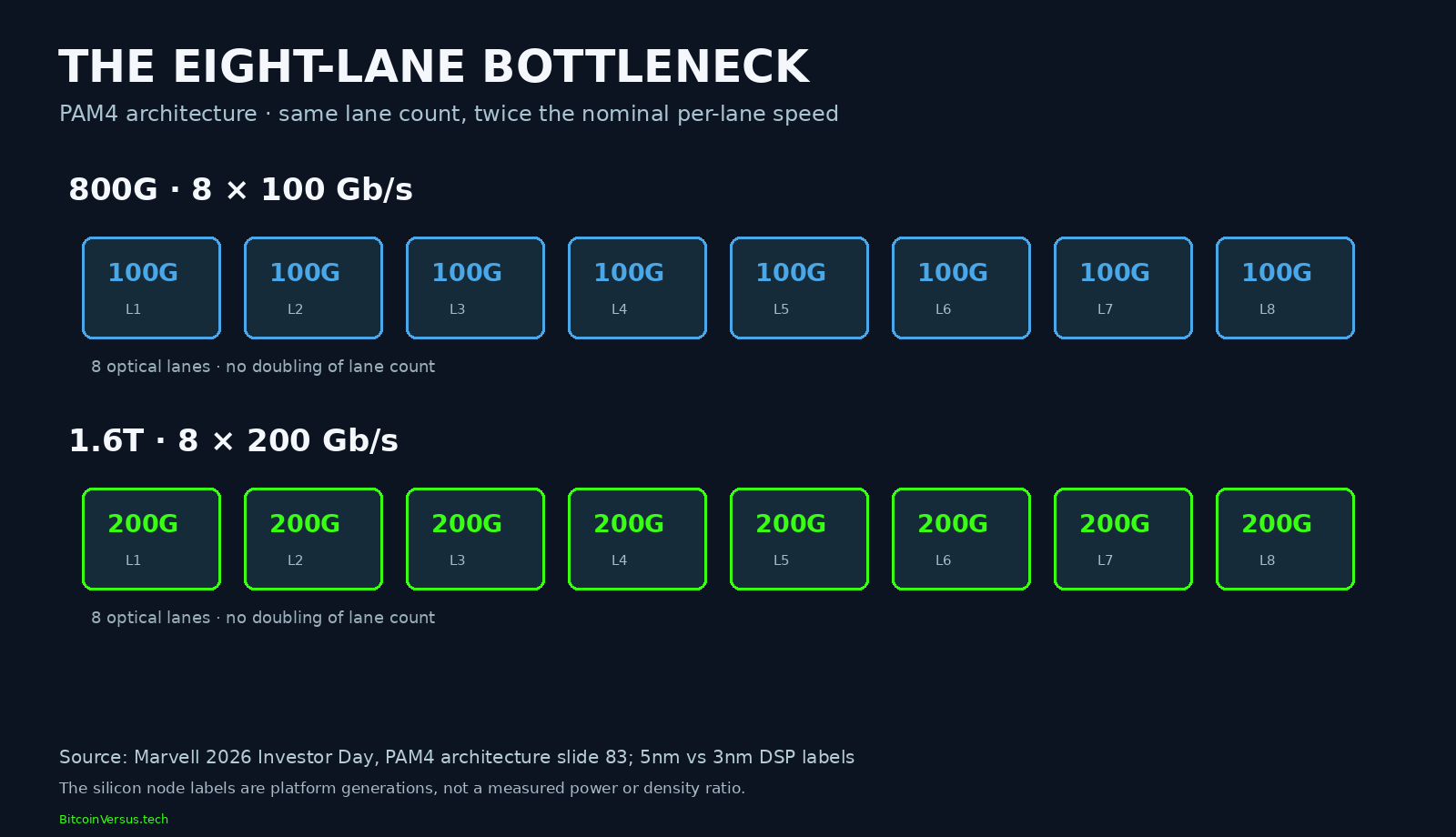
The headline difference is clear: 1.6T carries twice the nominal bandwidth of 800G. The crucial engineering detail is that both platforms use eight optical lanes. The newer reference architecture achieves the increase by raising nominal signaling from 100G to 200G per lane, rather than doubling the number of lanes.
What Changes Inside the Optical Module
Marvell lists its 800G PAM4 generation as a 5-nanometer DSP with eight 100G lanes, while the 1.6T generation uses a 3-nanometer DSP with eight 200G lanes. The 5nm and 3nm labels describe semiconductor process families; subtracting them does not yield a valid chip-area, cost or energy-efficiency percentage. Their measured transistor counts, module power, and real error rates are not provided in the comparison slide.
At 800G, strengths include an established deployment ecosystem, 100G-per-lane component designs and mature operational knowledge. At 1.6T, strengths include 200G-per-lane signaling, greater bandwidth per nominal module and newer DSP options for power optimization or link robustness. Both generations remain subject to connector, optics, host-port and interoperability requirements. Readers can review the site’s optical-transceiver engineering guide before selecting a form factor.
An earlier demonstration provides a view of the established 800G module class. The manufacturer video is illustrative and is not a laboratory test against the 1.6T reference architecture.
QSFPTEK — demonstration of an 800G QSFP-DD DR8 optical transceiver. Product footage provides background on the 800G module class, not a measured head-to-head Marvell benchmark.
Why Doubling the Label Does Not Double Useful Throughput
An optical lane’s nominal rate is not automatically application goodput. Forward-error correction, protocol framing, packet sizes, switch congestion, optical loss and link-recovery behavior all influence useful traffic. A network also needs compatible host silicon and physical-layer components before a faster optic can deliver an advantage. BitcoinVersus.Tech has previously distinguished bandwidth, throughput and latency and covered 1.6T Ethernet link recovery. Faster signaling can increase design and test difficulty even when overall throughput capacity improves.
The 1.6T ecosystem has moved beyond conceptual slides. Marvell says its 3nm Ara platform ships in volume and identifies Ara T and Ara X among its power- and robustness-optimized derivatives. Marvell says Ara T can reduce optical module power by more than 35% in suitable designs; that is a vendor claim about a specialized 1.6T implementation, not evidence that 1.6T modules use 35% less electricity than 800G modules. No normalized, same-test wattage or price dataset was supplied for the two generations.
The next demonstration covers 1.6T Ethernet alongside 800ZR interoperability at an industry event. It documents a test ecosystem, not proof of universal plug-and-play interoperability.
VIAVI and Ethernet Alliance — 1.6T Ethernet and 800ZR interoperability demonstration at OFC 2026. Background test footage; reported rates should not be treated as independently reproduced application benchmarks.
What a Practical Upgrade Requires
Network buyers need more than a rate label: qualified optics, optical power budgets, switch ports, forward-error-correction settings, acceptable bit-error rates and an operating cost analysis. The OIF 1.6T roadmap identifies evolving high-speed optical standards, while earlier deployment reporting explains why interoperable validation matters before large-scale rollout. Marvell’s broader switching and memory-connectivity work shows that optics are only one element of an AI network.
Marvell Technology’s official April 6, 2026 social post discusses memory, systems and interconnect co-design for AI infrastructure. It provides industry context, not an optical-speed benchmark.
The evidence-based verdict: 1.6T wins rated link bandwidth and per-lane speed; 800G retains a mature installed ecosystem. An organization cannot infer superior power efficiency, value, latency or reliability without matched equipment and measured operating conditions. The comparison reflects Marvell’s specified PAM4 platform generations, not every 800G or 1.6T product using a different optical architecture.
Sources: Marvell Investor Day, October 6, 2026, slide 83; Marvell November 5 engineering-award update; Marvell 1.6T platform announcement; Marvell Ara T power-design analysis. Nominal speeds are engineering specifications, not field measurements.
BitcoinVersus.Tech Editor’s Note
Comparison uses Marvell’s stated 800G 5nm 8×100G and 1.6T 3nm 8×200G PAM4 DSP reference generations, as presented on October 6, 2026. Figures describe nominal bit rates, not measured end-user throughput, watts per bit or field failure rates. The featured artwork is conceptual, not a photograph of production test results. Third-party product videos and the official social post provide background and are not endorsements of the comparison.
We volunteer daily to ensure the information on this platform is Verifiably True. If you would like to support the research, please scan QR code.

Support independent reporting with an optional donation of 5,000 satoshis. Scan the original QR code from a separate screen using a Bitcoin wallet, or use a compatible saved-image scanner. Verify the destination address 3C9o19EH5HSiwEPyCTmEKzxhNCbo2X6TTb and amount before sending.
BitcoinVersus.Tech is not a financial advisor. Financial coverage is provided purely for informational purposes.


Leave a Reply