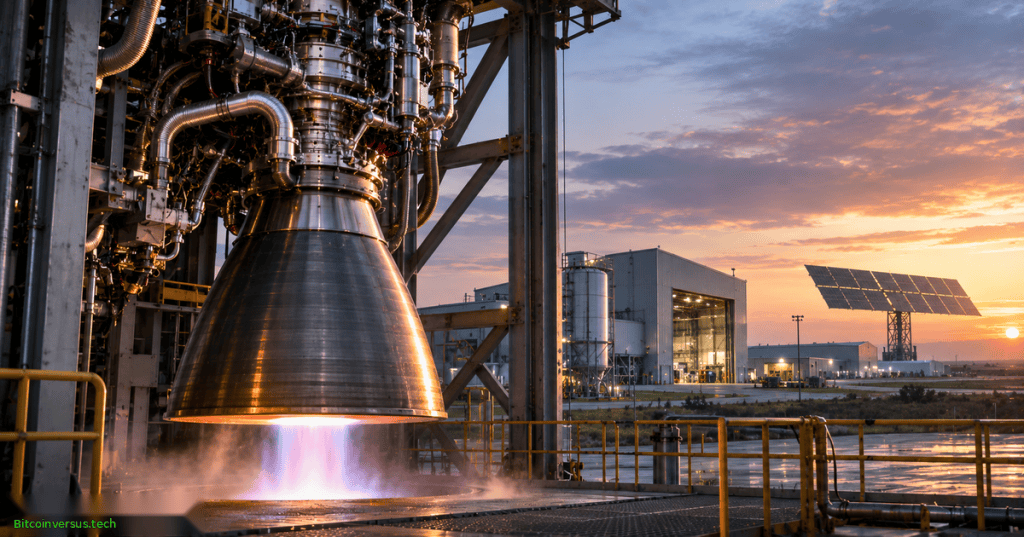
Liquid-fueled rockets depend on powerful combustion engines, high-speed turbopumps and carefully controlled propellant flows. Developing a reliable large engine requires years of testing before the completed launch vehicle can fly. For satellite-network operators, propulsion technology has become a major business decision: owning rocket production promises more control over launch schedules, but adds manufacturing expense, technical risk and new capital requirements.
Firefly Aerospace announced on November 6, 2026, an agreement valued at more than $1.3 billion to provide engines, intellectual-property licensing and engineering services for AST SpaceMobile’s proposed Blacklift rocket. Firefly’s announcement identifies 36 engines for the first three rockets. AST aims to use Blacklift to deploy its BlueBird satellites for direct-to-smartphone cellular broadband. The contract is a planned multi-year commercial commitment, not $1.3 billion of revenue already earned.
How the $1.3 billion agreement is structured
According to AST SpaceMobile’s SEC-filed November 6 announcement, roughly $800 million covers a perpetual engine-manufacturing license. The licensing consideration includes $400 million in cash and 10–14 million AST Class A shares, with the final count determined by a pricing formula. Another $250 million covers the engines for the first three launches, while $250 million is allocated to engineering support over three years. The disclosed components add to approximately $1.30 billion; the companies describe the total agreement as exceeding that rounded amount.
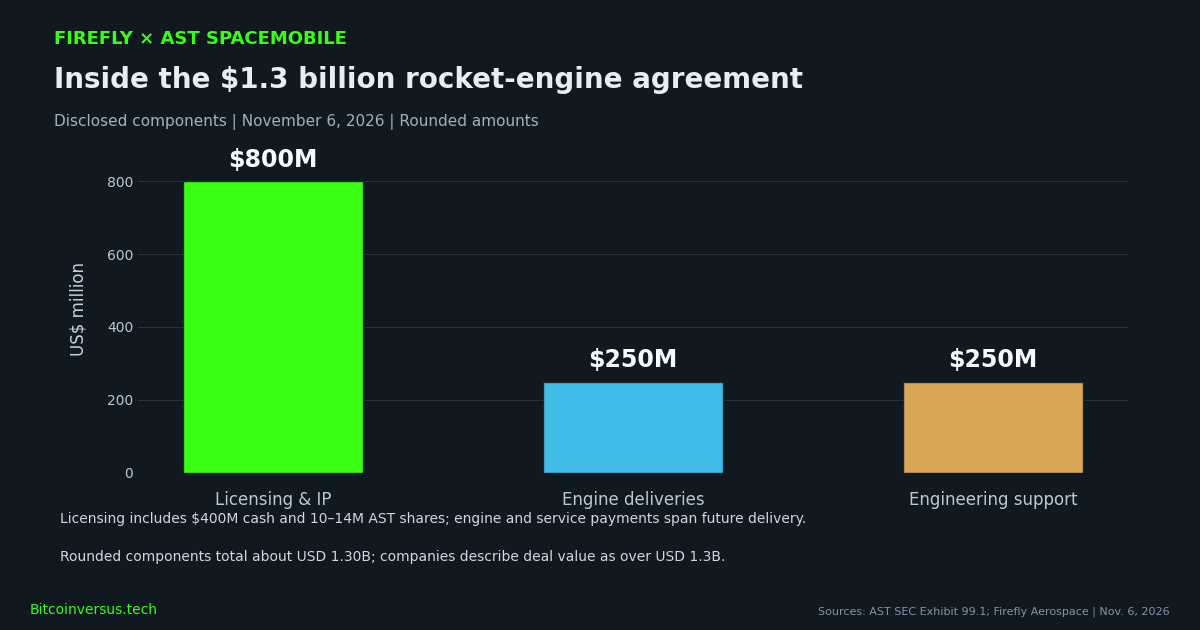
The financial structure matters as much as the headline valuation. Share-based consideration can affect AST investors through dilution; cash payments and future service obligations affect funding needs and timing. Firefly retains ownership of its engine intellectual property while licensing manufacturing rights to AST. Neither company established a realized return on investment or a verified future cost per satellite in the announcements reviewed.
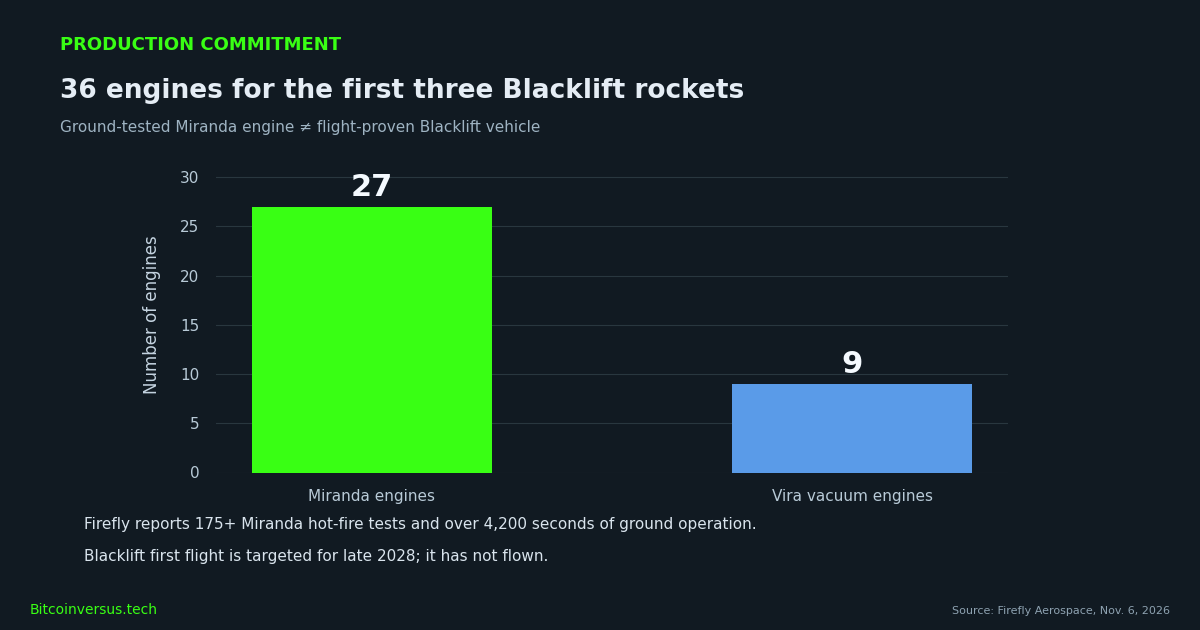
Thirty-six engines, but no Blacklift flight yet
Firefly will supply 27 Miranda engines and nine vacuum-variant Vira engines for AST’s first three planned Blacklift rockets. Firefly reports more than 175 Miranda hot-fire tests totaling over 4,200 seconds; the engine is rated at approximately 230,000 pounds-force of thrust. Those are ground-test and rated-thrust figures, not evidence that Blacklift has flown or demonstrated reusability. The Vira variant also remains under development.
Firefly Aerospace’s official “Miranda Engine 60 Second Hot Fire Test,” published July 12, 2024. Historical ground-test footage, not a Blacklift launch. Credit: Firefly Aerospace/YouTube.
AST describes Blacklift as a reusable 20-ton-class launch system, targeting late 2028 for initial launches and as many as five BlueBird satellites per mission. The target remains a projection. AST says external-launch agreements already cover more than 100 satellites expected to be deployed cumulatively during 2027–2028, reducing immediate dependence on an unbuilt rocket. An earlier BitcoinVersus.Tech ranking of operating orbital rockets provides context for launch-capability claims: proposed vehicles should not be ranked alongside rockets with completed flights.
Launch independence comes with execution risk
For Firefly, the deal could fund additional test bays, specialized equipment and manufacturing staff while supporting its separate Alpha and Eclipse programs. Its involvement in other commercial space infrastructure projects reflects a broader supplier business, but no Blacklift production schedule has been independently validated. AST must still assemble, qualify and fly an entire launch system, including tanks, structures, guidance, ground infrastructure and recovery systems.
The business logic resembles the vertical integration pursued by larger satellite operators. AST competes in the direct-to-device connectivity market discussed in earlier Starlink mobile coverage reporting, though network specifications, spectrum rights and launch economics differ. Space-sector suppliers also pursue dedicated equipment contracts, as illustrated by Redwire’s Axiom Station solar-array orders.
AST has scheduled a Blacklift presentation for November 12, 2026. Until technical specifications, financing requirements, first-flight tests and operating costs are established, the agreement demonstrates ambitious commercial investment—not proof of lower launch prices or operational independence.
Primary sources: Firefly Aerospace, November 6, 2026; AST SpaceMobile Exhibit 99.1, filed with the SEC; AST SpaceMobile Form 8-K; Firefly official engine-test footage, July 2024. Independent confirmation: Reuters, November 6.
Editor’s Note: Contract values, planned launch timing and propulsion specifications are attributed to the companies’ dated disclosures and SEC filing. Dollar allocations are rounded, while future revenue recognition, dilution, delivery and flight performance remain uncertain. The 1200 × 630 featured illustration is AI-generated conceptual artwork, not a photograph of Firefly’s hardware. Both in-story charts are original, source-based visualizations. The embedded 2024 YouTube video depicts a historical Miranda ground test rather than the proposed Blacklift rocket.
Support BitcoinVersus.Tech
To support independent technology reporting, scan the original donation QR below for an optional 5,000-satoshi contribution. On a phone, display the code on another screen and scan with a compatible Bitcoin wallet, or import the saved QR image if supported. Verify the destination and amount before confirming payment.

We volunteer daily to ensure the information on this platform is Verifiably True. If you would like to support the research, please scan QR code.


Leave a Reply