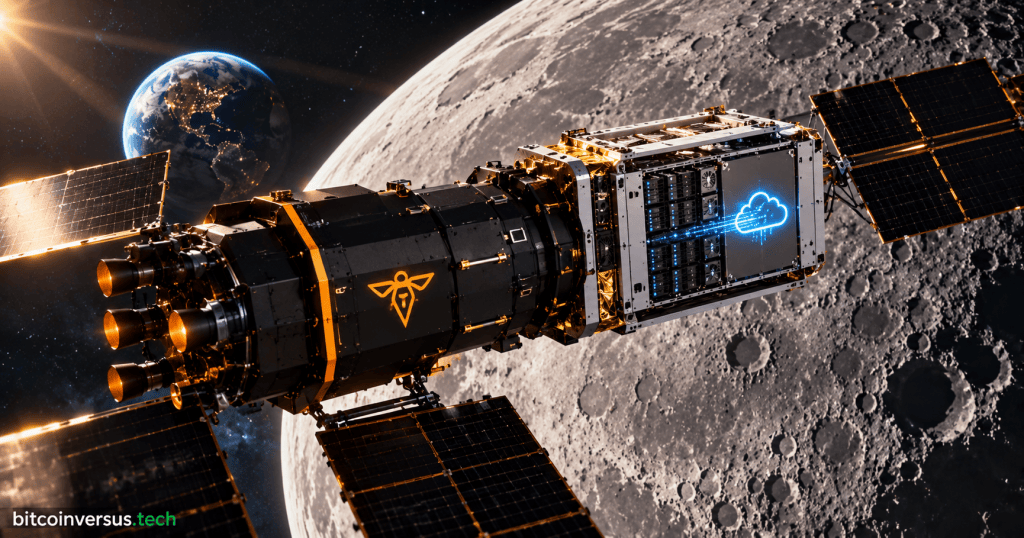
Firefly Aerospace and Starcloud are taking orbital computing beyond Earth orbit. Under a new commercial payload agreement announced September 30, Starcloud’s SC-1L AI-computing payload will fly aboard Firefly’s Elytra spacecraft on the company’s third lunar mission, targeted for no earlier than 2028, to test the building blocks of a future data center around the Moon.
Firefly summarized the mission in its official September 30 X update, saying SC-1L will process data from the spacecraft’s Solux vision system and validate capabilities needed for future lunar-orbit computing infrastructure.
The Payload Will Process Lunar-Orbit Data Locally
SC-1L is not being flown merely as stored cargo. Firefly says the processor will ingest imagery from Solux, run high-power AI computing in lunar orbit, and send processed results back to Earth. That architecture reduces the need to transmit every raw data product across hundreds of thousands of kilometres before analysis can begin.
The same basic idea is already appearing in low Earth orbit. BitcoinVersus.Tech recently covered India’s MOI-1A orbital-computing satellite, which uses NVIDIA hardware to process data in space instead of relying entirely on ground stations.
Elytra Becomes More Than a Transfer Vehicle
Firefly’s third lunar mission gives Elytra several jobs. It will first act as the transfer vehicle and communications relay for a Blue Ghost lander headed to the Moon’s Gruithuisen Domes. After the landing phase, Elytra is expected to remain in lunar orbit for as long as five years, supporting imaging and customer payload operations.
Independent reporting from GeekWire notes that the Starcloud demonstration is intended to validate technology that could eventually support AI data centers both in Earth orbit and around the Moon. The mission therefore turns Elytra into a test platform for persistent orbital infrastructure rather than a one-way spacecraft bus.
Orbital Compute Is Becoming a Real Infrastructure Category
Starcloud has already been moving aggressively toward that model. BitcoinVersus.Tech reported that Starcloud plans to test Bitcoin-mining ASICs on a future spacecraft, showing that the company is looking beyond conventional Earth-observation workloads toward continuously operated compute in space.
Google is investigating the same architectural direction at much larger scale. BitcoinVersus.Tech also covered Project Suncatcher, Google’s plan to put TPU-class AI hardware in orbit. The common theme is moving computation toward where data is generated and where solar power can be harvested directly.
The Moon Raises the Stakes
Lunar orbit is a much tougher environment than low Earth orbit. Latency to Earth is higher, communications windows can be more constrained, radiation exposure is significant, and hardware has to operate without routine physical service. Those conditions make local autonomy and local data processing more valuable.
They also make power, thermal control, fault tolerance and communications architecture inseparable from the compute payload itself. A useful lunar data center will need to survive long-duration orbital operations while delivering enough computing performance to justify the mass and power required to get it there.
A Data Center Around the Moon Starts as One Payload
SC-1L will not be a hyperscale data center in lunar orbit. It is a demonstration payload designed to prove that data can be captured, processed and returned using a persistent lunar spacecraft. But that is how infrastructure categories begin: one workload, one platform and one mission that proves the architecture can operate outside the lab.
If the 2028 mission works as planned, Firefly and Starcloud will have demonstrated a practical version of a larger idea now appearing across the space industry: orbital vehicles that do not simply collect data or relay communications, but perform meaningful computation where the data is created.
BitcoinVersus.Tech
Advertisement
Editor’s Note
We volunteer daily to ensure the credibility of the information on this platform is Verifiably True.
BitcoinVersus.tech is not a financial advisor. This media platform reports on financial subjects purely for informational purposes.


Leave a Reply