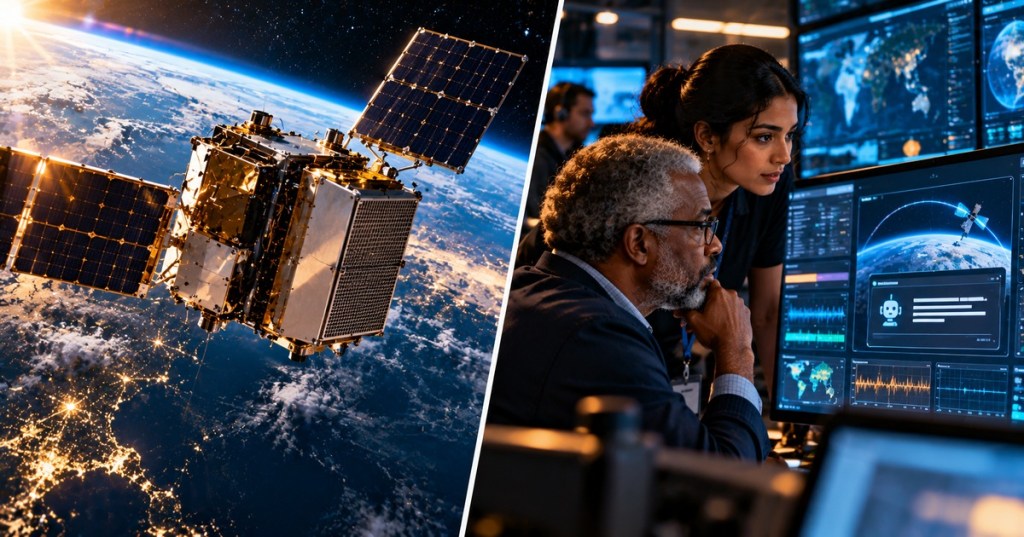
Google reported a milestone on October 30: its Project Suncatcher prototype satellite ran the company’s Gemma 4 AI model on a data-center-class Tensor Processing Unit (TPU) in orbit and transmitted the model’s first answer back to Earth. The successful exchange moves Google’s plan for solar-powered computing in space beyond a launch demonstration, but it is not the opening of a full-scale orbital data center.
Launched with SpaceX on October 1 and built in partnership with Planet Labs, the satellite spent several weeks undergoing checks. During a ground-station pass near Svalbard, Norway, engineers asked the onboard model to compose a short poem about space. Google said the answer reached Earth intact, then reported further tests involving limericks and spacecraft telemetry prompts. Polymarket shared the development on X.
Google’s Project Suncatcher overview explains the mission and its long-term vision for AI computing in space. The video predates the October 30 inference milestone.
A working AI processor, not yet a working data center
The first response demonstrates that a prompt can travel from Earth to an orbital model and its output can return during a communications window. It does not demonstrate thousands of accelerators training a model together, uninterrupted inference service or the economics of replacing a terrestrial AI facility. The prototype carries only a handful of TPUs, compared with the much larger chip fleets in ground-based data centers.
That distinction matters because space solves neither hardware reliability nor cooling automatically. In a vacuum, an accelerator cannot rely on fans blowing heat into surrounding air. Heat must move through thermal hardware and radiate away, while energetic particles can produce memory errors or silently corrupt computations. Google’s next research will measure those risks under real orbital conditions.
Google engineers demonstrate vibration and proton-beam testing used to evaluate TPU reliability before flight.
Google’s longer-term research proposal envisions solar-powered satellite clusters linked by high-speed optical communications. Its near-term milestone is more modest: two interconnected satellites planned for 2027, intended to test cooperation between spacecraft rather than merely isolated computing.
Google’s Project Suncatcher engineering video examines heat pipes, radiators and the challenge of cooling AI chips in a vacuum.
The October 30 result is the first AI answer Google says it has received from a data-center-class TPU in orbit—not a claim that no computer or AI system had ever operated in space. BitcoinVersus.Tech previously reported the Project Suncatcher launch, other orbital data-center experiments and how TPUs differ from general-purpose processors.
If the satellite survives prolonged radiation and thermal testing, Google will have stronger evidence for the next phase. For now, one useful AI response has been proven; a commercially viable data center in space remains a much bigger engineering challenge.
Editor’s Note: We volunteer daily to ensure the credibility of the information on this platform is Verifiably True. If you would like to support our work and help further secure the integrity of our research initiatives, please scan the QR code below to donate 5,000 sats.

Scan the QR code with a compatible Bitcoin wallet while reading the article on a laptop or larger screen. Donation address: 3C9o19EH5HSiwEPyCTmEKzxhNCbo2X6TTb.
BitcoinVersus.tech is not a financial advisor. This media platform reports on financial subjects purely for informational purposes.


Leave a Reply