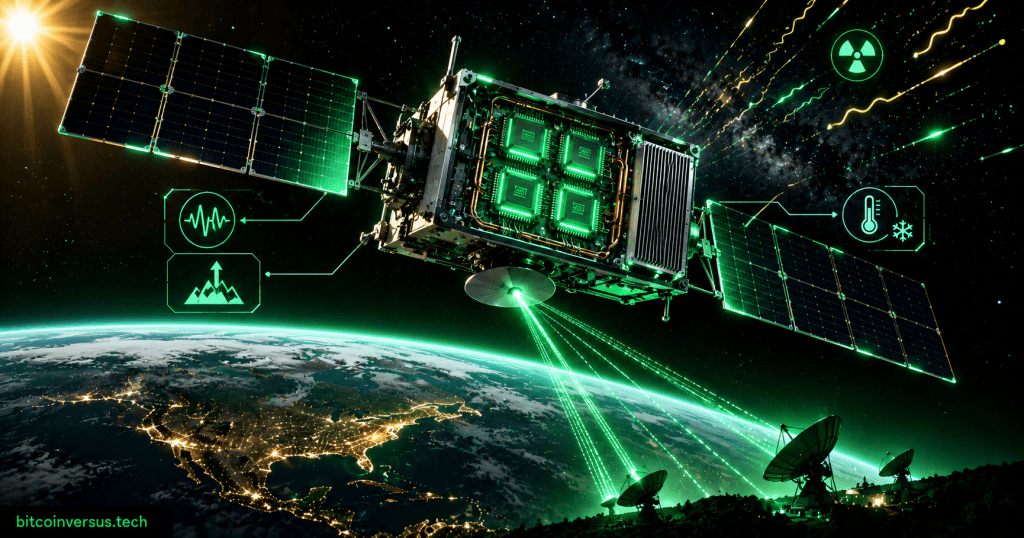
Google has moved Project Suncatcher from a ground experiment into an orbital hardware test. On October 1, a prototype satellite built with Planet reached orbit aboard SpaceX’s Transporter-18 mission carrying four Google TPUs, and Google says its team has established contact with the spacecraft and confirmed that it is operating as expected.
In Google’s October 1 mission update, the company says the next several weeks will be spent collecting data on how the TPUs respond to launch stress, radiation and the thermal extremes of space. Ars Technica’s engineering preview explains that the refrigerator-sized prototype carries four TPUs and faces a particularly difficult cooling constraint: the test hardware can only run compute workloads for limited periods before its radiator must shed accumulated heat.
Project Suncatcher has crossed its first real boundary: the hardware is actually in space
That sounds obvious, but it is the most important change since Google first disclosed the test. Before launch, every radiation test, vibration table and thermal-vacuum chamber was still an approximation of the orbital environment. The October 1 flight gives Google its first chance to observe the same AI hardware under the combined conditions it would face in a future space-compute system.
BitcoinVersus.Tech covered the earlier stage when Google was preparing its first orbital AI-chip test. That story was about whether the prototype could survive launch and whether its thermal design looked plausible on the ground. The new milestone is different: the satellite has launched, checked in and begun the orbital experiment.
Google highlighted the successful milestone in its official Project Suncatcher post on X, confirming that the Planet-built prototype reached orbit on Transporter-18 with four TPUs aboard.
Four TPUs are enough to test the hard problems without pretending this is already a data center
The prototype should not be confused with an operational orbital data center. Four TPUs are tiny compared with a terrestrial AI cluster, and the purpose of this mission is measurement rather than production computing. Google wants to know whether conventional accelerator hardware can tolerate radiation, repeated thermal cycling, launch vibration and vacuum while continuing to run useful workloads.
That distinction is important because space removes one problem and creates several others. Near-continuous sunlight can make orbital solar generation attractive, but vacuum eliminates the airflow that makes terrestrial heat rejection comparatively straightforward. Every watt consumed by a chip ultimately becomes heat that has to reach a radiator and then leave the spacecraft through thermal radiation.
Cooling may be the experiment that matters most
Radiation gets much of the attention because energetic particles can corrupt memory or damage electronics, but heat may be the more persistent scaling problem. On Earth, data centers can move heat into air or liquid and then reject it through large cooling plants. In orbit, the spacecraft has to conduct heat away from the TPUs and radiate it into space.
That makes radiator area, heat-pipe performance, chip duty cycle and spacecraft mass part of the compute architecture itself. If Google eventually wants dozens of accelerators on a satellite, thermal management has to scale alongside compute density rather than remain a support subsystem.
Orbital AI is becoming a real infrastructure race
Google is not alone in testing whether compute can move off Earth. BitcoinVersus.Tech recently covered Firefly and Starcloud’s plan to test AI data-center hardware around the Moon, another attempt to answer whether useful compute can operate outside conventional terrestrial facilities.
The market is also producing smaller infrastructure companies around the same thesis. Our report on Satlyt turning satellites into distributed AI data centers shows that orbital compute is no longer only a thought experiment discussed by hyperscalers.
The next test is whether these four TPUs keep working over time
A successful launch is only the opening condition. Google now needs to learn how error rates change under real radiation, how quickly the thermal system saturates, whether repeated hot-and-cold cycles degrade the hardware, and whether useful workloads remain stable across weeks of orbital operation.
The answers will shape the next phase of Project Suncatcher. Future systems would need more accelerators per spacecraft and high-bandwidth optical links between satellites so multiple vehicles can behave more like a distributed cluster than isolated computers.
Google has not built a space data center yet — it has finally built the experiment that can tell it whether one makes sense
That is the milestone worth focusing on. Project Suncatcher has progressed from simulations and laboratory tests to a spacecraft that is alive in orbit with four production-family AI accelerators aboard. The mission does not prove that orbital AI infrastructure will be practical, economical or scalable. It gives Google something more useful at this stage: real data.
If the TPUs survive, cool predictably and keep producing reliable results, the argument for larger orbital compute experiments becomes stronger. If they do not, the failure modes will tell engineers exactly which parts of the concept need to change before anyone tries to turn a four-chip experiment into a fleet.
BitcoinVersus.Tech
Advertisement
Editor’s Note
If you value independent technology reporting, consider supporting BitcoinVersus.Tech with a Bitcoin donation: 3C9o19EH5HSiwEPyCTmEKzxhNCbo2X6TTb
BitcoinVersus.tech is not a financial advisor. This media platform reports on financial subjects purely for informational purposes.


Leave a Reply