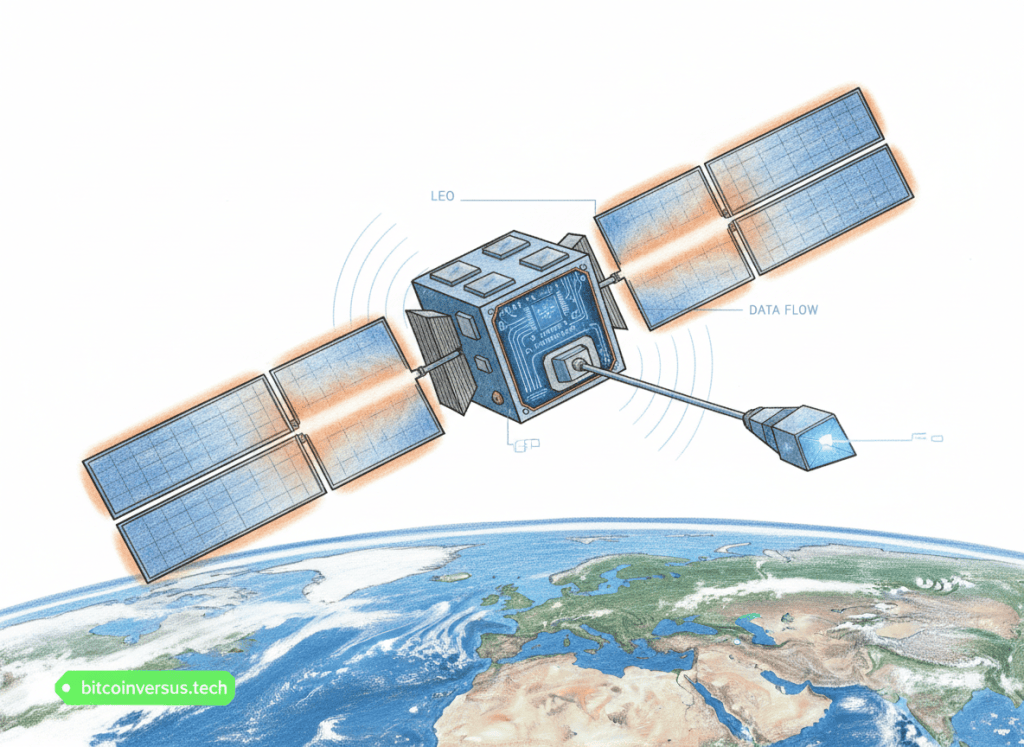
Google is preparing to send its Tensor Processing Unit hardware into orbit as Project Suncatcher moves from ground testing to its first spaceflight experiment.
The mission is a hardware test, not a full orbital data center. But it puts several problems familiar to terrestrial data-center engineers into a much harsher environment: power density, semiconductor reliability, thermal management and high-bandwidth interconnects.
Four TPUs are heading to low Earth orbit
Google said September 24 that the first Project Suncatcher test will fly on SpaceX’s Transporter-18 rideshare mission in partnership with Planet. The prototype is intended to measure how Google’s Trillium TPUs respond to launch vibration, radiation and thermal extremes in orbit.
Google says a spacecraft can experience sustained launch loads of about 10 g, while individual components can see substantially higher forces. The team has already shaken the satellite across three axes in vibration testing. It also ran TPU workloads during proton-beam testing at UC Davis’s Crocker Nuclear Laboratory to study radiation effects such as bit flips.
According to Google, initial testing indicated the Trillium devices could tolerate a total ionizing radiation dose greater than the expected exposure of a five-year mission. The orbital test is designed to show how that laboratory result translates to real operating conditions.
Cooling may be the harder infrastructure problem
On Earth, dense compute facilities can move heat with air, water and increasingly direct-to-chip liquid cooling. A satellite cannot rely on atmospheric convection. Heat must instead be conducted away from the processors and ultimately rejected through radiators.
Google is testing heat pipes and radiators after running the thermal system inside a vacuum chamber. Ars Technica reports that the refrigerator-sized prototype carries four TPUs and roughly 1 kW of solar generation, with compute runs limited to short intervals while the experimental cooling system catches up.
The networking challenge is measured in lasers
The long-term Suncatcher concept goes beyond putting a processor on a satellite. Google envisions clusters in which satellites carrying many TPUs communicate through high-bandwidth optical links. That requires extremely precise positioning and laser alignment while the nodes are moving in orbit.
Google plans a two-satellite experiment in 2027 to test that inter-satellite connectivity. The company says low Earth orbit can provide near-continuous sunlight and potentially far more solar energy per unit area than terrestrial installations, which is the power-system premise behind the project.
Why data-center and mining engineers should watch
Project Suncatcher is far removed from a Bitcoin mine, but the engineering questions overlap with the infrastructure themes BitcoinVersus.tech follows: how much useful compute can be extracted from a constrained power envelope, how efficiently heat can be removed, how reliably specialized silicon survives its environment and how much bandwidth is needed between compute nodes.
Bitcoin mining pushed those questions aggressively on Earth through ASIC efficiency, high-density electrical distribution and air, hydro and immersion cooling. AI infrastructure is now pushing power density and networking much further. Suncatcher asks what happens when the same optimization problem leaves the planet entirely.
For now, the important result will not be raw AI performance. It will be whether ordinary high-performance accelerator hardware can survive launch and then operate predictably under radiation and vacuum thermal constraints. If it can, orbital compute moves one small step from concept toward an engineering platform.
BitcoinVersus.Tech Editor’s Note:
Support BitcoinVersus.tech with Bitcoin: 3C9o19EH5HSiwEPyCTmEKzxhNCbo2X6TTb
Follow BitcoinVersus.tech on X: https://x.com/BitcoinVersus
BitcoinVersus.tech is not a financial advisor. This media platform reports on financial subjects purely for informational purposes.


Leave a Reply