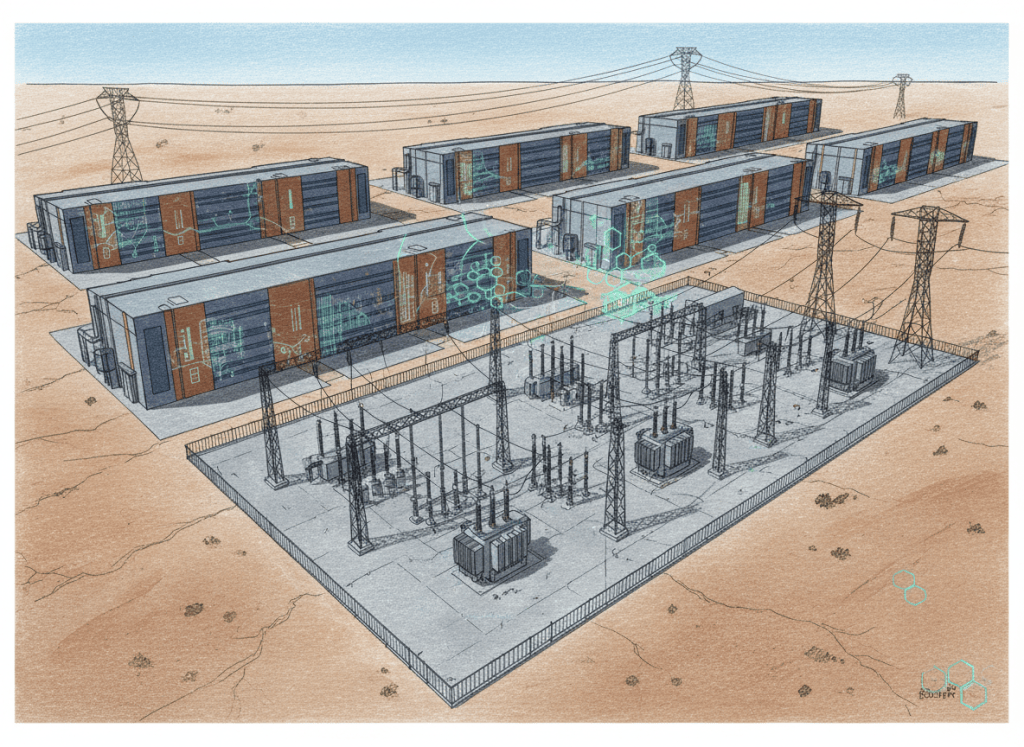
Cipher Digital, Fluidstack and Anthropic have committed a combined $10 million to repair and expand the water system serving Colorado City, Texas, the community next to Cipher’s Barber Lake AI data center campus.
The announcement matters beyond local infrastructure. Barber Lake is one of the clearest examples of the Bitcoin-mining industry’s shift toward high-performance computing and AI infrastructure, and the project is now moving from construction into tenant use while the surrounding community faces its own infrastructure demands.
A $10 million local infrastructure commitment
According to Cipher Digital’s September 14 announcement, the three companies will fund projects selected by Colorado City leaders through a newly formed Colorado City Water Infrastructure Foundation.
The money is intended to support repairs and upgrades following water shortages linked to severe summer storm damage. Cipher said the Barber Lake data center itself does not draw water from the city’s municipal water system, an important distinction as large AI campuses increasingly face scrutiny over electricity and water consumption.
For data-center operators, community infrastructure is becoming part of the development equation. Access to transmission, substations, roads, fiber and water resilience can all influence whether a large compute campus can operate reliably for decades.
Barber Lake is part of a much larger AI transition
Cipher’s Barber Lake campus has 300 MW of gross capacity committed to Fluidstack. Public company disclosures show that 244 MW is allocated to the first phase and 56 MW to the second. Cipher previously said the full site would support roughly 207 MW of critical IT load after the second Fluidstack agreement expanded the project.
The commercial structure also shows how former Bitcoin-mining infrastructure companies are becoming major AI landlords. Google backstops a portion of Fluidstack’s lease obligations, while Cipher has financed construction at the project level. Cipher has also signed a separate long-term lease with Amazon Web Services at its 300 MW Black Pearl campus.
That transition connects directly with the broader data-center expansion BitcoinVersus.tech tracks and the growing overlap between Bitcoin mining infrastructure and AI compute.
Why this matters for Bitcoin miners
Bitcoin miners spent years learning how to secure large power agreements, build electrical infrastructure quickly and operate energy-intensive computing fleets. AI developers now need many of those same capabilities, but with stricter requirements around redundancy, networking, cooling and service-level reliability.
Cipher’s evolution reflects that shift. The company changed its name from Cipher Mining to Cipher Digital in 2026 as it increasingly emphasized high-performance data-center development while retaining Bitcoin mining as part of its operating base.
The Barber Lake water commitment adds another dimension. The future of large-scale compute will not be determined only by megawatts and GPUs. Operators will also be judged on whether they can build durable relationships with the communities hosting those facilities and whether local infrastructure can support growth without creating additional strain.
BitcoinVersus.Tech Editor’s Note:
BitcoinVersus.tech is not a financial advisor. This media platform reports on financial subjects purely for informational purposes.


Leave a Reply