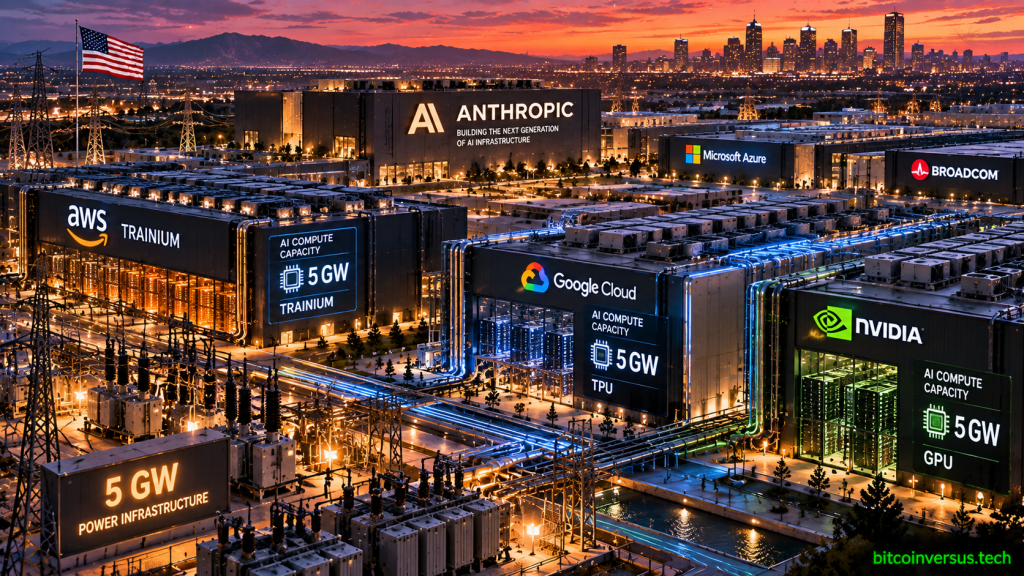
Anthropic’s race for AI compute is becoming a long-duration infrastructure commitment rather than a sequence of short cloud purchases. A confidential IPO filing reviewed by Reuters shows the Claude developer plans at least $518 billion of AI infrastructure spending over roughly the next decade, with much of the obligation structured as non-cancelable commitments.
Compute contracts are becoming infrastructure
Recent reporting says about 80% of Anthropic’s identified commitments are binding regardless of whether all the capacity is ultimately used. Reuters reported obligations including $111.1 billion tied to Google, $110 billion with Amazon, $31.4 billion with Microsoft and $161.2 billion of non-cancelable lease obligations involving Broadcom.
The scale helps explain why AI infrastructure increasingly resembles power and industrial development. Long-term accelerator supply, data-center capacity, networking, cooling and electrical delivery have to be secured years before all the workloads that will consume them exist.
BitcoinVersus.tech recently examined how Big Tech guarantees are supporting AI infrastructure financing. Anthropic’s disclosed commitments show the next step: the model company itself is locking in enormous quantities of future compute.
AWS remains the primary training partner
Anthropic has previously said Amazon remains its primary cloud provider and training partner. Its expanded AWS agreement secures up to 5 GW of new capacity, while Project Rainier and additional Trainium deployments give Claude access to purpose-built Amazon accelerators.
The following official AWS Events presentation is particularly useful technical context because it explains Trainium3 UltraServers and how Anthropic optimizes Claude models on the Trainium architecture.
An industry discussion on X has also focused on the economics behind Anthropic’s Trainium strategy, particularly memory bandwidth and training cost rather than treating peak arithmetic throughput as the only useful metric.
Google adds another accelerator architecture
The company’s own infrastructure disclosures show why the portfolio is deliberately diversified. Anthropic says it trains and runs Claude across AWS Trainium, Google TPUs and NVIDIA GPUs. Its Amazon agreement covers up to 5 GW, while a separate Google and Broadcom agreement is designed to bring multiple gigawatts of next-generation TPU capacity online beginning in 2027.
Google’s hardware strategy provides another view of the silicon Anthropic can draw from. This English-language Google Cloud Tech video covers Ironwood TPUs and the wider AI infrastructure stack.
The physical layer keeps getting larger
The commitments extend beyond accelerator choice. Every additional gigawatt requires utility interconnection, substations, backup and flexible generation, cooling systems, fiber and increasingly sophisticated data-center controls. BitcoinVersus.tech recently covered why energized land and grid access are becoming premium AI assets and Anthropic’s participation in Colorado City water infrastructure.
The filing therefore puts a financial number around a physical reality. Frontier AI companies are no longer merely customers of data centers. Their long-duration compute commitments increasingly determine which chips are manufactured, which campuses get financed and where new electrical infrastructure has to be built.
BitcoinVersus.Tech Editor’s Note: The $518 billion figure comes from commitments described in a confidential IPO filing reviewed by Reuters. Contract structures differ, and headline commitments should not be interpreted as cash already spent or as guaranteed future utilization.
Support independent AI hardware, semiconductor and data-center reporting: 3C9o19EH5HSiwEPyCTmEKzxhNCbo2X6TTb
BitcoinVersus.tech is not a financial advisor. This media platform reports on financial subjects purely for informational purposes.


Leave a Reply