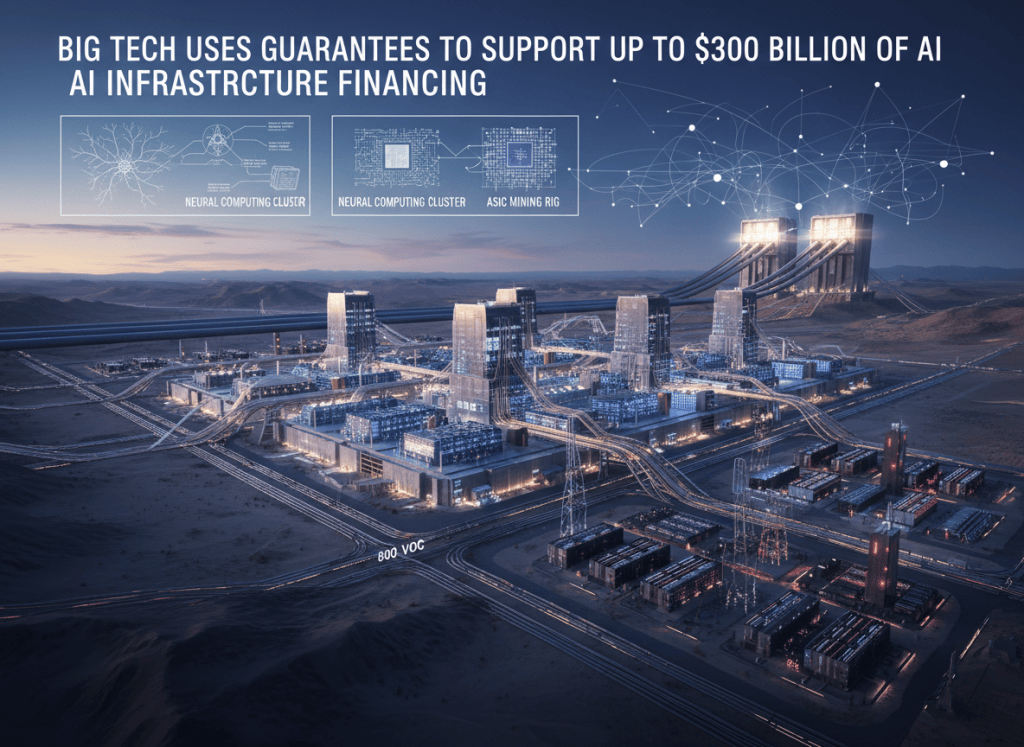
Big technology companies are increasingly using guarantees tied to artificial-intelligence infrastructure to support large amounts of debt financing without placing the full exposure directly on their balance sheets, according to new reporting from the Financial Times.
The structure centers on residual-value guarantees and related commitments attached to expensive assets such as AI accelerators, server racks and data centers. The FT reported that technology companies have provided up to roughly $300 billion of these commitments in less than a year, helping lenders finance infrastructure at lower borrowing costs by relying on the credit strength of major technology firms.
AI Infrastructure Is Becoming a Financing Market
The approach matters because the current AI expansion is not only a semiconductor and data-center story. It is also becoming a large credit-market story. Companies building AI clusters must finance GPUs, networking equipment, power systems, cooling infrastructure and construction before those assets begin generating revenue.
Guarantees can reduce financing costs because they give lenders additional protection if the underlying hardware or facility loses value. The tradeoff is that the guaranteeing company can retain economic exposure even when the associated debt is held by a special-purpose vehicle or another financing entity.
The FT cited structures involving Meta, Nvidia and Broadcom, including commitments linked to major AI infrastructure projects for companies such as OpenAI and Anthropic. The exact accounting treatment differs by transaction, but the broader pattern is clear: the AI buildout is creating increasingly complex links between technology companies, lenders, infrastructure operators and chip suppliers.
Credit Risk Now Sits Beside Compute Risk
For data-center operators, the trend adds another variable to infrastructure planning. A facility may be technically viable because it has power, cooling and network capacity, yet still depend on financing assumptions about future hardware values, utilization rates and long-term AI demand.
That makes residual value especially important for AI accelerators, which can depreciate quickly as new generations arrive. A guarantee can support financing today, but the real economic test comes later if the equipment is worth materially less than expected or if data-center capacity is underused.
The development does not by itself show that AI infrastructure spending is unsustainable. It does show that the financial architecture behind the buildout is becoming more sophisticated and more interconnected. As AI data centers scale into multi-gigawatt projects, understanding who ultimately carries the asset and credit risk may become almost as important as understanding who owns the compute.
BitcoinVersus.Tech Editor’s Note:
We volunteer daily to ensure the credibility of the information on this platform is Verifiably True. If you would like to support to help further secure the integrity of our research initiatives, please donate here: 3C9o19EH5HSiwEPyCTmEKzxhNCbo2X6TTb
https://x.com/1BitcoinVersus/status/1937006164555993338
BitcoinVersus.tech is not a financial advisor. This media platform reports on financial subjects purely for informational purposes.


Leave a Reply