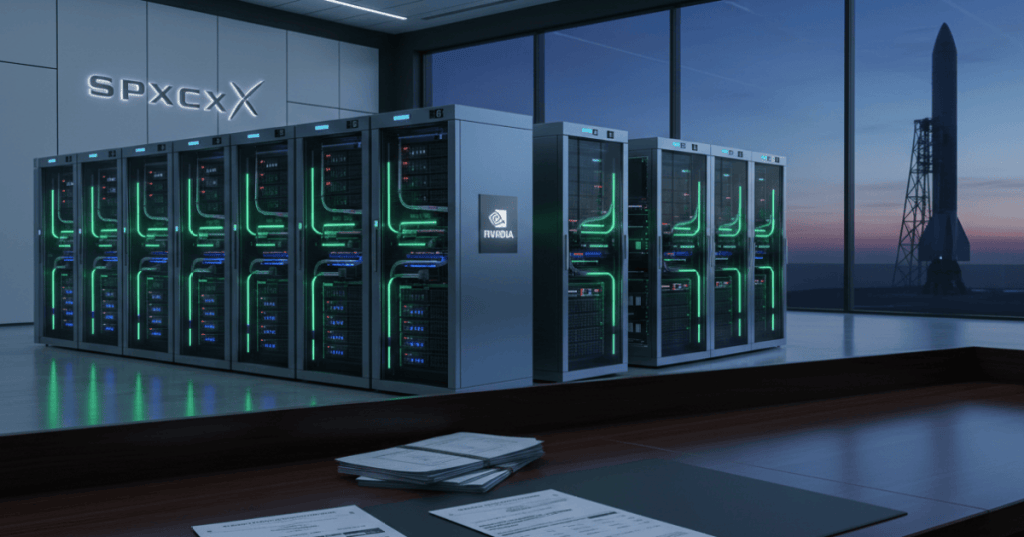
SpaceX is reportedly seeking $40 billion of new financing to buy NVIDIA processors, a deal that would turn the AI infrastructure boom into one of the largest corporate chip-financing exercises yet.
Reuters reported on October 6 that the financing is expected to be led by Apollo Global Management and used to acquire advanced NVIDIA chips for SpaceX’s AI infrastructure. The proposed package is split between roughly $10 billion of bank loans and $30 billion of investment-grade debt.
This Is No Longer Just a GPU Purchase
The scale of the financing shows how quickly AI hardware is becoming a balance-sheet issue rather than a normal capital-equipment purchase. BitcoinVersus.Tech has already tracked SpaceXAI’s reported target of 1.44 million GPUs for Colossus and xAI’s plan for up to 660,000 additional GB300 GPUs.
Those deployments are so large that the financing structure starts to resemble project finance. The hardware has to be purchased, powered, cooled and installed long before the revenue generated by the resulting compute fully arrives.
Apollo Would Lead the Financing
The Financial Times reported that Apollo Global Management is expected to lead the deal and help place the debt with institutional investors. Pimco was also among the lenders reportedly in discussions around the financing.
The reported transaction is expected to close in 2027. SpaceX’s investment-grade credit rating matters because it expands the pool of institutions that can potentially hold the debt, including insurance companies and pension funds with restrictions on lower-rated bonds.
NVIDIA Chips Are Becoming Financeable Infrastructure
The structure fits a broader Wall Street trend BitcoinVersus.Tech has been following: advanced compute is beginning to be treated more like infrastructure than ordinary information-technology equipment. Our recent analysis, NVIDIA Wants AI Compute to Become a Financeable Asset Class, examined how lenders are trying to value GPUs, leases and contracted compute as collateral.
That transition matters because the newest AI accelerators can depreciate technologically much faster than traditional infrastructure such as power plants, fiber networks or real estate. Lenders therefore have to price not just credit risk but also the possibility that a newer accelerator architecture could reduce the resale value of today’s hardware.
Colossus 2 Is the Physical Reason the Debt Exists
The financing is not abstract. It is connected to physical compute expansion. Colossus 2 has been planned at gigawatt scale, which means the GPU order sits inside a much larger stack of electrical, networking and cooling infrastructure.
BitcoinVersus.Tech recently covered how SpaceXAI doubled its Minihard supercompute effort in Memphis, another sign that the group is expanding both hardware volume and operational capacity rather than treating Colossus as a one-time build.
AI Financing Is Scaling as Fast as AI Hardware
The bigger pattern extends well beyond SpaceX. BitcoinVersus.Tech has already examined up to $300 billion of AI-infrastructure financing supported by Big Tech guarantees, showing how cloud contracts, equipment leases and corporate guarantees are becoming part of the capital stack behind AI data centers.
Reuters cited an industry estimate that AI infrastructure could require roughly $1.5 trillion in external financing by 2028. If that direction holds, banks, insurers, pension funds and private-credit firms will increasingly sit alongside chip designers and data-center operators as core participants in the AI supply chain.
The Risk Is That Hardware Moves Faster Than Debt
The attraction for lenders is obvious: hyperscale AI demand is growing rapidly, and large compute clusters can generate substantial contracted revenue. The risk is that GPU generations move quickly while debt maturities can extend for years or decades.
A financing package therefore has to survive a technology cycle in which today’s premium accelerator can become tomorrow’s second-tier asset. That creates a new kind of infrastructure-finance problem: the building, power equipment and fiber may last for decades, while the most valuable silicon inside the building can turn over far faster.
The Bigger Point
A $40 billion chip-financing plan shows that the AI arms race is moving beyond cash-rich technology companies paying for servers directly. The next phase increasingly depends on institutional capital markets.
If SpaceX completes the reported financing, NVIDIA GPUs will effectively be funded through a mix of bank credit and investment-grade debt at a scale normally associated with major infrastructure projects. That is a significant change in how the market pays for compute—and another sign that AI hardware is becoming a financial asset class as well as a technology product.
BitcoinVersus.Tech
Advertisement
Editor’s Note
The $40 billion financing has been reported by Reuters and the Financial Times and had not been publicly finalized at publication. Loan sizes, debt placement and closing timing could change before any transaction is completed.
Support BitcoinVersus.Tech research through the donation options listed on the site.
BitcoinVersus.tech is not a financial advisor. Content is provided for informational purposes.


Leave a Reply