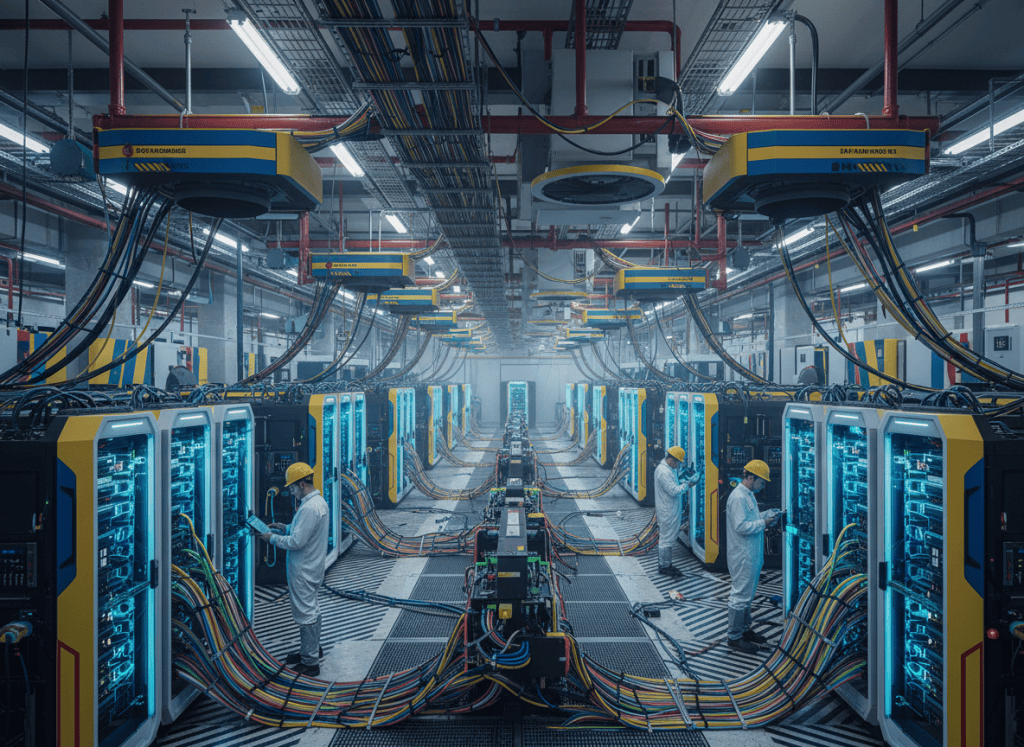
xAI is preparing another enormous expansion of its Colossus AI computing infrastructure, with Elon Musk saying hundreds of thousands of NVIDIA GB300 processors are scheduled to come online over the final months of 2026.
The September 25 update gives one of the clearest public snapshots yet of the hardware inside the Memphis-area clusters. Musk says Colossus 1 currently contains 150,000 H100s, 50,000 H200s and 30,000 GB200s, while Colossus 2 contains 110,000 GB200s and 440,000 GB300s.
Another 440,000 GB300s Are Scheduled
Musk said another 220,000 GB300 processors are expected to be fully operational next week, followed by another 220,000 in November. He also said a third group of 220,000 could come online in late December, but qualified that final tranche with “if we get lucky.”
That distinction matters. The first two additions represent a stated schedule. The December batch is a target rather than a completed or guaranteed deployment. If all three occur, the combined Colossus fleet would approach roughly 1.44 million GPUs based on Musk’s reported counts.
Fiber Switching Helps Set the Cluster Size
In a follow-up post, Musk said the repeated 110,000-unit increments are related to the number of fiber-optic cables that can connect to a central switch. That is a useful reminder that scaling AI is not simply a matter of purchasing GPUs. Networking architecture determines how effectively accelerators can communicate as one computing system.
Large AI training clusters also require enormous amounts of electricity, cooling equipment, transformers, switchgear, backup systems and physical space. Tom’s Hardware reports that a 1.2 GW power plant is being developed to support the broader buildout.
xAI Built Colossus Around Speed
xAI’s Colossus page says the original system was built in 122 days and initially interconnected 100,000 H100 GPUs before being doubled to 200,000 GPUs in another 92 days. The company has publicly described a roadmap toward million-GPU-scale computing.
The latest numbers go substantially beyond that original system. They also show how quickly the AI infrastructure race has moved from clusters measured in tens of thousands of accelerators to projects discussed in hundreds of thousands or more.
Reported Counts Still Depend on Company Statements
The detailed processor counts come from Musk’s public statements rather than an independently audited inventory of installed hardware. Bloomberg and Tom’s Hardware reported the same schedule while attributing the figures to Musk. “Fully operational” can also involve more than hardware delivery, including power, networking, cooling and software readiness.
Even with those limitations, the update provides a useful measure of the physical scale behind frontier AI. The constraint is increasingly not just access to advanced chips. It is the ability to power, cool and connect them quickly enough to operate as one machine.
Sources: xAI, Bloomberg reporting syndicated by Yahoo Finance, and Tom’s Hardware.
BitcoinVersus.Tech Editor’s Note: We volunteer daily to ensure the credibility of the information on this platform is Verifiably True. If you would like to support to help further secure the integrity of our research initiatives, please donate here: 3C9o19EH5HSiwEPyCTmEKzxhNCbo2X6TTb
Disclaimer: BitcoinVersus.tech is not a financial advisor. This media platform reports on financial subjects purely for informational purposes.
Related BitcoinVersus.tech coverage: SpaceXAI Colossus expansion · Giga Computing GB300 factory · Supermicro Vera Rubin racks · Armenia NVIDIA AI hub


Leave a Reply