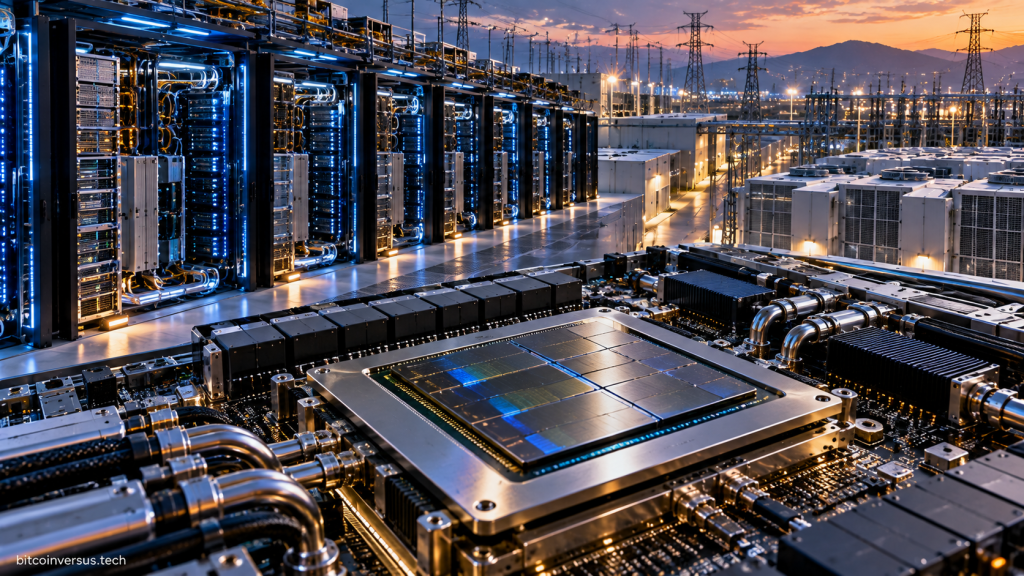
Alibaba has unveiled the Zhenwu V900, a new accelerator for AI training and inference that the company says delivers three times the performance of its previous-generation M890.
The chip debuted at Alibaba Cloud’s Apsara Conference on September 22 as part of a much larger full-stack AI roadmap spanning custom silicon, Qwen models, networking, servers and data centers.
216 GB of memory and 1,200 GB/s chip-to-chip bandwidth
Alibaba’s T-Head semiconductor unit lists 216 GB of memory for the V900 and 1,200 GB/s of inter-chip bandwidth. The processor supports precision formats from FP32 down to FP4, targeting both large-model training and high-volume inference.
Alibaba’s official X post presents the V900 as a T-Head processor built for both high-precision model training and low-precision inference.
Alibaba says one cluster can scale to 500,000 accelerators
CEO Eddie Wu said a V900 cluster can support as many as 500,000 cards. That is an architectural scale target, not evidence that Alibaba currently operates a 500,000-V900 installation. Mass production and commercial availability are planned for the first quarter of 2027.
The embedded Yahoo Finance video is an English-language explainer on Alibaba’s push to build AI accelerators, providing background on the company’s challenge to established GPU suppliers. Because it is in English, translated voice audio is not required.
Twenty gigawatts of data-center capacity by 2032
The hardware announcement came with an infrastructure target: Alibaba Cloud wants global data-center capacity to exceed 20 GW by 2032. The company is also training Qwen 4 and says later Qwen 4.5 and Qwen 5 models could scale to between 5 trillion and 10 trillion parameters.
The V900 therefore matters beyond one chip. Alibaba is attempting to control more of the AI stack, from accelerators and server processors to networking, models and the power-intensive facilities that operate them.
Performance still needs independent testing
Alibaba’s three-times-performance figure compares V900 with its own M890 rather than NVIDIA, AMD or another competing accelerator under independently reproduced benchmarks. Pricing, power consumption, software compatibility and real-world training throughput remain important unanswered questions ahead of the planned 2027 release.
Sources: Alibaba Group’s official Apsara Conference roadmap and X announcement, plus recent reporting from Reuters, AP and Bloomberg. Performance and cluster-scale figures are Alibaba claims unless otherwise noted.
BitcoinVersus.Tech
Advertisement: Follow BitcoinVersus.Tech for independent coverage of Bitcoin, mining hardware, artificial intelligence, robotics, data centers, semiconductors, energy, gaming and emerging technology.
BitcoinVersus.Tech Editor’s Note & Disclaimer:
We volunteer daily to ensure the credibility of the information on this platform is Verifiably True. BitcoinVersus.tech provides news, technical analysis and educational information and does not provide financial or investment advice. Verify manufacturer specifications and performance claims independently before making purchasing, deployment or investment decisions. If you would like to support to help further secure the integrity of our research initiatives, please donate here: 3C9o19EH5HSiwEPyCTmEKzxhNCbo2X6TTb
Related BitcoinVersus.tech coverage: Alibaba 20 GW plan · QBit robot SoC · Synopsys TSMC A14 · Axelera Europa AI


Leave a Reply