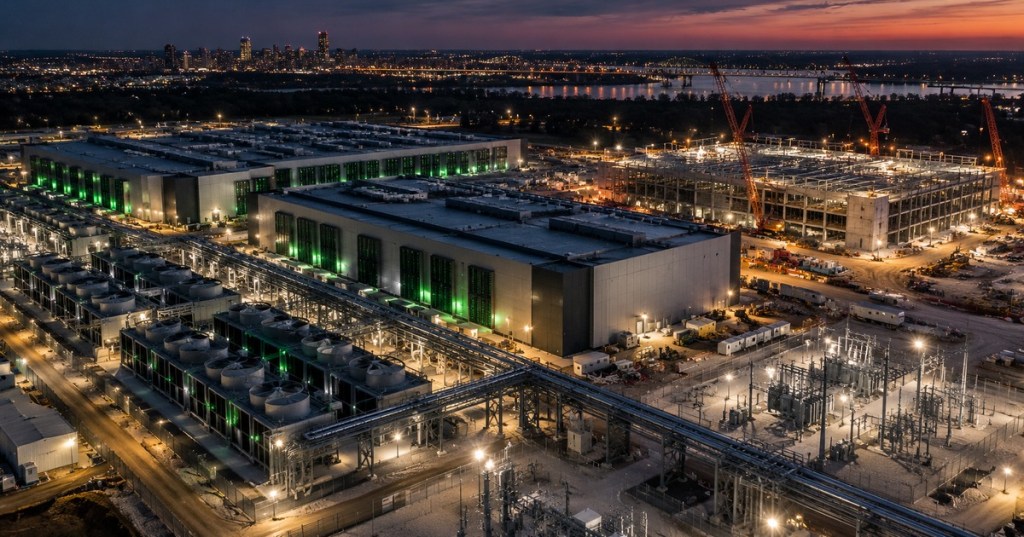
SpaceXAI’s Memphis supercomputing buildout is starting to look less like a single giant data-center project and more like a repeatable industrial construction program. A newly reported leadership reshuffle puts a veteran of SpaceX’s Starship launch operations in charge of bringing up multiple new compute phases, while Elon Musk says the separate facility known as “Minihard” has already doubled from its original planned size.
Business Insider reported that Kevin Holland, previously a senior director at SpaceX’s Cape Canaveral launch operation, became VP of Supercompute in Memphis. An internal memo reviewed by the publication tasked Holland with bringing up the next six phases of compute by the end of 2026, with senior SpaceX leaders from launch and Starlink organizations supporting the effort.
The personnel move matters because SpaceXAI is no longer expanding only by adding accelerators to one building. The company is coordinating power, cooling, networking, construction and commissioning across a growing cluster of facilities on both sides of the Tennessee-Mississippi border.
“Minihard” was doubled before it was finished
Musk made the physical expansion explicit in a September 25 post about Minihard. He said the facility originally received its name because it was planned at roughly half the size of another project called Macroharder, “but then we doubled the size of ‘Minihard.’”
That comment gives Minihard a clearer role in the Memphis buildout: it is not merely another room inside the original Colossus campus. It is part of a widening physical footprint that SpaceXAI is treating as a sequence of deployable compute phases.
BitcoinVersus.Tech previously covered SpaceXAI’s scheduled Colossus GPU expansion. The new development is the operating structure behind that scale: the company is assigning launch-program leadership to a data-center rollout that increasingly resembles aerospace manufacturing in its emphasis on standardized phases, aggressive schedules and parallel infrastructure work.
The official Memphis plan is already industrial-scale
On its official Memphis infrastructure site, SpaceXAI says Colossus is the supercomputer behind Grok and that it intends to equip the facility with one million GPUs during 2026. The company also says the original Colossus build reached operation in four months after an initial estimate of 24 months.
Those claims help explain why a Starship construction executive is relevant to an AI data center. Large accelerator clusters are systems-engineering projects: thousands of individual components are useless until electrical distribution, cooling loops, fiber, switching, controls and software are commissioned together.
Power infrastructure is becoming the product underneath the GPUs
SpaceXAI’s accelerator count gets the headlines, but the more durable asset is the energized infrastructure surrounding those chips. BitcoinVersus.Tech recently examined the Megapack battery system being built behind Colossus 2, which illustrates how storage and power quality are being engineered alongside the compute halls.
The regional footprint is expanding as well. BitcoinVersus.Tech also reported on SpaceXAI’s buildout toward 2 GW of AI compute in Mississippi. Minihard adds another layer to that story because it shows the company multiplying facilities while reorganizing management around repeatable deployment.
Why the Starship connection matters
AI infrastructure is increasingly constrained by construction velocity rather than by chip design alone. A company can secure accelerators and still lose months waiting for substations, cooling equipment, network fabrics, permits or commissioning work. SpaceXAI appears to be attacking that bottleneck by moving executives accustomed to launch-site schedules into supercompute operations.
If the six-phase target is met, the important result will not simply be another headline GPU total. It will be evidence that SpaceXAI has turned the construction of giant AI clusters into a repeatable deployment process. Minihard’s doubled size is therefore less interesting as a nickname than as a signal: the company expects the physical infrastructure behind frontier AI to keep scaling after Colossus.
BitcoinVersus.Tech
Advertisement
Editor’s Note
We volunteer daily to ensure the credibility of the information on this platform is Verifiably True. If you would like to support to help further secure the integrity of our research initiatives, please donate here: 3C9o19EH5HSiwEPyCTmEKzxhNCbo2X6TTb
BitcoinVersus.tech is not a financial advisor. This media platform reports on financial subjects purely for informational purposes.


Leave a Reply