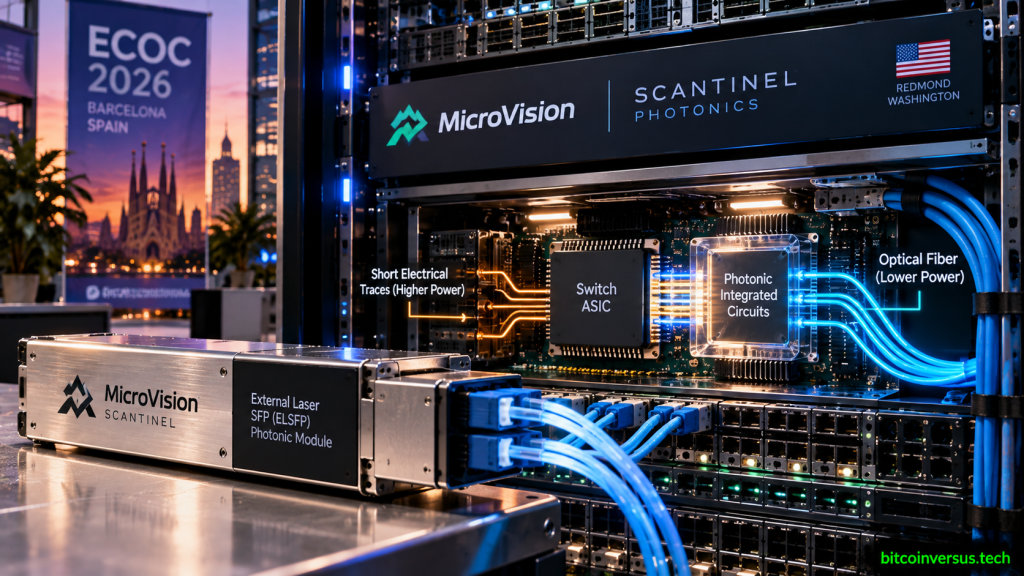
MicroVision is taking technology developed for lidar and aiming it at one of AI infrastructure’s fastest-growing bottlenecks: moving data between accelerators without burning excessive power. Its Scantinel subsidiary has introduced an external laser small form-factor pluggable module, or ELSFP, designed to provide a centralized and serviceable light source for co-packaged optics.
A lidar photonics platform moves into the AI rack
The company announced the technology September 22 as the photonics industry gathered for ECOC. The module is built around Scantinel’s two-dimensional photonic integrated circuit platform, the same core technology MicroVision says underpins its FMCW lidar architecture.
The reuse is notable because the workloads are very different. Lidar sends and receives laser light to measure the physical world. AI networking uses optical links to move enormous quantities of digital information among processors, switches and racks. The common component is a photonics platform capable of manipulating light efficiently at high speed.
BitcoinVersus.tech has been tracking the same transition through Ciena’s move from 1.6T optics toward 6.4T CPO and Molex’s 3,456-fiber 1RU system. MicroVision is attacking the light-source side of that optical stack.
Why move the laser outside the switch package?
Co-packaged optics places optical engines close to the switch ASIC to reduce the length and power cost of high-speed electrical signaling. An external laser architecture keeps the light source in a separately serviceable module while feeding light into those optical engines.
That matters operationally. Lasers generate heat and can eventually fail. Keeping them accessible at the faceplate can make replacement easier than servicing a laser buried beside expensive switch silicon. It also separates part of the thermal load from the hottest portion of the networking system.
The following English-language Open Compute Project presentation provides technical context for why optical compute interconnects are moving closer to processors and switches.
AI networking is forcing optics deeper into compute
MicroVision says the architecture is intended to reduce complexity and power while supporting high-bandwidth AI connectivity. The company is already discussing licensing and development opportunities with potential partners, although it has not announced a production customer for the ELSFP technology.
That commercialization caveat is important. The new module is a technology introduction, not evidence of a hyperscale deployment. But it arrives as the industry is already shifting from conventional pluggable transceivers toward optical engines positioned much closer to compute and switching silicon.
BitcoinVersus.tech recently examined the growing AI interconnect bottleneck. ELSFP architectures address another piece of the same problem by making the laser source powerful, centralized and replaceable while the optical engine moves deeper into the switch.
Broader industry work on co-packaged optics makes the underlying motivation clear: as AI clusters exchange more data, copper traces consume more power and become harder to scale. Moving more of that traffic into light is increasingly an architectural requirement rather than simply a networking upgrade.
BitcoinVersus.Tech Editor’s Note: MicroVision has introduced and is discussing commercialization of the Scantinel ELSFP technology, but no hyperscale production deployment was announced with the September 22 release. Product-performance claims should therefore be distinguished from independently measured deployment results.
Support independent semiconductor, networking and AI infrastructure reporting: 3C9o19EH5HSiwEPyCTmEKzxhNCbo2X6TTb
BitcoinVersus.tech is not a financial advisor. This media platform reports on financial subjects purely for informational purposes.


Leave a comment