Anthropic has one of the fastest-growing revenue lines in technology, but its latest financial disclosures show the harder half of the frontier-AI equation: revenue can explode while the cost of AI compute grows even faster.
Reuters reported on October 7 that Anthropic generated about ₿55,218 ($4.6 billion) of revenue in 2025, nearly 12 times the prior year, while spending about ₿87,629 ($7.3 billion) on compute and infrastructure. Its operating loss widened to roughly ₿96,752 ($8.06 billion), from $2.98 billion in 2024. Bitcoin conversions use a spot price of about $83,306 per BTC at publication and are only a snapshot.
Revenue Is Growing Fast, but Compute Is Still Bigger
The first number is extraordinary: ₿55,218 ($4.6 billion) of annual revenue for a company founded in 2021. The second number explains why profitability remains unresolved. Anthropic spent roughly ₿32,411 ($2.7 billion) more on compute and infrastructure than it generated in total revenue before accounting for payroll, research, sales, legal expenses and the rest of the business.
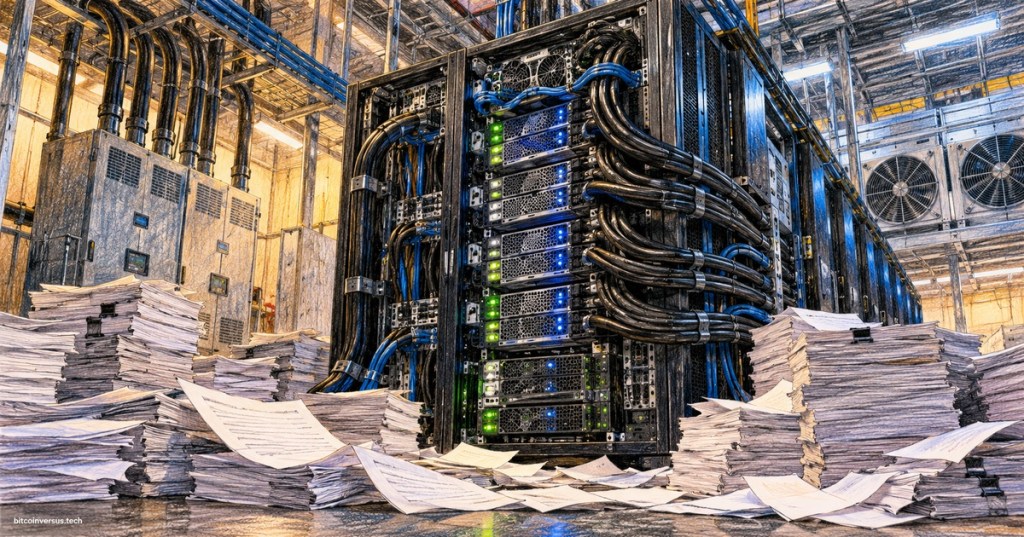
That is the central economic problem for frontier AI training and inference. A model can attract millions of users and enterprise contracts, but every additional workload still lands on physical GPUs, memory, networking, storage, cooling and power inside AI data centers.
The Infrastructure Commitments Are Enormous
Anthropic’s IPO prospectus puts the scale in sharper focus. Reuters reported from the filing that the company had about ₿6.22 million ($518 billion) of future infrastructure obligations. BitcoinVersus.Tech previously covered those $518 billion of AI infrastructure commitments and the financing structures emerging around them.
One example is Broadcom’s offer of up to $42 billion in financing for Anthropic infrastructure. Another is Anthropic’s multibillion-dollar cloud procurement, including the $11.6 billion Akamai cloud agreement. The pattern is clear: frontier models are increasingly tied to long-duration financial commitments for the hardware and facilities underneath the software.
Anthropic Is Also Cutting The Price Of Intelligence
The profitability challenge gets more interesting because model providers are simultaneously making their products cheaper. On October 7, Anthropic launched Claude Haiku 5.5 and said the small model costs about 75% less to run on average than Haiku 4.5. The company also cut Claude Sonnet 5.5 cache-read pricing, lowering the cost of many agentic workloads.
That is good for adoption, but it compresses revenue per unit of usage unless cheaper tokens trigger enough additional demand to offset the price decline. Anthropic highlighted the lower-cost model in Claude’s official X post, making price-performance a direct part of the product pitch.
Cheaper Tokens Do Not Automatically Mean Higher Profit
The optimistic case is straightforward: lower inference costs make AI useful in more places, customers run more queries, agents work for longer periods, and total spending rises even as the price per token falls. That is the same basic dynamic behind many computing markets, where lower unit costs unlock workloads that were previously uneconomic.
The harder case is that competition forces price cuts faster than efficiency improves. If model quality converges while OpenAI, Anthropic, Google and other labs keep lowering prices, users benefit but providers may struggle to turn explosive demand into durable operating margins.
The Real Test Is Operating Leverage
Investors will ultimately care less about raw token volume than operating leverage: whether each new dollar of revenue requires proportionally less compute, infrastructure and overhead than the dollar before it. Better chips, higher utilization, model distillation, caching, batching and smarter routing can all push the cost curve down.
That is why NVIDIA GPUs becoming a financeable asset class matters to the business model. If expensive accelerators can be financed against customer contracts rather than paid for entirely with equity, AI companies can scale faster. But financing changes when cash is paid; it does not eliminate the underlying cost.
Power And Data Centers Are Part Of The Margin Story
AI economics increasingly extend beyond the model itself. The cost of electricity, transformers, cooling systems, land, network capacity and grid-connected data center power can affect the economics of every training run and every inference request served at scale.
That makes frontier AI partly a software business and partly an infrastructure business. Software can scale at near-zero distribution cost; a GPU cluster cannot. Each new cluster must be manufactured, installed, powered, cooled, networked, financed and eventually replaced.
What Anthropic Has To Prove
Anthropic has already demonstrated that customers will pay billions for frontier AI. The next test is whether revenue can outrun the physical cost of producing that intelligence. That means improving utilization, reducing cost per useful task, keeping customers as prices fall and ensuring long-term infrastructure commitments do not overwhelm cash generation.
The company does not need compute spending to disappear. It needs the ratio between revenue and compute expense to improve. If that happens while demand keeps expanding, today’s losses can look like the buildout phase of a huge new computing market. If it does not, the industry may discover that the most capable AI systems are easier to scale technically than economically.
BitcoinVersus.Tech
Advertisement
BitcoinVersus.Tech covers the hardware, software, energy, finance and infrastructure behind the technologies reshaping computing.
Editor’s Note
We volunteer daily to help keep the information on this platform verifiably accurate. If you would like to support our independent research, please donate here: 3C9o19EH5HSiwEPyCTmEKzxhNCbo2X6TTb
BitcoinVersus.tech is not a financial advisor. Content is provided for informational purposes.


Leave a comment