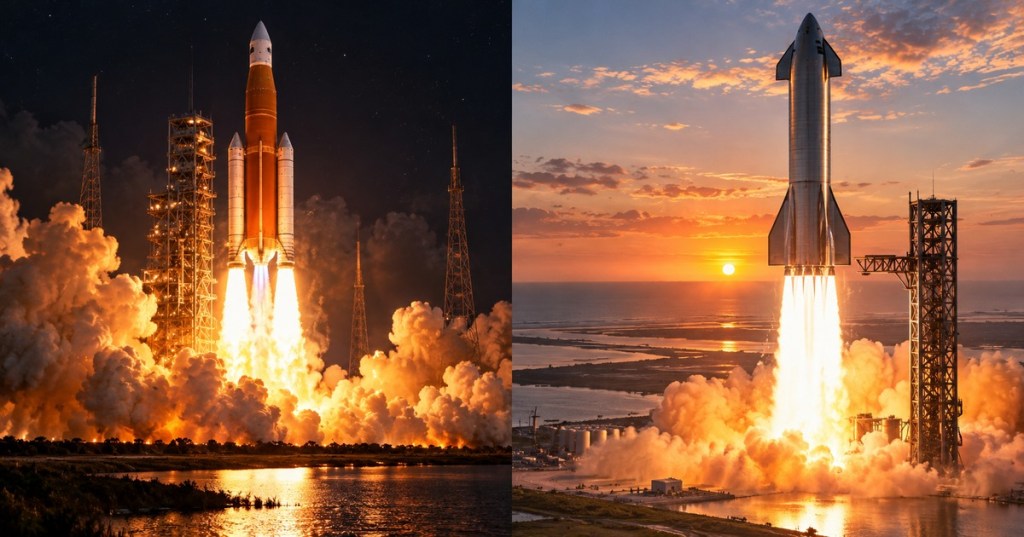
The world’s most capable rockets are carrying larger payloads into orbit in 2026, with a new contender at the top. SpaceX’s September 28 Starship mission reached orbit and deployed 26 next-generation Starlink satellites, putting a launch vehicle designed for more than 100 metric tons ahead of NASA’s Space Launch System on paper. But that ambitious capacity remains a target, not a payload weight the spacecraft has demonstrated.
This countdown ranks seven active orbital rocket families by their published maximum payload capacity to low Earth orbit (LEO) as of October 30, 2026. A family qualifies if it has successfully reached orbit and remains in an active flight or development program; experimental Starship is included on that basis, not called fully operational. Figures describe maximum advertised configurations, frequently with boosters expended or different payload arrangements. They do not represent the mass carried on the cited launch video or the heaviest payload each rocket has actually delivered.
7. SpaceX Falcon 9 — 22.8 Metric Tons to LEO
The workhorse Falcon 9 stands at 22,800 kilograms of maximum published LEO lift capability. Its familiar two-stage layout uses nine Merlin engines on the first stage and a single vacuum-rated Merlin on the second. The upper-stage engine can restart to place satellites into different orbits, while the first stage is routinely recovered for reflight.
Space Affairs’ October 27, 2026 livestream of a Falcon 9 launch from Vandenberg, California.
On October 27, a Falcon 9 sent 27 Starlink satellites into orbit from California, underscoring a distinction between sheer lift capacity and launch frequency. The maximum 22.8-ton specification describes an expendable configuration, while returning a booster uses propellant that otherwise could have supported extra payload. SpaceX’s record of repeated launches illustrates the economic importance of reuse even without topping the capacity ranking.
6. China’s Long March 5 Family — Up to 25 Metric Tons
China’s heavy Long March 5 family is rated for approximately 25,000 kilograms to LEO in its highest-lift configurations, including the 5B variant developed for large space-station modules. The family combines liquid-hydrogen/liquid-oxygen core propulsion with four kerosene-fueled boosters. Its capabilities have supported major exploration missions, including lunar sample-return and Mars spacecraft.
SciNews footage of a standard Long March 5 lifting off from Wenchang with TJSW-25 on June 11, 2026; the 25-ton LEO benchmark refers to the heavy-lift family configuration.
The June 11 flight launched the TJSW-25 technology-test satellite toward geostationary transfer orbit, which is a different mission from lifting a large object to LEO. That difference matters: a rocket’s allowable mass varies with the destination orbit and required velocity. The Long March 5 and space-station-focused 5B should not be treated as identical configurations.
5. ULA Vulcan Centaur — 27.2 Metric Tons
United Launch Alliance’s Vulcan Centaur can lift up to 27,200 kilograms to a reference LEO with six solid rocket boosters. Two methane-fueled BE-4 engines drive its main stage, and the hydrogen-fueled Centaur V upper stage handles precise orbital insertion. Lighter configurations carry less mass, so the maximum is not the specification for every mission.
United Launch Alliance’s footage of the February 12, 2026 USSF-87 national-security launch aboard Vulcan.
The U.S. Space Force’s February 12 USSF-87 flight demonstrated Vulcan’s role in demanding national-security launches, where reaching a precise high-energy orbit can matter more than carrying the greatest possible mass into low orbit. The manufacturer’s performance table places the six-booster design above the Long March 5 family on the common LEO benchmark.
4. Blue Origin New Glenn — 45 Metric Tons
Blue Origin’s New Glenn moves the contest into a higher payload class with a published 45,000-kilogram LEO capacity. The approximately 98-meter launcher uses a reusable first stage with seven BE-4 engines and a large seven-meter-diameter fairing. Its hydrogen-fueled upper stage is designed for payloads headed into higher-energy orbits as well as LEO.
Blue Origin’s official replay of New Glenn mission NG-3, launched April 19, 2026.
The NG-3 mission launched AST SpaceMobile’s BlueBird 7 satellite in April, with the booster returning to Blue Origin’s ocean landing vessel. The vehicle’s large fairing also makes it attractive for bulky spacecraft: payload volume and mass can each limit a mission independently. The 45-ton figure is the company’s stated capability, not a claim that this single satellite weighed 45 tons.
3. SpaceX Falcon Heavy — 63.8 Metric Tons
The three-core Falcon Heavy is rated for 63,800 kilograms to LEO, using 27 Merlin engines at liftoff. Its advertised peak performance assumes the required mission configuration; when its boosters are recovered, attainable payload falls. That flexibility has allowed heavy spacecraft launches and direct, high-energy missions.
NASASpaceflight’s webcast of Falcon Heavy launching the NROL-97 mission on October 2, 2026.
On October 2, Falcon Heavy launched the classified NROL-97 mission from Kennedy Space Center. Its two side boosters returned to Cape Canaveral, while the center core was expended. The mission account demonstrates the trade-off operators make between reuse and performance. The mission’s classified payload mass should not be inferred from the rocket’s published maximum.
2. NASA Space Launch System Block 1 — 95 Metric Tons
NASA’s Space Launch System, in its Block 1 form, is rated to lift 95 metric tons into low Earth orbit. Its four RS-25 core engines and two enormous solid-fuel boosters build on space-shuttle-era technology. The expendable vehicle is intended for human deep-space exploration, particularly lifting Orion toward the Moon, rather than carrying routine commercial satellite batches.
NASA’s official footage of the Artemis II crew launching aboard SLS on April 1, 2026.
The Artemis II launch on April 1 carried four astronauts aboard Orion on a crewed lunar flyby. NASA distinguishes its 95-ton LEO reference capability from the roughly 27 metric tons it can send toward the Moon in this configuration. That is why comparing only payload to LEO cannot determine which rocket is best suited for a particular destination.
1. SpaceX Starship and Super Heavy — More Than 100 Metric Tons Targeted
Starship and Super Heavy take first place on published design capacity of more than 100 metric tons to LEO in a fully reusable configuration. Its methane-and-oxygen Raptor engines, nine-meter-diameter body and proposed recovery of both stages are built around a radically different scale of orbital transport. Yet this is an engineering goal, not a demonstrated 100-ton payload delivery. Starship remains in flight testing.
Space Affairs’ coverage of Starship Flight 14 on September 28, 2026, when the rocket reached orbit and deployed 26 Starlink V3 satellites.
The September 28 Flight 14 reached orbit and released 26 Starlink V3 satellites, moving beyond earlier suborbital test trajectories. SpaceX cut the planned mission short after an engine issue, and the upper stage returned to a Pacific splashdown. The first actual orbital deployment establishes an important milestone; it does not yet prove the full payload target, repeatable recovery, refueling in orbit or airline-like reuse economics.
Why Maximum Payload Is Only Part of Rocket Power
Measured by published LEO mass, the order is Starship, SLS, Falcon Heavy, New Glenn, Vulcan Centaur, Long March 5 and Falcon 9. But mission success depends on much more than a ranking. Staging, target orbit, upper-stage restart capability, fairing diameter, launch cost, recovery plans and reliability each change what a customer can actually fly.
Above all, designed, certified, contracted and demonstrated payload capabilities are different measures. A reusable rocket may carry less on a recovery mission than its expendable maximum; a lunar launcher can trade payload mass for the energy required to leave Earth orbit. Starship’s position could become more consequential as testing continues, but the operating fleet’s established launch records remain the strongest evidence of what the industry can deliver today.
BitcoinVersus.Tech
BitcoinVersus.Tech Editor’s Note: We volunteer daily to ensure the credibility of the information on this platform is Verifiably True. If you would like to support our work and help further secure the integrity of our research initiatives, please scan the QR code below to donate 5,000 sats. For best results, scan the QR code from a laptop or larger screen.
Bitcoin address: 3C9o19EH5HSiwEPyCTmEKzxhNCbo2X6TTb. Confirm the destination address before sending.

BitcoinVersus.tech is not a financial advisor. This media platform reports on financial subjects purely for informational purposes.


Leave a Reply