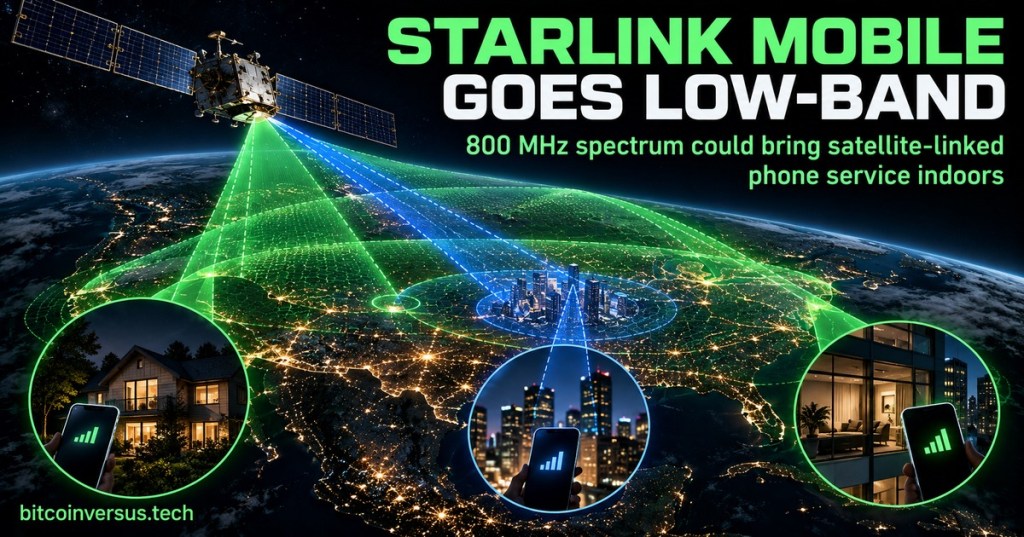
SpaceX has agreed to acquire 100% of Grain Management’s nationwide 800 MHz spectrum portfolio, adding the kind of low-band airwaves that can travel farther and penetrate obstacles better than the higher-frequency spectrum Starlink Mobile already controls. The transaction is still subject to Federal Communications Commission approval, but it addresses one of the hardest problems in direct-to-device satellite service: keeping a normal phone connected when the user is near trees, walls, or buildings instead of standing under a perfectly open sky.
Why 800 MHz Changes the Coverage Problem
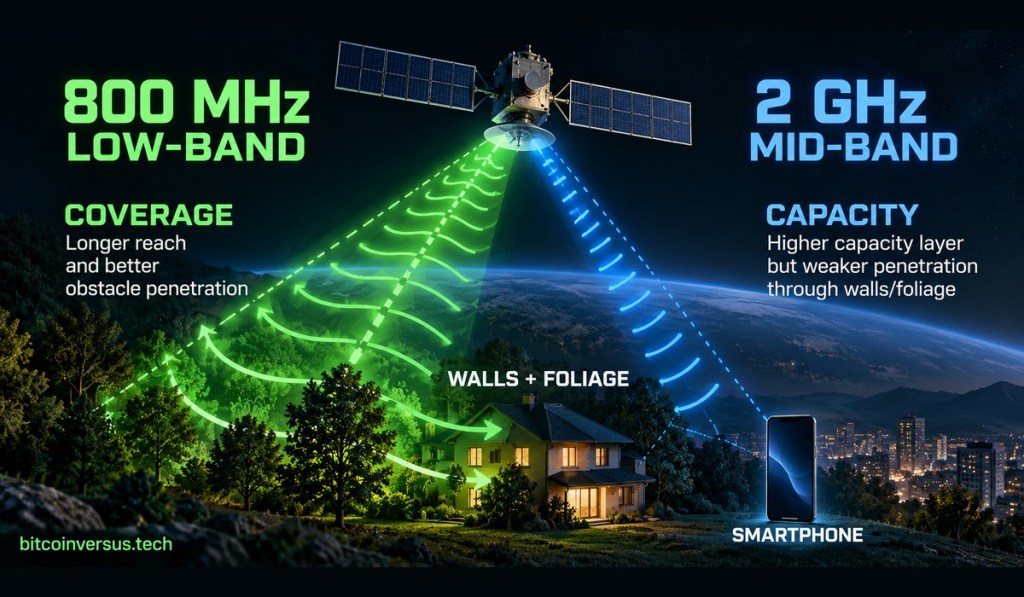
Starlink Mobile already has access to higher-capacity spectrum, including a global 2 GHz layer. The new 800 MHz licenses give SpaceX a complementary coverage layer. Lower-frequency radio waves generally propagate farther and handle walls, foliage, and other obstacles better than higher-frequency signals. That does not make 800 MHz unlimited, and satellite links still have difficult power and geometry constraints, but it fills a different job than the capacity-oriented 2 GHz layer.
The deal covers up to 14 MHz of paired 800 MHz spectrum. According to Grain Management’s announcement, the spectrum is intended to support next-generation direct-to-device service and let Starlink Mobile reach customers from both ground and space. Most existing mobile devices already support the underlying 800 MHz band, so the strategy is built around ordinary handsets rather than requiring a proprietary satellite phone.
Starlink Is Moving Beyond “Emergency Backup” Coverage
Direct-to-device satellite service began as a way to reach places traditional towers miss. BitcoinVersus has already followed that expansion through the FCC’s push to open more direct-to-device spectrum, Starlink V3 satellite deployment, and the radio hardware behind the network, including SpaceX’s large Filtronic GaN amplifier order.
The 800 MHz purchase points toward something broader: a network that blends satellites with terrestrial infrastructure instead of treating orbital connectivity as a narrow fallback. That would put Starlink Mobile closer to the architecture of a full wireless carrier—one using space for reach, ground infrastructure where useful, and multiple frequency bands for different coverage and capacity jobs.
The FCC Is a Major Part of What Happens Next
The spectrum cannot simply change hands and go live overnight. The acquisition needs FCC approval, and the Commission has already attached deployment conditions to the 800 MHz licenses. In its 2026 spectrum policy work, the FCC explicitly described direct-to-device service as a tool for closing coverage gaps and increasing wireless competition. Earlier this year the FCC also authorized a second tranche of 7,500 Gen2 Starlink satellites, bringing the authorized Gen2 total to 15,000.
That regulatory backdrop matters because spectrum is finite. Grain acquired these 800 MHz licenses from T-Mobile under conditions intended to prevent the band from sitting idle. SpaceX now has to move from owning rights on paper to demonstrating that its satellite-plus-terrestrial plan can satisfy buildout requirements, coexist with other users, and deliver reliable service at scale.
Why This Matters
The technical story is not that 800 MHz is “better” than 2 GHz. It is that the two bands solve different problems. A serious mobile network needs both coverage and capacity. Starlink’s higher-frequency spectrum can carry more data, while the newly acquired low-band spectrum can help the network reach farther and survive obstacles that are especially punishing for satellite-to-phone links.
If the acquisition closes and the network performs as intended, Starlink Mobile could evolve from a dead-zone extension into a much more conventional competitor to nationwide wireless carriers. The more interesting long-term possibility is a network where a phone moves among terrestrial cells and orbital cells without the user needing to think about which one is carrying the connection—an extension of the same resilience idea seen when Starlink restored communications after severe flooding in Poland.
What Comes Next
- FCC review: the Grain-to-SpaceX license transfer still needs final regulatory approval.
- Network architecture: SpaceX has to show how the 800 MHz terrestrial and satellite pieces will be deployed together.
- Indoor reliability: the key real-world test is whether the low-band layer materially improves service around buildings and foliage.
- Device compatibility: support in ordinary phones is a major advantage, but network authorization, modem behavior, and carrier integration still matter.
- Competition: AT&T, Verizon, T-Mobile, AST SpaceMobile, Amazon, and other satellite/mobile players now have even more reason to accelerate their own direct-to-device strategies.
BitcoinVersus.Tech
Editor’s Note: The featured image and in-body spectrum graphic are editorial illustrations. They do not depict the final Starlink Mobile radio architecture or a specific production satellite.
We volunteer daily to improve the credibility of the information on this platform. If you would like to support the research, please donate here: 3C9o19EH5HSiwEPyCTmEKzxhNCbo2X6TTb
BitcoinVersus.tech is not a financial advisor. This media platform reports on technical and financial subjects purely for informational purposes.


Leave a comment