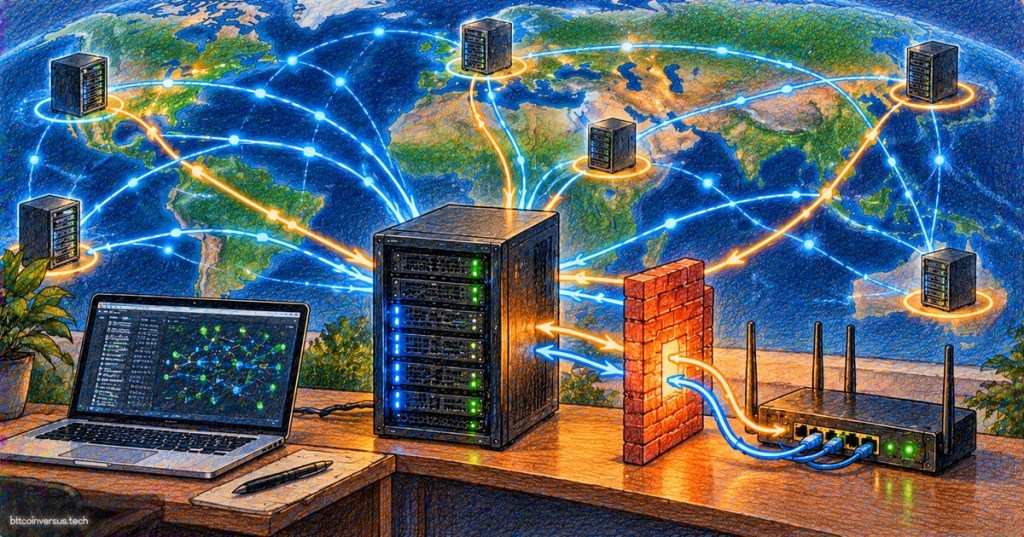
Bitcoin mainnet nodes use TCP port 8333 by default for peer-to-peer communication. That port is where full nodes discover each other, exchange version information, relay transactions, announce blocks, and keep the network connected without a central server.
This is separate from Bitcoin Core’s RPC interface. RPC is how administrators and software talk to their own node. Port 8333 is part of the public peer-to-peer network that lets Bitcoin nodes talk to other Bitcoin nodes.
Port 8333 Is the Default Bitcoin Mainnet P2P Port
The Bitcoin developer reference lists 8333 as the default mainnet P2P port. Test networks use different defaults, and Bitcoin Core can be configured to listen on another port, but 8333 remains the conventional public port for Bitcoin mainnet nodes.
Bitcoin peer traffic runs over TCP. TCP provides an ordered, reliable byte stream, which suits a protocol that exchanges structured network messages such as version handshakes, transaction inventory, blocks, peer addresses, and keepalive traffic.
A Full Node Does Not Need a Central Server List
A newly installed node initially has a bootstrapping problem: it knows Bitcoin’s rules, but it does not yet know the IP addresses of active peers. Bitcoin Core solves this with several discovery mechanisms rather than depending on one central directory.
One of those mechanisms is DNS seeds. Bitcoin Core contains a set of seed hostnames that can return addresses of nodes believed to be reachable. This is a bootstrap mechanism, not the permanent structure of the network. After a node connects, peers can tell it about additional peers.
The DNS portion is ordinary networking. Bitcoin Core asks the local resolver to look up seed hostnames, which makes the process dependent on the same DNS concepts used by browsers, servers, and other applications.
DNS Seeds Are for Bootstrapping, Not Consensus
DNS seed operators do not decide what Bitcoin’s valid blockchain is. They only help a new node obtain addresses it can try. Once connected, the node independently validates blocks and transactions according to its own consensus rules.
Bitcoin Core’s DNS seed policy explicitly treats seeds as a small trust surface and requires seed results to consist of fairly selected, functioning Bitcoin nodes. The protocol also avoids relying exclusively on seeds by learning addresses from peers and preserving known-peer information across restarts.
Peers Exchange Addresses With Each Other
After a node connects to the Bitcoin network, peers can exchange address information through P2P messages such as addr and addrv2. These messages let the node learn additional IP addresses and ports without returning to a central lookup service every time it starts.
Bitcoin Core stores information about known peers on disk so it can try previously learned peers during later startups. That persistent address database makes the network more resilient and reduces unnecessary DNS-seed use.
Outbound Connections Usually Work Without Port Forwarding
Most home and office networks use NAT or PAT. A Bitcoin node behind a typical router can usually initiate outbound TCP connections to public peers without manually forwarding port 8333.
That means a node can synchronize the blockchain, validate blocks, relay transactions, and participate in Bitcoin even if strangers on the internet cannot initiate a new connection directly to it.
Inbound Port 8333 Makes the Node Reachable to More Peers
If an operator wants the node to accept unsolicited inbound P2P connections from the public internet, the network path must permit those connections. On many home routers this means forwarding TCP port 8333 from the public side to the node’s private IP address and allowing the traffic through the host firewall.
Port forwarding is a NAT/PAT operation. The router maintains the translation between the public-facing connection and the node’s private LAN address.
Making a node reachable can improve network connectivity because other nodes gain another inbound peer option. It is not required for validating your own transactions and blocks, however, and administrators should not open ports they do not understand.
The Firewall Still Matters
A router forwarding port 8333 does not automatically mean the operating system will accept it. The host firewall can still block inbound connections. Linux firewalls, Windows Firewall, cloud security groups, and upstream firewalls all become part of the path.
Troubleshooting should therefore follow the network path in order: internet → public IP → router/firewall → NAT rule → server NIC → host firewall → bitcoind listening socket. Skipping layers often leads to changing Bitcoin Core settings when the real problem is ordinary networking.
Port 8333 Is Not the Same as Bitcoin Core RPC
This distinction is critical. Bitcoin Core’s P2P service communicates with untrusted peers. The RPC service is an administrative interface used by bitcoin-cli, wallets, monitoring scripts, mining software, and other trusted local applications.
An administrator should never assume that because P2P port 8333 is intentionally public, the RPC service should also be public. Exposing administrative RPC interfaces directly to the internet can create serious security risk.
The Version Handshake Happens First
When two Bitcoin nodes establish a TCP connection, they perform a protocol handshake. Each side sends a version message containing information such as protocol version, supported services, timestamp, and network-address details. The peers acknowledge the connection with verack.
Only after that negotiation do the peers proceed with normal P2P message exchange. This lets Bitcoin Core understand what services the remote peer claims to support before relying on it for particular network functions.
Peers Relay Transactions by Inventory
Bitcoin nodes do not blindly transmit every full transaction to every peer at all times. The protocol uses inventory-style announcements so peers can learn that another node has data they may want, then request missing objects.
This relay process is one reason a locally broadcast transaction can propagate across the global network within seconds. Each independently operated node receives, validates, and relays data according to its own policy and state.
Blocks Travel Over the Same P2P Network
When a miner or mining pool finds a valid block, that block must reach other full nodes quickly. Nodes validate the block and relay it onward, causing the new chain tip to spread through the network.
This creates a direct operational connection between Bitcoin mining and network engineering. ASICs perform SHA-256 proof of work, but the winning block only matters to the broader network after software nodes receive and validate it.
Mining Pools Use More Than One Network Protocol
Bitcoin miners often connect to pools through Stratum, not directly through port 8333. Stratum carries mining jobs and share submissions between ASICs and the pool. The pool’s full-node infrastructure separately participates in Bitcoin’s P2P network.
That means an industrial mining site can involve several distinct network layers at once: ASIC-to-pool Stratum traffic, Bitcoin-node P2P traffic, local SNMP monitoring, web-management interfaces, DNS, NTP, switch management, and administrative APIs.
Bitcoin Core Can Show You Its Peers
Operators can inspect peer state through Bitcoin Core RPC. Commands such as getpeerinfo and getnetworkinfo can show connected peers, network addresses, services, traffic counters, connection types, and other diagnostic information.
The -netinfo view in bitcoin-cli provides a compact operational summary and is useful when troubleshooting whether the node has outbound peers, inbound peers, IPv4, IPv6, Tor, or other connection types.
Useful Troubleshooting Questions
- Does the node have working internet connectivity?
- Can the operating system resolve the configured DNS seed names?
- Does Bitcoin Core show outbound peers in getpeerinfo?
- Is bitcoind actually listening on the expected TCP interface and port?
- If inbound connectivity is desired, does the router have the correct port-forward rule?
- Does the node have a stable private IP or DHCP reservation so the forward still points to the correct host?
- Does the host firewall permit inbound TCP 8333?
- Is another upstream firewall, ISP policy, carrier-grade NAT, or cloud security group blocking inbound traffic?
- Are peer failures Bitcoin-specific, or does ordinary IP connectivity fail too?
- Do logs show connection errors, bans, timeouts, or repeated handshake failures?
Carrier-Grade NAT Can Prevent Simple Port Forwarding
Some residential and mobile ISPs place many customers behind carrier-grade NAT. In that design, the public IP address belongs to the provider’s upstream translation system rather than directly to the customer’s router.
If that is the case, configuring port forwarding on the local router may not create a reachable inbound path because another NAT layer exists upstream. The node can still make outbound Bitcoin connections, but conventional inbound IPv4 reachability may require a public address, IPv6, a VPN/tunnel design, Tor, or an ISP service change.
IPv6 Can Remove the NAT Translation Step
With globally routable IPv6, a Bitcoin node may not require traditional IPv4 NAT port forwarding. The firewall still matters, and the address must be reachable under the local network policy, but there is no need to translate a public IPv4 port to a private RFC1918 address.
Tor Gives Bitcoin Another Reachability Path
Bitcoin Core can also communicate over Tor, allowing nodes to make or receive peer connections through onion services without exposing a conventional public IPv4 service in the same way. Tor changes the routing and privacy model but does not change the core idea: Bitcoin still depends on independently operated peers exchanging protocol messages.
Opening 8333 Does Not Make a Node a Miner
A full node validates and relays Bitcoin data. A miner performs proof-of-work calculations. Running Bitcoin Core and accepting connections on port 8333 does not make the machine an ASIC miner, and an ASIC miner by itself does not replace a validating full node.
The two systems complement each other. Mining pools generally operate full nodes to construct and validate candidate blocks while specialized ASIC fleets perform the hashing work.
Why More Reachable Nodes Help
A network with many independently operated, reachable nodes has more paths for transactions and blocks to propagate. It is harder for one network operator, data center, ISP, or software service to become a mandatory intermediary.
Bitcoin does not require every node to accept inbound connections, but reachable nodes contribute connection capacity to peers that need it. This is part of the infrastructure layer behind Bitcoin’s decentralized validation model.
The Simple Way to Remember Port 8333
Port 8333 is Bitcoin mainnet’s default peer-to-peer TCP door. A node uses it to connect to peers, exchange Bitcoin protocol messages, relay transactions, and spread blocks. DNS seeds help a fresh node find its first peers; peer-address gossip and persistent peer records help it find more later.
Outbound Bitcoin networking usually works behind normal NAT. Opening and forwarding 8333 is mainly about letting other nodes initiate inbound connections to yours.
References
- Bitcoin Developer Guide — P2P Network
- Bitcoin Developer Reference — P2P Networking
- Bitcoin Core — DNS Seed Policy
BitcoinVersus.Tech
Advertisement
BitcoinVersus.Tech covers Bitcoin IT, mining, networking, ASIC hardware, data centers, Linux, software, and the infrastructure behind proof of work.
Editor’s Note
Bitcoin Core networking defaults and options can change between releases. Confirm listening interfaces, firewall rules, port forwarding, Tor settings, and RPC exposure against the documentation for the exact Bitcoin Core version in production.
We volunteer daily to help keep the information on this platform verifiably accurate. Support our independent research through the support options available on BitcoinVersus.Tech.
BitcoinVersus.tech is not a financial advisor. Content is provided for informational purposes.


Leave a comment