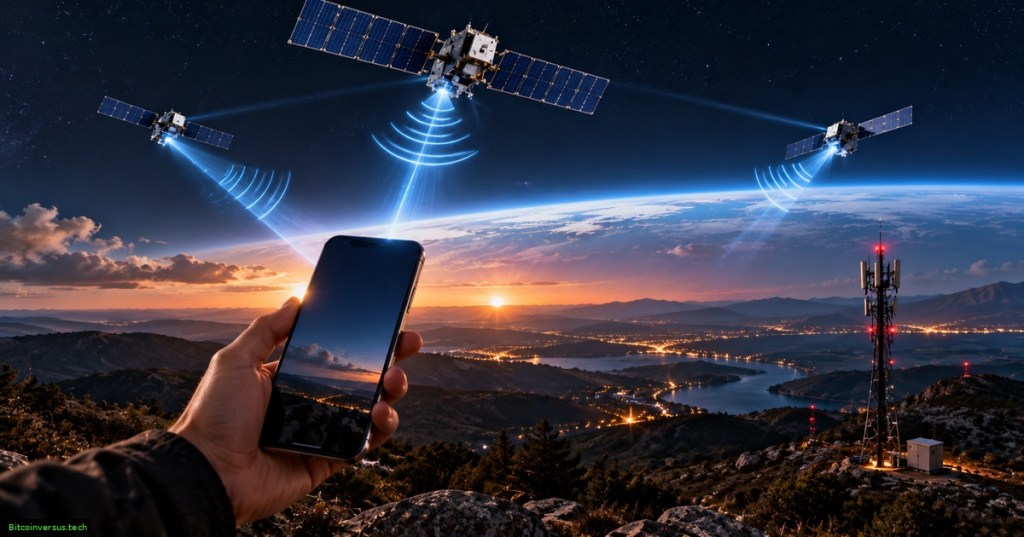
The Federal Communications Commission will vote on October 29, 2026 on whether to advance a new wireless-spectrum auction aimed at expanding direct-to-device satellite service—the technology that lets ordinary smartphones connect directly to satellites when terrestrial cellular coverage disappears.
Reuters reports that the proposal would auction 25 MHz of spectrum for direct-to-device operations and make an additional 482 MHz available for supplemental coverage from space. The important distinction is that this is still a regulatory proposal and upcoming vote, not a completed auction or final commercial allocation.
Direct-to-Device Turns Satellites Into Cell Towers in Space
The FCC describes direct-to-device, or D2D, as space-based coverage delivered directly to consumer end-user devices. In practice, a compatible phone can communicate with a low-Earth-orbit satellite without carrying a separate satellite dish. The agency has already been widening its regulatory framework for D2D, including an August 2026 proceeding that explored allowing some unlicensed devices to communicate directly with satellites.
That pushes satellite communications closer to ordinary mobile networking. Instead of a satellite terminal being a specialized endpoint, the phone itself becomes part of the satellite-access network. BitcoinVersus has previously covered how low-Earth-orbit networks are increasingly being designed as communications infrastructure rather than isolated spacecraft.
Why 25 MHz Matters
Radio spectrum is the shared electromagnetic real estate that wireless systems use to carry information. More usable bandwidth generally means more room for simultaneous users, higher aggregate data rates, or additional services—provided interference is controlled and the radios can use the frequencies efficiently.
The FCC proposal therefore matters for more than licensing paperwork. A dedicated 25 MHz block can give D2D operators more predictable access to radio capacity, while the additional 482 MHz contemplated for supplemental coverage from space could broaden the combinations of terrestrial and satellite networks available to carriers.
SpaceX Is Already Designing Around Dedicated Spectrum
SpaceX says its next-generation Starlink Direct-to-Cell satellites will use dedicated spectrum together with custom silicon, phased-array antennas and optimized 5G protocols. The company says the next generation is designed for roughly 20 times the throughput of a first-generation satellite and more than 100 times the overall system capacity.
Those claims remain manufacturer performance targets, but the architecture explains why spectrum ownership is so valuable. Wider channels plus thousands of spatial beams allow a satellite to reuse radio resources across many geographic cells. BitcoinVersus has also covered the physical RF side of that network, including Starlink’s high-frequency amplifier hardware and newer Starlink satellite deployments.
Amazon Is Building a Competing D2D System
Amazon Leo has separately filed with the FCC for a direct-to-device constellation of up to 5,105 satellites, with deployment planned to begin in 2028. Amazon says the system would use L-band and S-band links between satellites and mobile devices, with higher-capacity Ka-band and V-band links carrying aggregated traffic between satellites, ground stations and the internet.
That means the emerging market is not simply “satellite internet versus cellular.” It is becoming a hybrid architecture in which mobile carriers, satellite operators and spectrum owners can cooperate—or compete—across the same end-user device.
The Auction Will Not Instantly End Dead Zones
Even if the FCC advances the auction on October 29, commercial service still depends on final auction procedures, eligible bidders, interference protections, satellite capacity, mobile-network partnerships and device support. Spectrum allocation is one layer of the system—not the finished network.
But it is a critical layer. Satellite-to-phone systems cannot scale on antennas and spacecraft alone. They need legally usable frequencies, enough bandwidth, compatible radios and rules that let terrestrial and orbital networks share spectrum without overwhelming one another.
What to Watch on October 29
The key questions are whether the FCC advances the 25 MHz auction, how it structures access to the additional 482 MHz, what interference limits it proposes, and how much flexibility satellite and terrestrial carriers receive to build hybrid services. Those details will determine whether D2D becomes a narrow emergency-connectivity layer or starts behaving more like ordinary nationwide mobile coverage.
BitcoinVersus.Tech
Advertisement
Editor’s Note
The FCC action described here is scheduled for an October 29 vote and remains subject to Commission action and subsequent auction proceedings. Manufacturer capacity figures are company claims and may differ from real-world commercial performance.
Support and donation options are available through BitcoinVersus.Tech.
BitcoinVersus.tech is not a financial advisor. Content is provided for informational purposes.


Leave a Reply