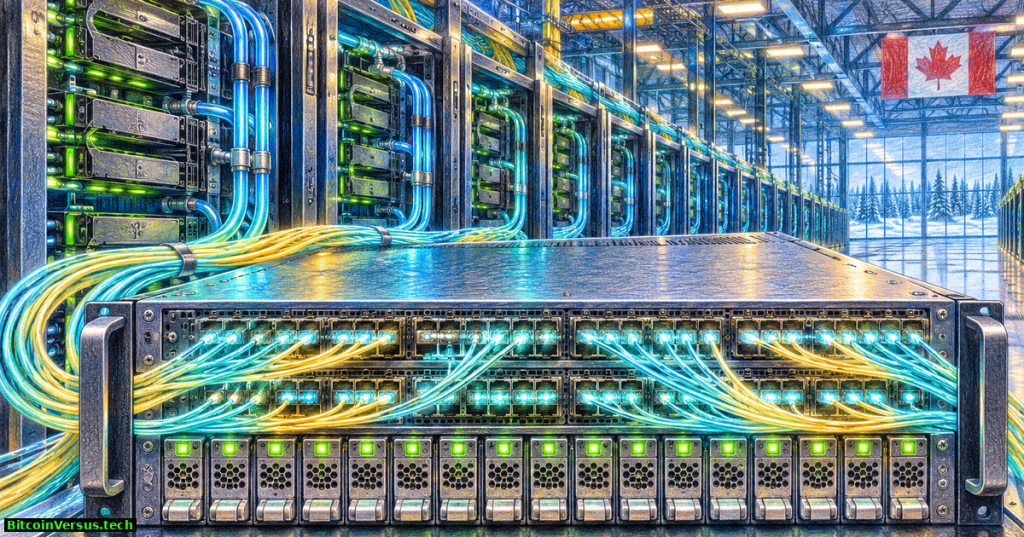
More than 10,000 NVIDIA Blackwell Ultra GPUs at a Quebec AI campus are now connected through co-packaged optical networking switches, according to a November 16, 2026 announcement from cloud provider Lambda. The deployment brings an emerging photonics architecture into a production-scale computing facility and offers measured comparisons with conventional pluggable optical modules.
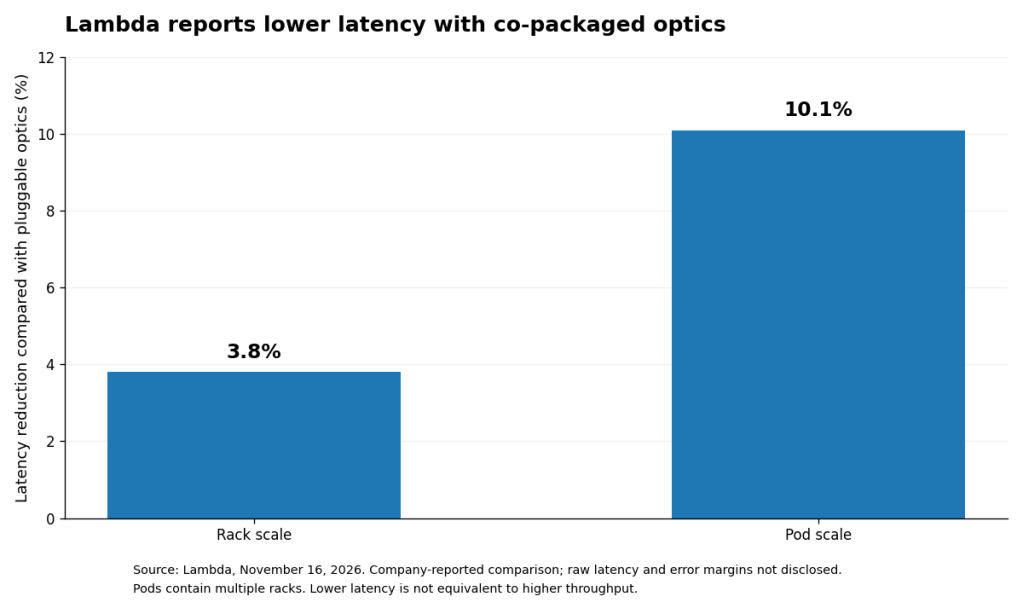
Lambda reports 10.1% lower network latency at pod scale, equivalent throughput, and a 15°C reduction in median optics temperature. The numbers come from the company’s own tests, rather than a publicly released independent benchmark. Lambda’s announcement and NVIDIA’s technical report describe the architecture.
Official Lambda and NVIDIA production AI factory video, linked by both companies in their November 16 reports. The footage explains the deployment; numerical comparisons are company reported.
How the optical switches work
In traditional pluggable networking, high-speed electrical signals travel from a switch ASIC across a circuit board to transceivers at the front panel. Co-packaged optics, or CPO, moves optical engines beside the switch processor, shortening the electrical path from inches to millimeters. Optical fibers still carry light between racks. Shorter electrical traces can reduce signal loss and remove the need for some retimer components.
Each NVIDIA Quantum-X Photonics switch in the Lambda deployment provides 144 ports rated at 800 Gb/s, liquid cooling and 18 removable external light sources. Multiplying 144 by 800 Gb/s gives 115.2 Tb/s of nominal aggregate port capacity per switch. That calculation describes rated interfaces, not measured application throughput, network bisection bandwidth or the total capacity of the Quebec campus.
The external light sources also address a serviceability concern: technicians can replace a failed laser module without replacing the complete optical switch. ServeTheHome’s SC26 hardware analysis explains why fewer serviceable laser units matter as optical networks become denser.
What Lambda measured
Lambda compared CPO with front-panel pluggable optics at rack, scalable-unit and pod scales. The published latency advantage grows from 3.8% at rack scale to 10.1% at pod scale, while the company reports unchanged throughput. Median operating temperature for optical hardware fell from 51°C to 36°C. Cooler operation may improve component lifetime, but temperature alone does not prove a particular failure rate.
NVIDIA additionally advertises up to five times better optical power efficiency and up to 15 times higher reliability compared with conventional pluggables. Those are vendor claims, not independently verified measurements of the entire 10,000-GPU facility. Lambda has not provided enough public test detail to isolate workload-specific effects, cost per port or long-term field failure rates.
NVIDIA’s official SC26 special address, linked from its conference program. Relevant to the deployment and broader supercomputing platform, rather than an independent audit of Lambda’s benchmarks.
Why the deployment matters
A training cluster is only as productive as its communication fabric. When thousands of GPUs synchronize a model update, delay or a failed network component can idle costly accelerators. Lower network power also frees a greater portion of a site’s electrical budget for computation. Yet CPO introduces tighter integration among silicon, fiber connectors, laser modules and liquid cooling, making repair practices and optical diagnostics central operational challenges.
The development follows earlier live co-packaged optics demonstrations, a 102.4 Tb/s CPO switch announcement, and evolving optical networking standards. Our 800G versus 1.6T optics comparison explains another bandwidth transition. Lambda’s contribution is evidence of deployment at scale, not proof that all AI networks should abandon pluggable transceivers.
Sources
- Lambda, November 16, 2026, deployment announcement and benchmarks
- NVIDIA Blog, November 16, 2026, product architecture and efficiency claims
- HPCwire, November 17, 2026, independent conference reporting
- ServeTheHome, November 16, 2026, hardware analysis
Editor’s Note: We volunteer daily to ensure the credibility of the information on our platform is Verifiably True. If you would like to support our work and the integrity of our research initiatives, scan the QR code below to donate 5,000 sats.

For mobile scanning, open the article on another display and scan the QR code with a Bitcoin wallet. Verify receiving address 3C9o19EH5HSiwEPyCTmEKzxhNCbo2X6TTb before sending.
BitcoinVersus.Tech publishes technology journalism for informational purposes and does not provide professional investment, engineering or financial advice.


Leave a Reply