
Cisco raised its fiscal 2027 hyperscaler AI-infrastructure revenue outlook to $9 billion on November 12, 2026, up from the $7.5 billion forecast issued in August. The 20% guidance increase followed a record first fiscal quarter, with total sales of $18.5 billion, up 24% year over year, and Networking product revenue increasing 43%. The $9 billion figure is a management forecast for one customer segment, not completed sales or total Cisco networking revenue.
Cisco’s official Q1 fiscal 2027 earnings call livestream, November 12, 2026, linked directly in its investor release. Management discusses results and forward guidance. Credit: Cisco Investor Relations / YouTube.
Networking hardware drove the quarter
For the three months ended October 24, Cisco reported $11.132 billion of Networking product sales within $18.517 billion of total revenue. Product revenue overall grew 32%, while services increased 1%. Security product revenue rose 7%; the categories do not share the same growth rate, making a uniform AI-driven explanation misleading. The results were reported in Cisco’s November 12 investor release.
Chief executive Chuck Robbins characterized the demand environment as the beginning of a multiyear networking expansion. Cisco’s non-GAAP gross margin fell to 65.6% from 68.1% a year earlier, however, showing pressure from costs and product mix. Rivals are pursuing the same market; Arista’s recently reported product-led growth illustrates the competition without providing a directly comparable fiscal-period measure.
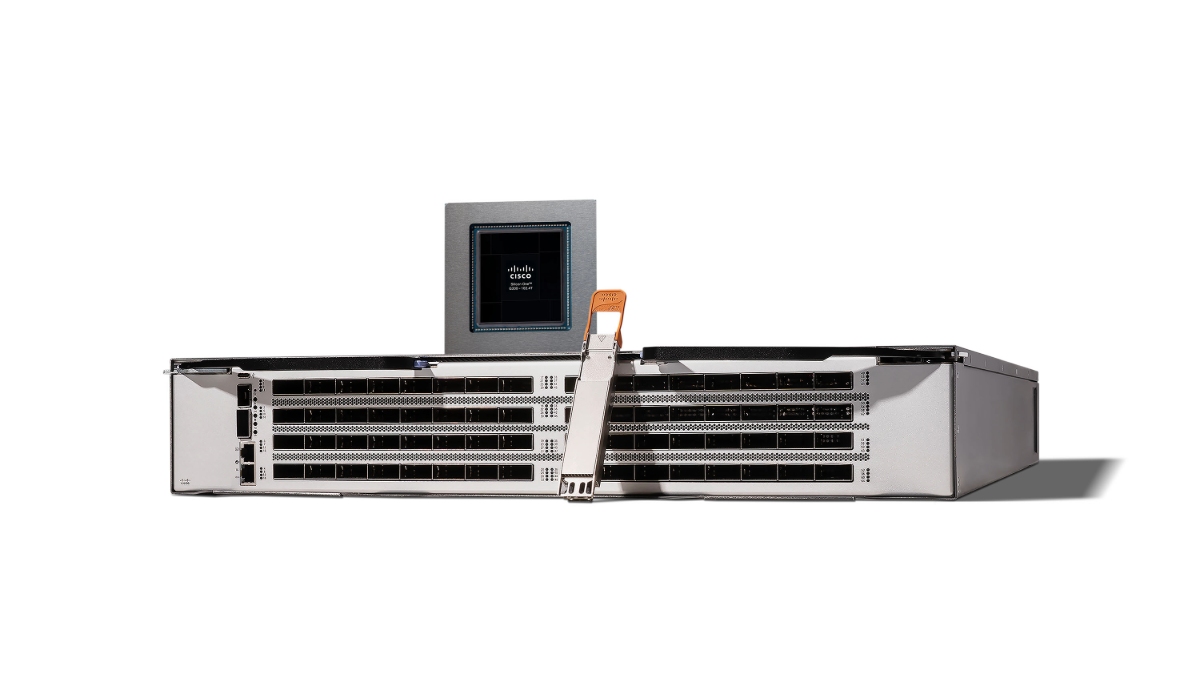
The $9 billion forecast is not $9 billion of orders
Cisco says hyperscaler AI-infrastructure revenue reached approximately $4 billion during fiscal 2026. In August it forecast $7.5 billion for fiscal 2027; November’s update raised the expectation to $9 billion. The revised figure is $1.5 billion higher than the prior outlook and 2.25 times the prior year’s reported revenue. Cisco also raised its total fiscal 2027 sales forecast to $74.8–$75.8 billion, versus the former $72.2–$73.4 billion range.
Optics and switch silicon link the sales story to GPU clusters
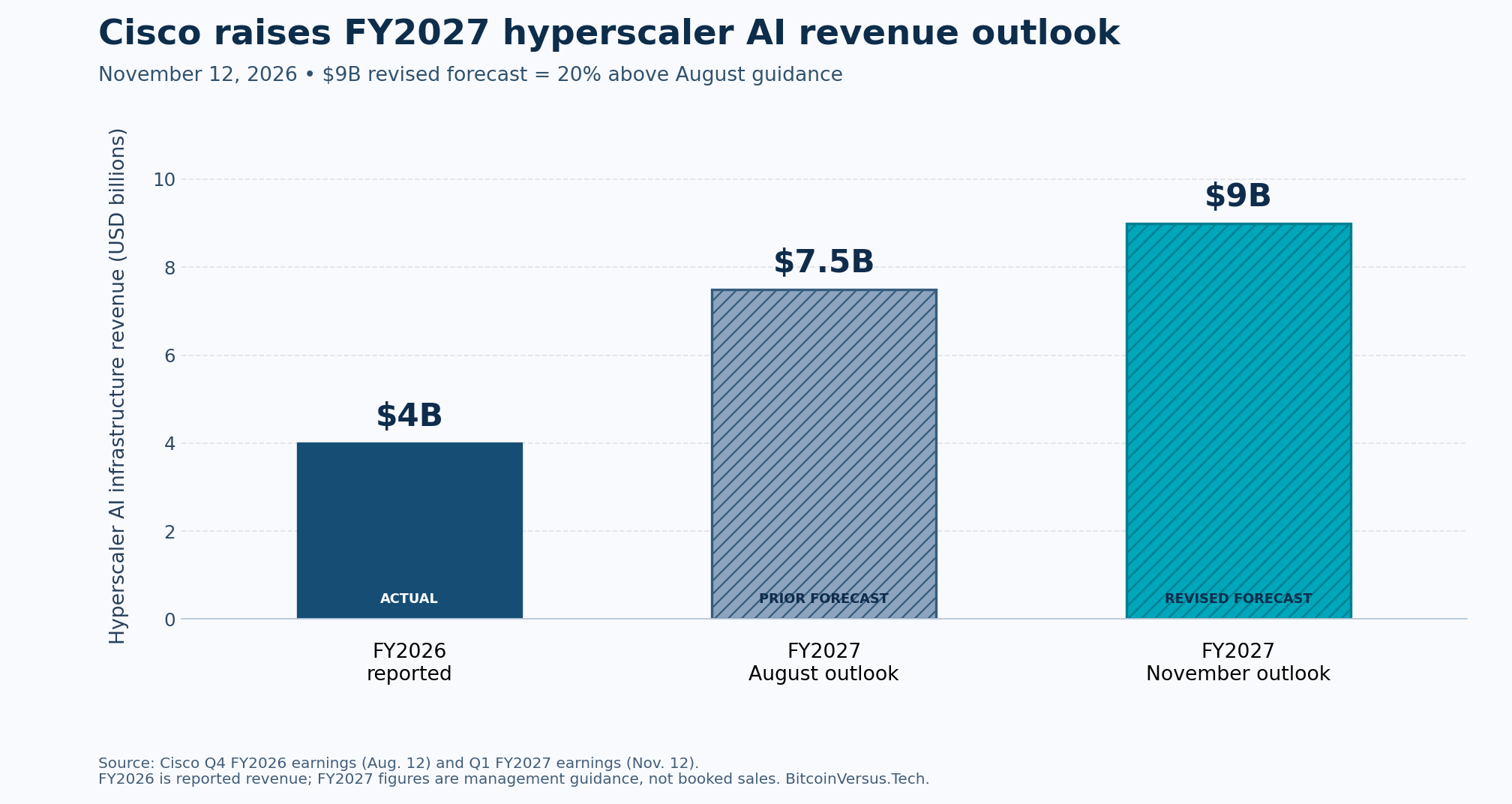
AI infrastructure requires Ethernet or other fabrics connecting accelerators, storage, routers and data centers. Cisco’s Silicon One systems include G300-based 102.4-terabit-per-second switch designs and pluggable optics, but their advertised switching capacity is not the same metric as company revenue or a verified customer deployment count. OSFP and QSFP-DD interoperability and 800G versus 1.6T optical links explain why lane rate, thermal design and host compatibility matter in high-density networks.
Cisco’s official “Silicon One G300 | Liquid Cooling for AI Data Centers,” published May 19, 2026. Manufacturer demonstration of the 102.4 Tb/s switching platform; not evidence of November quarterly shipment volume. Credit: Cisco / YouTube.
What could limit the projected expansion?
Customer capital spending, the timing of optics and accelerator deliveries, competing switch platforms and component costs could affect the forecast. A strong quarter does not ensure every hyperscaler expansion proceeds on schedule. Related optical-interface standardization projects target future speeds but should not be counted as already commercialized deployments. Cisco’s remaining performance obligations reached $46.2 billion, although the figure spans products and services beyond hyperscaler AI infrastructure.
The verified development is a substantial upward revision to Cisco’s forecast, supported by a completed quarter of stronger networking revenue. The next test is whether orders convert into deliveries and the company sustains profitability as faster links, new switch silicon and cooling requirements spread across AI facilities.
Primary sources: Cisco Q1 fiscal 2027 results, November 12, 2026; Cisco fiscal 2026 results and original FY2027 guidance, August 12, 2026; Reuters independent coverage, November 12; Cisco Silicon One G300 equipment announcement, February 2026. Hardware demonstration and earnings webcast are separate from audited shipments.
Editor’s Note: Reporting distinguishes fiscal 2026 revenue, fiscal 2027 management guidance, Networking category revenue and hyperscaler-specific AI sales. The 1200 × 630 featured cover is original anime-style editorial artwork, with a neon-green Bitcoinversus.tech watermark; it does not depict named Cisco employees or a real deployment site. The in-story Cisco equipment image is authentic manufacturer press photography from February 2026, and the zero-baseline chart was generated from Cisco’s dated financial disclosures. Both YouTube videos are credited to Cisco. WordPress-generated embeds are not proof of playback on every browser or handset.

BitcoinVersus.Tech is volunteer-run and publishes independent technical journalism. An optional 5,000-satoshi donation supports ongoing research. Scan the original QR from a second screen using a compatible Bitcoin wallet; on the same phone, use a wallet that can import a saved QR image when supported. Independently verify recipient 3C9o19EH5HSiwEPyCTmEKzxhNCbo2X6TTb and the 5,000-satoshi amount before sending. Bitcoin transfers are generally irreversible.
We volunteer daily to ensure the information on BitcoinVersus.Tech is Verifiably True. Technical and financial coverage is educational and informational, not personalized engineering, securities, tax or investment advice.


Leave a Reply