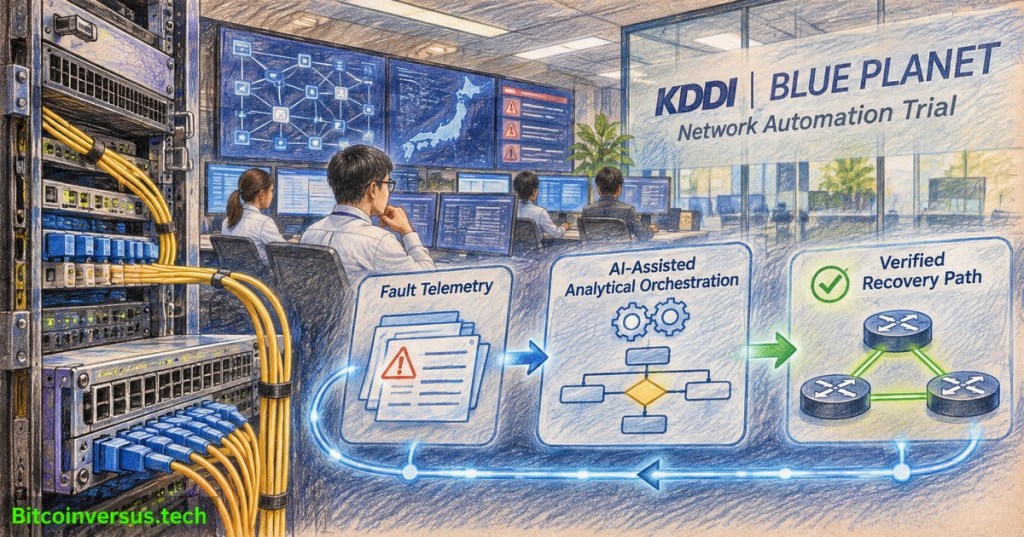
Japan’s KDDI is expanding AI-driven network operations with Ciena’s Blue Planet division and Accenture after a six-month laboratory trial. Announced November 12, 2026, the multiyear program will begin with KDDI’s fixed-network operations and is planned to extend to mobile networks in 2028. The companies demonstrated automated alarm handling, service orchestration and fault-remediation workflows. They did not report a nationwide production deployment or independently measured reductions in network downtime.
Official CienaCorp video, May 8, 2026: “How Ciena and Blue Planet Enable AI-Driven Automation and Visibility.” A verified company explainer, not footage of the November KDDI trial.
How an AI-assisted network fixes a fault
Telecommunications networks rely on operations-support systems (OSS) to maintain equipment inventories, examine alarms, coordinate configuration changes and track service health. A closed-loop workflow monitors network state, identifies a problem, initiates a controlled action and checks whether the action worked. Human operators can remain responsible for high-risk decisions. Automation without trustworthy inventory or outcome validation can amplify configuration mistakes across many devices.
Blue Planet’s November 12 release identifies four lab-tested use cases: natural-language searches of network alarms, machine-learning-based alarm prioritization, AI-triggered remediation through orchestration and assurance, and automated service-lifecycle workflows. The stack uses Blue Planet Inventory, Blue Planet Orchestration, Unified Assurance and Analytics, and AI Studio. Accenture is responsible for integration support, operational processes and governance.
What the trial establishes—and what remains unknown
A six-month exercise in KDDI and Accenture laboratories supports the feasibility of connecting data sources and executing automated workflows. It does not, by itself, demonstrate safe autonomous operation across Japan’s live fixed and mobile networks. Neither KDDI nor Ciena disclosed the number of devices tested, a before-and-after mean time to repair, false-positive rates, rollback success rates, production service-level improvements or the project’s contract value.
Operational safety depends on accurate topology data, access controls, change windows, simulated impact, audit logs and fallback procedures. Cisco’s governed network-agent initiative highlights similar questions about which automated actions should need approval. Recent router-incident coverage illustrates why apparently routine network changes can create service-wide consequences.
Fierce Network TV, July 27, 2026: “How Blue Planet Helps Carriers Trust Automation.” Blue Planet executives discuss configuration governance and multi-vendor change control; the interview predates KDDI’s announced expansion.
Fixed networks first, mobile rollout planned for 2028
The companies plan to adapt reusable software components, interfaces and AI agents to KDDI’s Japanese operating environment and mix of equipment suppliers. Starting with fixed networks offers a staged approach before mobile-system expansion, where service availability, mobility management and subscriber impact can complicate automation. The 2028 date is a stated rollout plan, not evidence that the mobile deployment is already active.
Ciena’s technical overview defines network autonomy as a progression from human-operated systems toward higher levels of closed-loop control. The KDDI announcement does not assign a verified TM Forum autonomy level to its production network. Even with automated responses, engineers must isolate faults, inspect protocol behavior and verify routes; OSPF authentication and passive-interface guidance offers an example of network controls requiring careful configuration.
AI-driven operations could reduce repetitive alarm work and accelerate restoration, but benefits must be proven through longitudinal field measurements. Unlike the Uniti–Nokia 800G transport trial, which tested a physical client interface, KDDI’s initiative focuses on the software and data governing network changes. Its key test will be whether automation improves reliability without sacrificing operator accountability.
Sources and verification (November 15, 2026): Blue Planet/Ciena primary release, November 12; SDxCentral, November 12; Ciena autonomous-network technical explanation; Impress Watch archival photograph, July 11, 2023. Video descriptions and publishers checked against discoverable YouTube listings. The companies’ performance claims are not independent production benchmarks.
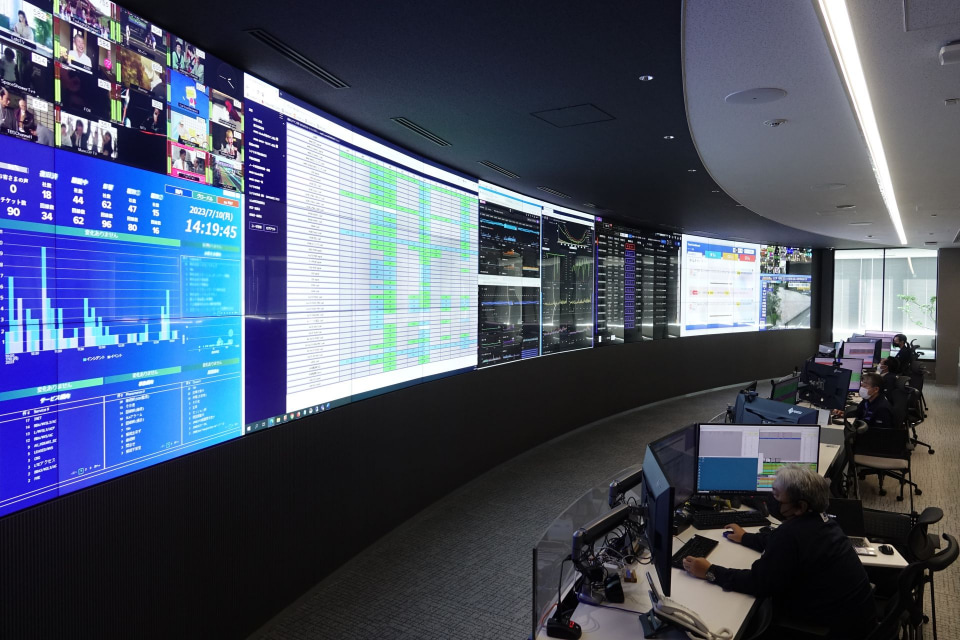
Editor’s Note: Reporting separates the completed six-month laboratory exercises from planned network deployments and prospective 2028 mobile expansion. The original 1200 × 630 colored-pencil cover is a conceptual depiction of a KDDI–Blue Planet network-automation workflow and not a photograph of the laboratory. The in-story control-room photograph is authentic archival media from 2023 with source credit; it does not document the announcement. Both verified video listings provide technical context rather than footage of the trial. Actual video playback and small-screen rendering have not been independently proven through a browser test.

BitcoinVersus.Tech is a volunteer-run technology publication. An optional 5,000-satoshi donation supports independent reporting. Scan the QR code using a compatible Bitcoin wallet on another screen; when reading on the same phone, import a saved image into a wallet application if supported. Verify the recipient 3C9o19EH5HSiwEPyCTmEKzxhNCbo2X6TTb and the amount before submitting any payment. Bitcoin transactions are generally irreversible.
We volunteer daily to ensure the information on BitcoinVersus.Tech is Verifiably True. Editorial coverage is independent, for informational purposes, and does not endorse a vendor, product, business arrangement or investment. Reader support is voluntary.


Leave a Reply