
For one week, a convention center in Chicago becomes a testbed for some of the fastest research networks on Earth. Approximately 240 volunteers are assembling and operating SCinet for the November 15–20 SC26 supercomputing conference. Organizers planned 19.6 terabits per second (Tbps) of combined wide-area network capacity, up from 13.72 Tbps delivered at the 2025 event. The 2026 figure is a capacity target, not a confirmed sustained transfer-speed measurement.
SC Conference Series’ official March 17, 2026 behind-the-scenes tour with SCinet leaders. The video precedes the November build and does not prove the final 19.6 Tbps target was attained.
The network is assembled, tested and dismantled
SCinet is far more than conference Wi-Fi. Engineers stage switches, routers, optical transceivers, fiber runs and security systems before moving equipment into McCormick Place. University of Illinois networking leader Debbie Fligor, the SC26 deputy chair, described a roughly yearlong planning process, a month of construction, one week of operation and teardown after the event. Volunteers came from eight countries, 28 U.S. states and 109 organizations, according to the university.
Network teams use Nautobot as a shared source of truth for interface assignments, physical patching, device inventory and automated configurations. Network to Code says 17 specialized teams coordinate fiber installation, wide-area transport, routing, cybersecurity, power, DevOps and research demonstrations. Accurate inventory matters when multiple teams are connecting equipment under a conference deadline.
How much faster is 19.6 Tbps?
SCinet’s official history records 13.72 Tbps across 30 connections in 2025. Internet2’s November 9 announcement lists 19.6 Tbps planned for 2026. Dividing the 5.88 Tbps difference by the earlier capacity gives 42.9% potential growth. The comparison concerns the sum of provisioned wide-area links, not one connection, average traffic or application throughput.
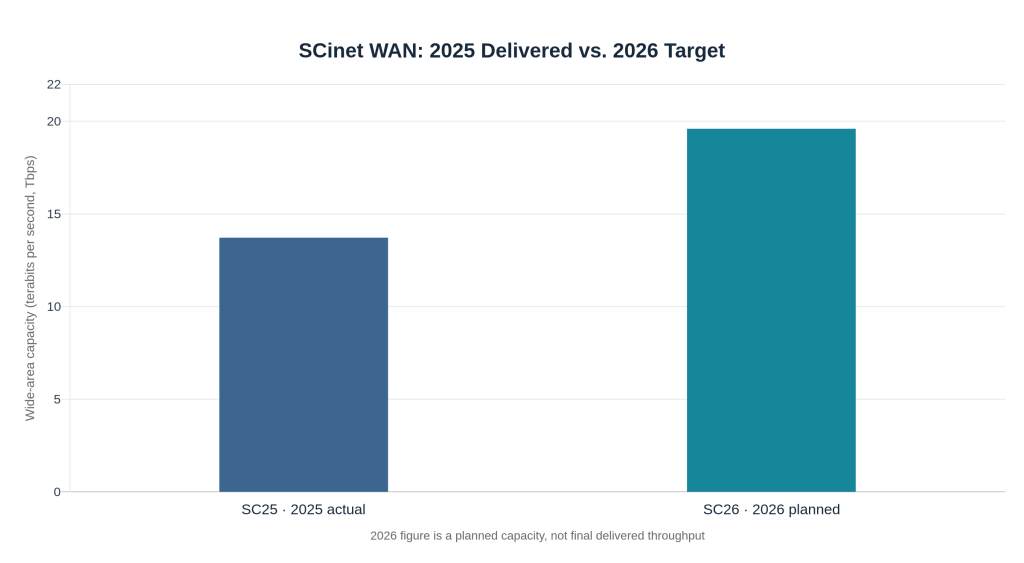
Internet2 expects to contribute 7.6 Tbps, or approximately 38.8% of the planned total. Its breakdown includes 1.6 Tbps for conference connectivity and another 6 Tbps across six research paths. Each circuit still has its own endpoints, congestion behavior and achievable rate. Summing port capacities does not make any single download travel at 19.6 Tbps.
NANOG’s June 19, 2025 presentation by Internet2 engineer Annalicia Duran and TACC engineer Corey Eichelberger explains SCinet volunteer work and deployment challenges. An archival engineering talk about SC25, not SC26 performance footage.
Why researchers need the temporary network
Scientific workflows move large simulation outputs, telescope observations and instrument measurements between institutions. The SC26 Network Research Exhibition includes high-capacity optical trials, packet-marking experiments and a Chicago-area quantum-key-distribution demonstration. The network offers researchers access to equipment and interconnections that are difficult to coordinate across ordinary production networks.
Our earlier report on Ciena and Internet2’s 800G optical link describes a separate long-distance transmission test. The Chicago-to-Europe quantum-safe demonstration examines cryptographic interoperability, while the optical transceiver guide explains modules moving the bits. Coverage of Lambda’s GPU networking illustrates comparable pressure inside AI computing facilities.
What would count as a record?
A confirmed final SC26 network capacity figure, measured utilization, packet-loss results and documented end-to-end benchmarks would answer different questions. Organizers’ 19.6 Tbps plan shows the scale of the installation, while the ultimate achievement remains dependent on testing and operation. Another enduring result is practical experience: engineers return to research networks and data centers with lessons in optical cabling, change control and automated infrastructure deployment.
Reporting sources and limitations
- Internet2, November 9, 2026, planned SC26 capacity, contribution breakdown and research applications.
- SC Conference SCinet history, delivered 2025 capacity and historical operations.
- University of Illinois, November 2026, volunteer counts and engineering timetable.
- Network to Code, 2026, Nautobot and network automation workflow.
Reporting note: The featured cinematic-anime illustration depicts an imagined technician, not an identifiable SCinet participant. Both independently located videos predate SC26’s November operation. The chart uses official reported and planned capacity figures, not measured single-stream speed. A complete end-user video playback test was not performed.
Editor’s Note: We volunteer daily to ensure the credibility of the information on this platform is Verifiably True. If you would like to support to help further secure the integrity of our research initiatives, please scan the QR code below
BitcoinVersus.Tech provides technology journalism for informational purposes only; no engineering, investment or operational guarantee is implied.


Leave a Reply