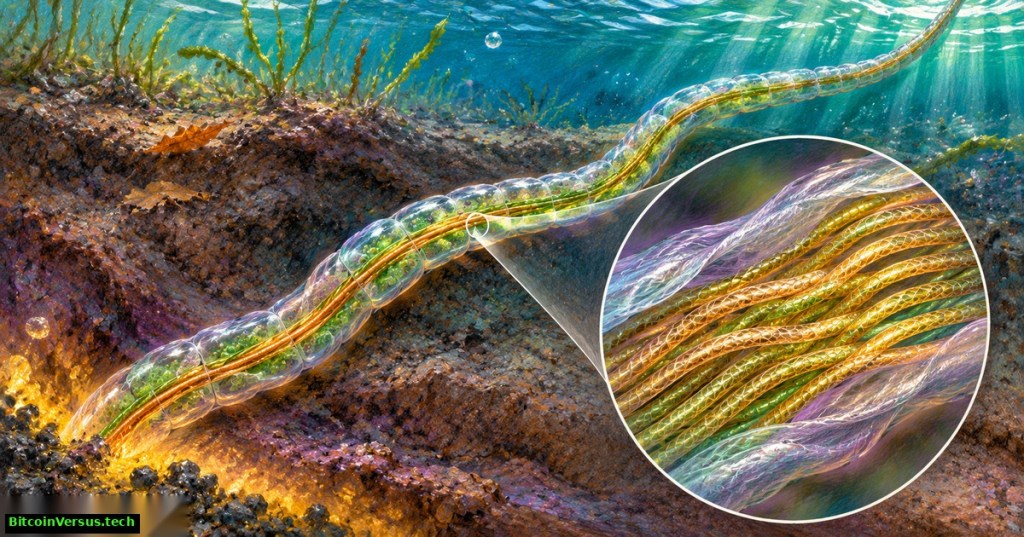
Scientists have discovered that microscopic bacteria can manufacture highly conductive nickel-organic wires inside their own bodies. The material belongs to a family called metal-organic frameworks, or MOFs, previously associated with engineered chemistry. An international team led by the University of Antwerp detailed the finding in a September 2026 Nature Communications study, with Britain’s Diamond Light Source publishing a new research highlight on November 17.
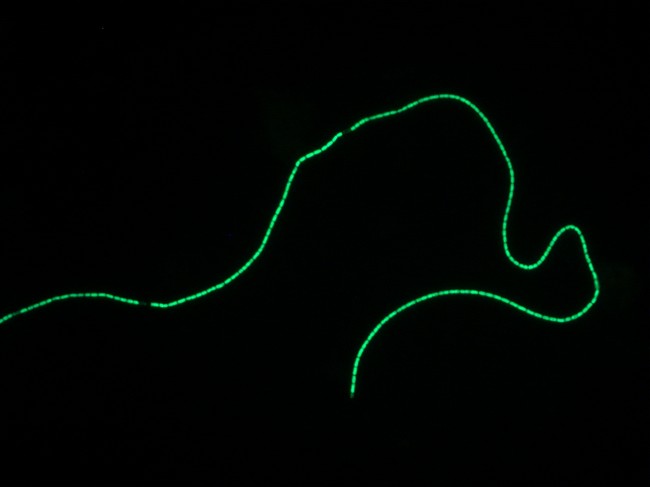
The organisms, known as cable bacteria, transport electrons across centimetres of underwater sediment. A typical filament contains 20 to 70 parallel conductive fibers, each around 50 nanometres wide. The microscopic cables are biological structures, not commercial power lines or a newly demonstrated electricity generator.
Research-related cable bacteria video published in 2019, explaining earlier evidence that the microorganisms conduct electricity over long distances. The molecular nickel-organic framework was identified in the newer 2026 study.
How bacteria move electricity through mud
Cable bacteria grow as long chains of cells in oxygen-poor lakebeds and coastal sediments. A cell deeper in the mud can transfer electrons from sulfide oxidation toward oxygen available nearer the surface. Conductive fibers connect neighboring cells, letting distant chemical reactions work together even when their reactants occupy different sediment layers.
For years, scientists understood the electrical behavior without fully knowing what carried the current. Earlier studies implicated a nickel-containing system, rather than the iron-based electron-transfer structures often found in biology. The newer research identifies an extended, ordered molecular network built within the bacterial cell envelope.
The discovery inside a 50-nanometre fiber
High-resolution electron microscopy revealed roughly 11 intertwined nanoribbons per fiber, each measuring about 1.4 nanometres across. Nickel atoms bond with sulfur-containing organic molecules called dithiolenes. Repeated nickel bis(dithiolene) units form a continuous framework, creating pathways where electrons can move along the ribbon network.
Researchers combined electron microscopy with Raman spectroscopy, computational modeling and synchrotron X-ray measurements. At the European Synchrotron Radiation Facility, a 35-nanometre X-ray beam mapped nickel-rich lines through multiple cell junctions. At Diamond Light Source, absorption measurements helped establish how nickel atoms are coordinated inside the material.
American Chemical Society’s October 2025 explainer on metal-organic frameworks, the subject of that year’s Nobel Prize in Chemistry. The educational video covers engineered MOFs, not the new bacterial sample.
How conductive are the natural wires?
Previous experiments measured whole bacterial fibers at approximately 5 to 500 siemens per centimetre (S/cm), according to the peer-reviewed paper. Accounting only for the much thinner conducting nanoribbon cross-section gives an estimated 150 to 15,000 S/cm. The higher interval is a geometric estimate, not a second directly measured conductivity range or a claim that bacteria outperform ordinary copper cables.
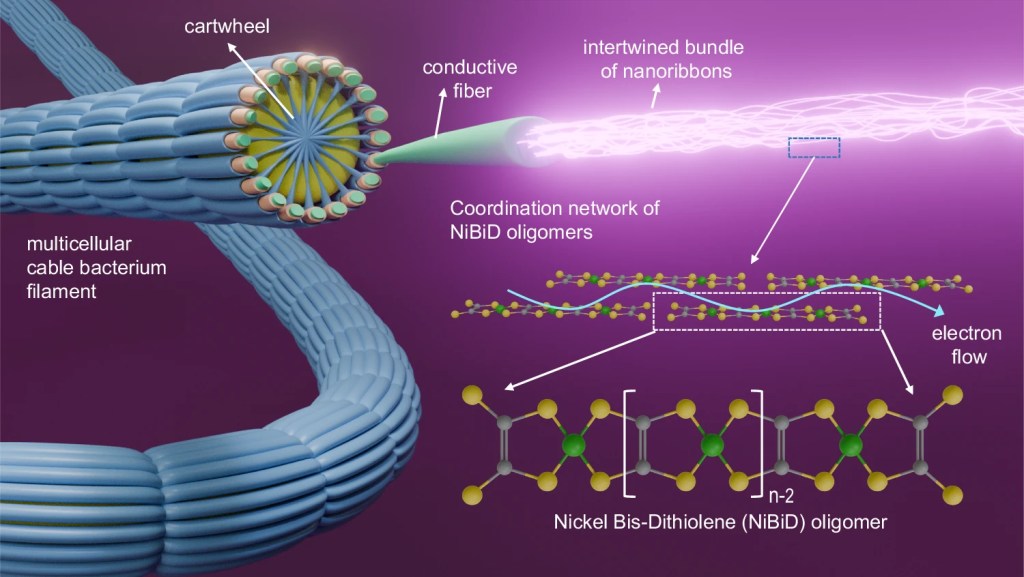
The proposed architecture resembles a flexible braided cable: several microscopic conductors share a protective protein sheath. That structure may let moving bacteria bend without losing electrical continuity. The European Synchrotron Radiation Facility’s report also describes copper-rich junctions joining neighboring fibers, further explaining the cellular electrical network.
Could living wires become electronics?
The research offers a potential design route for biodegradable sensors, conductive films and new metal-organic materials. Yet researchers have not demonstrated scalable manufacturing, commercial circuit integration, service life, stable electrical contacts or competitive costs. Living filaments require suitable biological conditions, and extracting their conductive structures creates additional engineering questions.
The findings complement recent copper MOF electronic materials research and industrial battery graphite production. They also illustrate the broader frontier between life and electronics, alongside a high-resolution bionic eye and computing systems built with living neurons.
The near-term advance is scientific: identifying how an organism assembles its own orderly, electrically functional material. Future commercial uses remain research possibilities, not production-ready devices.
Sources
- Nature Communications, September 2026: “Highly efficient long-range conduction through a biosynthetic nickel-organic framework”
- Diamond Light Source, November 17, 2026: “Scientists discover the first MOF made by nature”
- ESRF, September 28, 2026: imaging and conductivity methodology
- University of Antwerp: cable bacteria research program
- Chemistry World, October 22, 2026: independent scientific context
Editor’s Note: We volunteer daily to ensure the credibility of the information on this platform is Verifiably True. If you would like to support to help further secure the integrity of our research initiatives, please scan the QR code below

Verify the receiving address 3C9o19EH5HSiwEPyCTmEKzxhNCbo2X6TTb before sending Bitcoin. Mobile readers may open the article on another display to scan the QR code.
BitcoinVersus.Tech covers scientific research and emerging technology for informational purposes. Research-stage materials and inferred conductivity values do not establish product availability or commercial performance.


Leave a Reply