
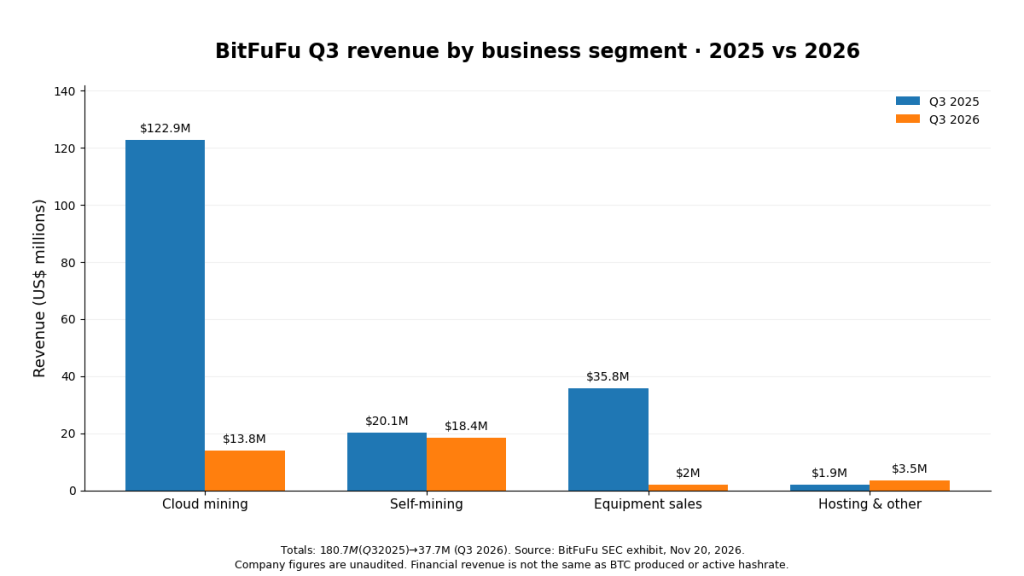
Bitcoin mining company BitFuFu reported a 79.1% decline in third-quarter revenue, even as its own miners produced nearly half again as much Bitcoin. In unaudited results released November 20, 2026, the company reported $37.7 million in revenue for the three months ended September 30, down from $180.7 million in Q3 2025. Self-mining output, however, increased from 174 to 258 BTC, a 48.3% gain.
The gap reveals a fundamental difference between running mining equipment and selling access to mining capacity. BitFuFu operates its own machines, rents hashrate through cloud-mining contracts, sells ASIC hardware and hosts machines for customers. Weakness in the last three lines can overwhelm an increase in Bitcoin produced by its own fleet.
Blockspace / The Mining Pod interview, March 18, 2025. BitFuFu investor relations executive Charlie Brady explains cloud-mining contracts, hosting and power sourcing. Historical background, not footage from the November 2026 earnings announcement.
Cloud contracts fell far faster than Bitcoin production
Cloud Mining Solutions revenue shrank from $122.9 million to $13.8 million, an 88.8% decline. Equipment sales fell from $35.8 million to $2.0 million. Self-mining revenue declined more modestly, from $20.1 million to $18.4 million, despite producing additional BTC. Hosting and other revenue rose from $1.9 million to $3.5 million.
BitFuFu attributed the revenue contraction to weaker cloud-mining demand, lower selling prices and a 38.0% fall in average Bitcoin prices compared with Q3 2025. The company reported average BTC prices of approximately $71,000 versus $114,500 a year earlier. More hashes and more mined coins do not guarantee higher dollar revenue.
Managed hashrate is not measured active output
The company reported 19.4 EH/s under management as of September 30, versus 36.0 EH/s one year earlier, a 46.1% reduction. Available power capacity also fell from 624 MW to 324 MW. Its hashrate definition includes energized machines that may be temporarily offline and uses manufacturer specifications, so it is not a measurement of continuously delivered pool-side work.
Meanwhile, average hashrate allocated specifically to self-mining increased 50.9%, helping explain the 258 BTC production figure. Cloud-mining customers produced only 195 BTC during Q3 2026, compared with 1,033 BTC in Q3 2025. The two populations should not be combined and called company-owned mining output.
New to The Street TV, October 9, 2025. BitFuFu investor relations executive Charley Brady discusses cloud mining and self-mining economics. The interview predates the Q3 2026 results.
Why reported net income still increased
BitFuFu also reported $24.9 million in net income, up from $11.6 million, despite a $2.0 million gap between revenue and cost of revenue. A major factor was a $36.5 million fair-value gain related to digital assets and associated balances, compared with $10.0 million a year earlier. Accounting valuation gains should not be mistaken for cash generated by operating ASICs.
The company reported a $2.05 million credit-loss provision related to its pending Ethiopia mining acquisition. Earlier reporting documented the acquisition risk, while BitFuFu separately addressed Ethiopia power restrictions. Both issues remain relevant to capacity planning.
The mining hardware question
BitFuFu says it deployed newer S21 XP miners while adjusting equipment utilization and power sourcing. Its earlier October fleet-efficiency report supplies a later operating snapshot, not a substitute for quarter-end financial figures. Rival miners also face ASIC equipment demand pressure.
The wider network’s November difficulty reduction improved expected BTC earned per unit of work under otherwise unchanged conditions, but future profitability still depends on energy rates, machine efficiency, uptime and BTC prices.
BitFuFu’s report demonstrates why hardware productivity, customer contract sales, financial accounting and power availability must be examined separately. A stronger own-mining fleet cannot by itself replace disappearing third-party cloud contracts.
Sources and documentation
- BitFuFu November 20, 2026 unaudited Q3 results, SEC Exhibit 99.1
- BitFuFu original corporate earnings release, November 20, 2026
- BitFuFu October 2026 operations update, SEC exhibit
- BitFuFu corporate operations and mining-service overview
- Blockspace / The Mining Pod, Charlie Brady interview, March 18, 2025
- New to The Street TV, BitFuFu cloud mining interview, October 9, 2025
Editor’s Note: We volunteer daily to ensure the credibility of the information on this platform is Verifiably True. If you would like to support to help further secure the integrity of our research initiative, please scan the QR code below

For mobile scanning, open the article on another display and scan the QR code with a Bitcoin wallet. The voluntary donation amount is 5,000 sats. Verify the receiving address 3C9o19EH5HSiwEPyCTmEKzxhNCbo2X6TTb before sending.
BitcoinVersus.Tech publishes technology and financial journalism for informational purposes and does not provide financial, investment, or legal advice.


Leave a Reply