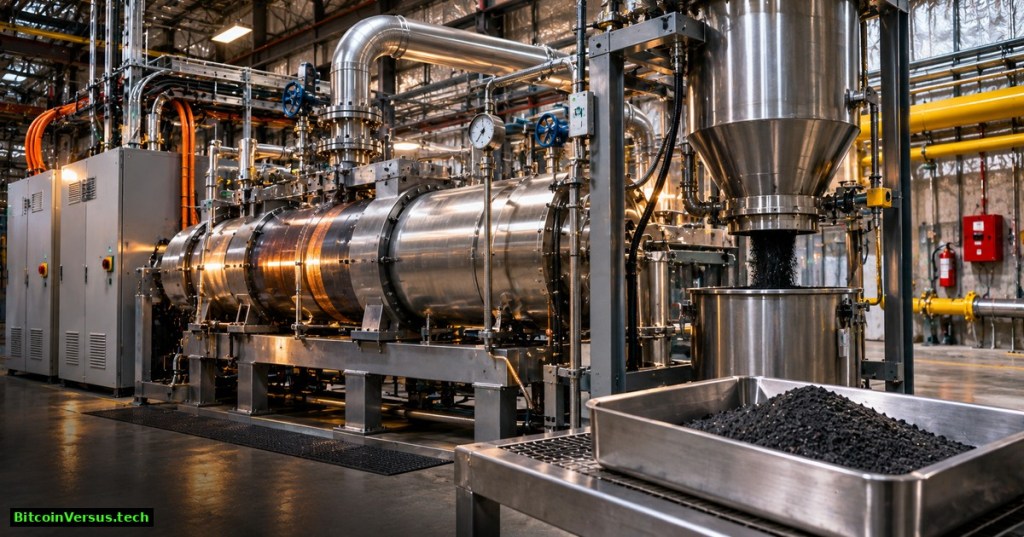
Molten Industries has begun operating a demonstration plant in Oakland, California, that transforms natural gas into battery-grade graphite and hydrogen. Announced November 18, 2026, the site uses a modular reactor rated for 300 metric tons of graphite anode material per year. Molten calls it the first operating plant of its kind.
Graphite is the dominant conventional anode material in lithium-ion batteries. Molten hopes to make it without mining graphite ore or processing petroleum coke in a lengthy, high-temperature graphitization furnace. The company says the Oakland plant is already running, but 300 tons represents annual production capacity, not independently audited output.
Fifty Years, August 6, 2025. Molten co-founders Caleb Boyd and Kevin Bush explain how their original hydrogen project developed into graphite production. The interview predates the 2026 plant.
How natural gas becomes graphite
Methane pyrolysis uses heat to split methane, the major constituent of natural gas, into solid carbon and hydrogen. Its ideal chemical balance is CH₄ + heat → C + 2H₂. Electricity heats the reactor without introducing oxygen for combustion. Carbon then requires appropriate particle formation and refinement to meet the specifications of battery makers.
Molten claims its process avoids a separate graphitization furnace and requires about 4.5 kilowatt-hours of electricity per kilogram of graphite, roughly one-third of conventional production by the company’s comparison. The announcement did not include an independently audited energy balance that would establish the result across a complete commercial supply chain.
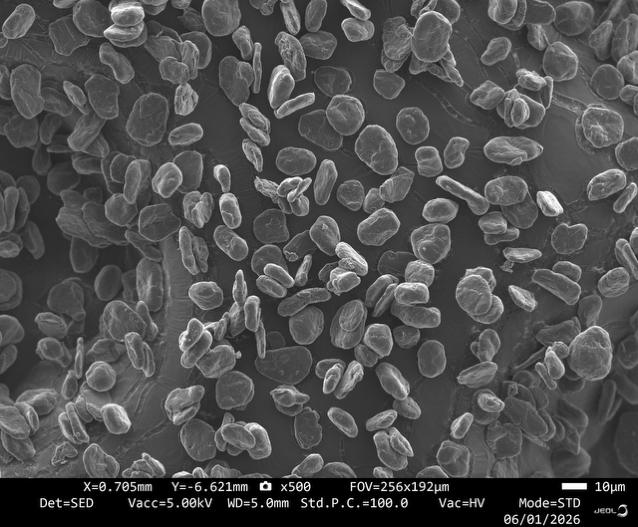
A working reactor is an important first step
Molten reports natural-gas-to-graphite yields above 95% and says hydrogen is collected as a coproduct. Samples of its MG Series battery material are expected to become available December 1, 2026. Meaningful independent tests must still confirm sustained output, purity, electrode performance, maintenance requirements and actual delivered costs.
Methane splitting produces no direct carbon dioxide from the reaction when oxygen is excluded. Zero direct reaction CO₂ does not equal zero lifecycle emissions. Natural gas extraction and transport can leak methane; purchased electricity and other plant processes also have environmental impacts. Customers need verified measurements for meaningful comparisons.
Next Unicorn, June 24, 2023. Molten co-founder Caleb Boyd discusses early hydrogen technology and industrial scaling. The video is historical context, not coverage of the 2026 commissioning.
Why American battery makers are watching
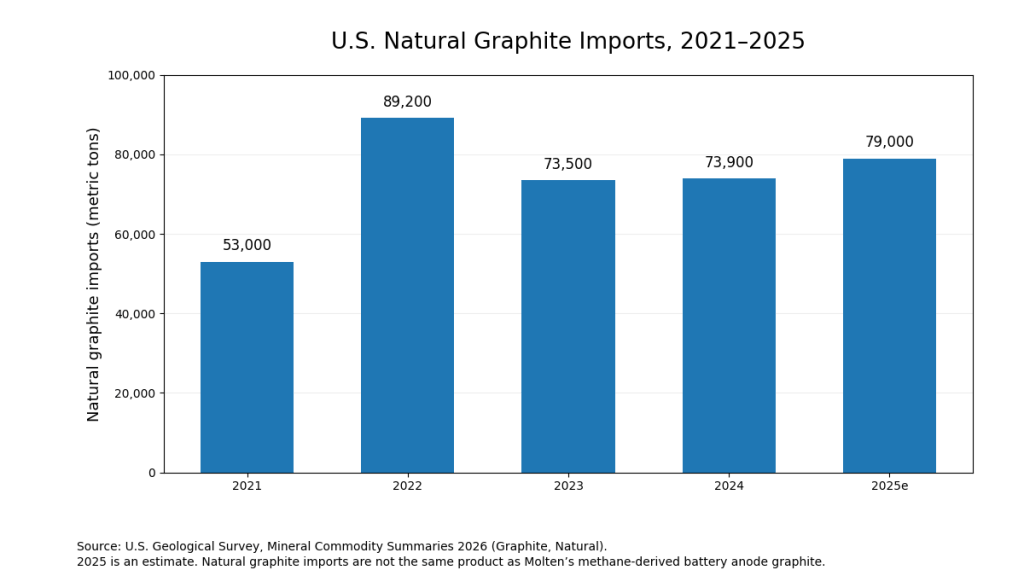
The United States imported an estimated 79,000 metric tons of natural graphite in 2025, according to the U.S. Geological Survey, up from 53,000 in 2021. No natural graphite was mined domestically in 2025. Mining and processing remain different operations, and USGS natural graphite imports are not directly comparable to Molten’s manufactured battery-anode output.
In March, POSCO Future M announced a development agreement with Molten to process methane-derived graphite into battery materials. Competition remains active. Talga has reported long-cycle graphite tests, while Sila is advancing silicon-rich anodes. Different chemistries and test conditions make direct cycle-life rankings unreliable.
What comes after the announcement
Battery manufacturers require uniform particle size, chemical purity, efficient coating, charge retention, predictable supply and traceable product specifications. Other graphite-growth experiments show how many methods remain in development, while battery health research demonstrates the importance of testing across time.
The milestone is a commissioned demonstration plant, not proof of universal cost parity or a fully scaled supply chain. Sustained operating records, independent lifecycle analysis and qualified customer orders will determine whether methane-derived graphite becomes a substantial domestic battery material.
Sources and documentation
- Molten Industries company announcement, November 18, 2026
- Molten Industries technology and Oakland facility
- Molten Industries graphite product specifications
- TechCrunch interviews Molten founders, November 18, 2026
- POSCO Future M announcement, March 26, 2026
- USGS Mineral Commodity Summaries 2026, Graphite (Natural)
- Fifty Years interview, August 2025
- Next Unicorn interview, June 2023
Editor’s Note: We volunteer daily to ensure the credibility of the information on this platform is Verifiably True. If you would like to support to help further secure the integrity of our research initiative, please scan the QR code below

For mobile scanning, open the article on another display and scan the QR code with a Bitcoin wallet. The voluntary donation amount is 5,000 sats. Verify the receiving address 3C9o19EH5HSiwEPyCTmEKzxhNCbo2X6TTb before sending.
BitcoinVersus.Tech publishes technology and financial journalism for informational purposes and does not provide financial, investment, or legal advice.


Leave a Reply