A compact artificial-intelligence model trained to adjust analog circuits has achieved an 87.1% success rate on a defined engineering benchmark, according to new research from MIT, IBM Research and Analog Devices. MIT announced the work on November 23, 2026, after the authors posted their SLIC paper on November 10. The result raises a practical question for semiconductor teams: how much design work can a small, local model accomplish with simulator feedback?
SLIC, short for Small LM Iterating on Circuits, trains a 4-billion-parameter language model to improve existing amplifier designs. The researcher-hosted interactive project page includes recorded circuit-optimization cases and transistor-level schematics. Those demonstrations document simulated optimization, not fabricated chips or production deployment.
A circuit simulator becomes the AI’s teacher
An analog amplifier must meet several competing targets at once. Raising gain can affect bandwidth, power consumption and stability. SLIC accepts a circuit topology, component parameters and engineering requirements, proposes numerical changes, then runs simulations to measure the resulting circuit. Feedback from each attempt guides the next adjustment.
The training method combines demonstrations with reinforcement fine-tuning and simulator-verified rewards. A successful benchmark task must satisfy four specifications together: voltage gain, −3 dB bandwidth, power and phase margin. A single improved metric is insufficient. The reported Pass@1 results evaluate whether one optimization trajectory meets the test’s criteria within a specified budget of simulation turns.
Researchers trained the model using open-source 65-nanometer CMOS predictive technology models. Their 41-topology benchmark separates 35 circuit families represented during training from six held-out families. The model optimizes component values within supplied connectivity; it does not autonomously invent an entire semiconductor architecture, perform physical placement or manufacture a chip.
What the 87.1% benchmark really measures
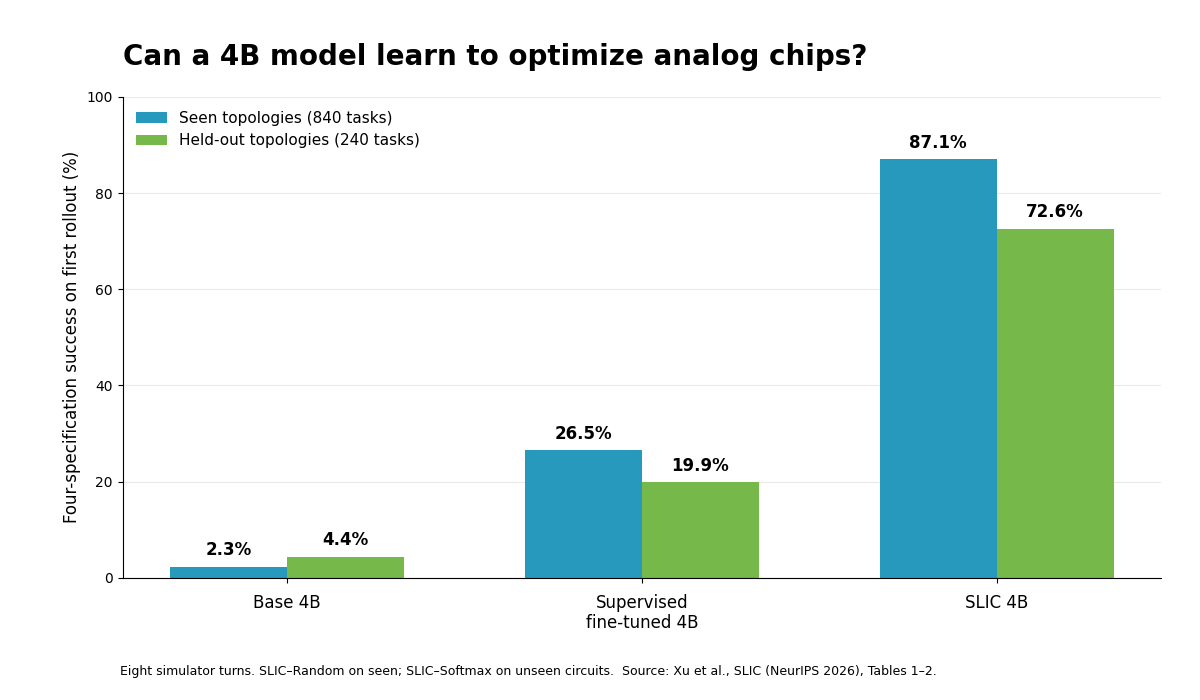
Across 840 in-distribution tasks, SLIC–Random passed 87.1%, compared with 26.5% for a conventionally supervised fine-tuned 4B model and 2.3% for the untuned base model. The improvement over supervised fine-tuning equals 60.6 percentage points. For 240 tasks involving unseen circuit topologies, SLIC–Softmax achieved 72.6%, versus 19.9% for supervised fine-tuning.
The team also evaluated transfer between semiconductor process models. On a commercial TSMC 65 nm process design kit, SLIC–Random recorded 49.9% success on held-out circuit topologies without further fine-tuning. Allowing as many as 32 simulator turns raised reported held-out success to as much as 83.2% under the study’s test settings. The eight-turn and 32-turn percentages do not share an identical computation budget.
Why local chip-design AI matters
A foundry’s process design kit may contain confidential transistor models, manufacturing design rules and device characterization. Running a specialized model on local hardware could reduce dependence on transmitting sensitive parameters to hosted services. The researchers describe laptop-scale inference, but the paper does not establish a universal energy-saving figure or guarantee confidentiality in every implementation.
Analog engineering intersects several areas already covered by BitcoinVersus.Tech: advanced chip packaging for data centers, integrated optical amplification, signal integrity in circuit boards and hardware-level security using photonic chips. Better analog blocks could eventually improve sensor interfaces, radios and power-management systems, although no product-level efficiency gain has been proven by the SLIC benchmarks.
Engineering verdict and primary evidence
SLIC is an experimental design-optimization method with an accessible benchmark, open-source code and recorded demonstration trajectories. Independent hardware measurements, manufacturing yield, design-rule verification and comparisons of engineering labor remain important before claiming a commercial breakthrough. The immediate result is narrower and more useful: a small model learned an iterative circuit-design procedure that transferred beyond its training cases.
- MIT News, November 23, 2026: institutional research announcement
- Xu et al., SLIC, submitted November 10, 2026; accepted to NeurIPS 2026
- Official project, benchmarks and recorded circuit demonstrations
- Research implementation and evaluation materials
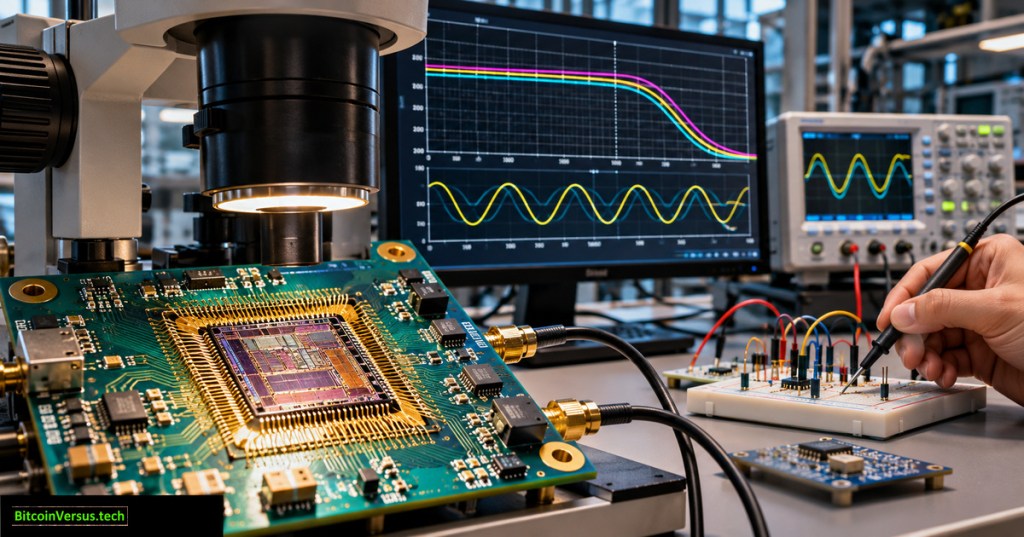
Media disclosure: The featured 1200 × 630 photograph-style image is an original conceptual illustration, not documentation of a fabricated MIT SLIC chip. The established BitcoinVersus.tech watermark pixels were reused once at bottom-left. The in-article benchmark is a data visualization based on the authors’ figures. No unrelated or unverified video embed was included.
We volunteer daily to ensure the credibility of the information on this platform is Verifiably True. If you would like to support to help further secure the integrity of our research initiative, please scan the QR code below.



Leave a Reply