
A silicon chip designed to process light could also identify itself through tiny imperfections left by manufacturing. In a November 19, 2026 preprint, researchers from Spain’s Universitat Politècnica de València and University of Vigo reported generating 1,107-bit hardware fingerprints from programmable photonic processors. Instead of storing an identity code in nonvolatile memory, the experimental system measures how each device responds to carefully selected optical inputs. Two nominally identical chips produced distinguishable responses. The findings remain laboratory research, not a certified commercial security product.
A September 2026 educational presentation explains physical unclonable functions and device identity. Background material, not footage of the new photonic experiment. Watch directly on YouTube.
How light turns manufacturing flaws into identity
A physical unclonable function, or PUF, exploits fabrication variations that are difficult to duplicate precisely. A verifier supplies a challenge, and a device produces a characteristic response. In the new experiment, a laser enters a silicon photonic mesh containing 72 tunable Mach–Zehnder interferometers and 28 peripheral optical ports. Imperfect waveguides, couplers and detectors change how light travels through the network, giving each manufactured unit a distinctive signature.
But the researchers encountered a problem: random settings allowed most light to escape along short routes, leaving distant optical ports starved of useful signal. Their solution, called Isotropic Ring routing, first sends light toward the mesh center and then distributes it outward. The revised pathway suppresses a 14.7-decibel distance-related power drop, while mean response entropy rose from 1.95 to 3.48 bits, an increase of approximately 78%. The gain came from programming the existing hardware rather than fabricating a different chip.
Where the 1,107 bits come from
For the larger fingerprint, the team swept the laser across 168 closely spaced wavelengths near 1,550 nanometers. They analyzed the spectrum at 27 output ports and extracted 41 bits from each port. Multiplying 27 × 41 yields 1,107 raw response bits per challenge. The reported average Hamming distance between fingerprints from separate chips was 50.0%, while changing the challenge on one chip produced 49.8% distance. Both values are close to the 50% separation expected for uncorrelated binary strings.
Reliability is a different question. Repeated readings of the same device differed by 4.9% on average, with a larger maximum variation in the reported tests. Consequently, 1,107 measured bits do not automatically constitute a stable 1,107-bit cryptographic key or 1,107 bits of proven security strength. Error correction, secure challenge management and protection against modelling attacks would still be necessary before deployment.
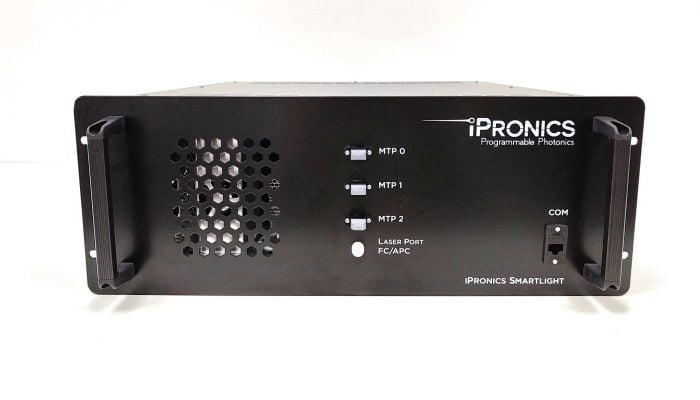
An earlier iPronics SmartLight technical presentation explains reprogrammable photonic hardware. Product background, not an independent review of the November 2026 preprint. Watch directly on YouTube.
What makes the result relevant to infrastructure
Programmable photonic circuits already have uses in optical signal processing, communications and computing. A single processor that also supports device authentication could eventually help verify replacement hardware in sensitive optical networks or AI data centers. Related BitcoinVersus.Tech reporting covers hardware roots of trust using quantum entropy and BTQ’s separate cryptographic-chip development. Neither approach is equivalent to a photonic PUF.
For optical context, our articles on NIST’s chip-scale frequency comb and 775 Gb/s scientific file transfers illustrate different uses of light-based hardware. Photonic authentication protects identity; it does not itself accelerate storage transfers or Bitcoin hashing.
The experiment is promising, not a security certification
Only two independently fabricated processors were assessed in the published demonstration. Larger device populations, temperature variation, aging, calibration drift, manufacturing reproducibility and adversarial testing remain open deployment questions. A separate 2026 security assessment found that some simulated optical PUF designs could be modelled after relatively few observed challenge-response pairs, reinforcing the need for architecture-specific attack testing. The next milestone is not merely a longer fingerprint, but repeatable authentication that remains secure against realistic attackers.
Primary documentation: Arnal Martínez and colleagues, preprint submitted November 19, 2026; 2026 security assessment of photonic PUFs; iPronics SmartLight hardware background.
We volunteer daily to ensure the credibility of the information on this platform is Verifiably True. If you would like to support to help further secure the integrity of our research initiative, please scan the QR code below.



Leave a Reply