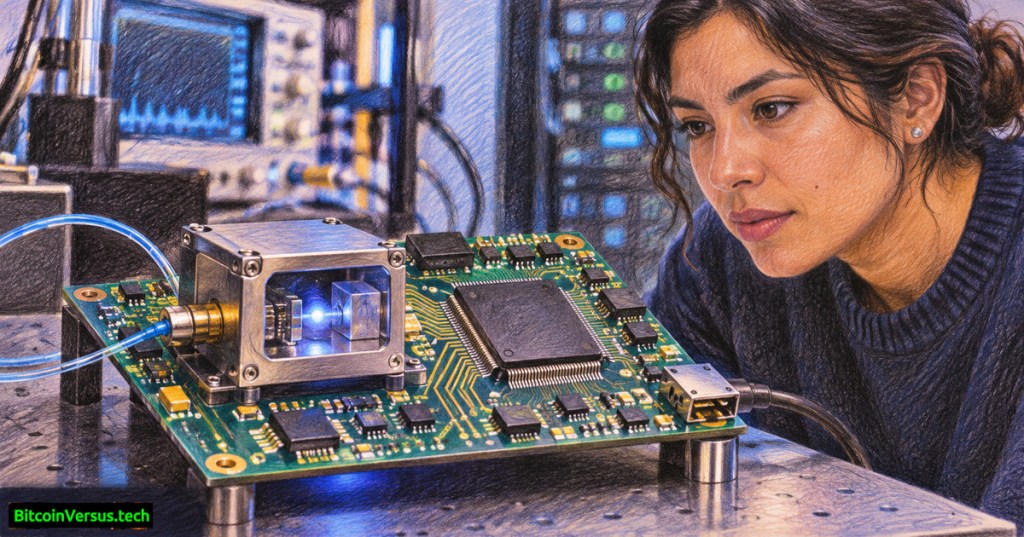
A small quantum-randomness module may play a critical role in securing future servers. On October 21, 2026, Lattice Semiconductor’s official video library listed a demonstration integrating a Quside verified quantum entropy source with a Lattice hardware root of trust. The engineering goal is to make unpredictable bits used to create cryptographic secrets measurable and trustworthy before relying on them to secure firmware, identities, and communications.
The demonstration is not a quantum computer or proof that a server cannot be hacked. It is a hardware-security integration focused on the quality of a cryptographic building block often hidden from users.
Open Compute Project, October 2025: technical QRNG/root-of-trust background. Watch on YouTube if embedded playback is blocked.
Why randomness matters
Every server needs secret keys for authenticated boot, encrypted communications, and device identity. A cryptographic pseudorandom generator can stretch a secret seed into a long sequence of bits, but predictable seed material undermines every key derived from it. Photonic quantum random number generators, or QRNGs, measure physical quantum processes to provide an entropy source.
Quside’s approach adds monitoring at the source. The company calls the method Locally Verified Entropy. A data stream passing visual or statistical randomness tests does not establish unpredictability. Metrology, hardware health checks, correct integration, and independent assessment still matter, as explored in BitcoinVersus.tech’s guide to hardware security modules.
A photonic source beside programmable security hardware
A hardware root of trust is a trusted starting point for authenticating firmware and establishing device identity. FPGA-based logic can handle verification and platform-control functions while an entropy component supplies random material for cryptographic key generation. Quside earlier described an Onyx module combining its Ruby S1 device with Lattice hardware, citing a 50 Mbit/s entropy-generation rate for Ruby S1. The supplier figure is not an independently measured end-to-end rate for the newer demonstration.
Strong randomness and post-quantum cryptography defend against different weaknesses. ML-KEM establishes shared secrets; ML-DSA authenticates digital signatures. Lattice separately demonstrated those algorithms on Mach-N2 devices in its October catalog. A strong entropy source cannot repair defective signature code, and quantum-resistant mathematics cannot rescue predictable keys. Earlier reporting covers Lattice’s post-quantum security FPGA and another quantum-security chip undergoing external audit.
Lattice Semiconductor, July 2026: AI data-center control-plane security seminar. Watch on YouTube if embedded playback is blocked.
What the October demonstration does and does not prove
The publicly listed October demonstration shows system integration, not an independently audited deployment across a large server fleet. Published materials provide no comprehensive field statistics proving fewer attacks, shorter startup time, or lower key-management failure rates. Operators evaluating similar designs should ask for measured entropy under voltage and temperature changes, fault-handling behavior, verifiable firmware updates, secure provisioning, key rotation, and external audit findings.
Those checks become important when thousands of management controllers, switches, and accelerator hosts share an AI data-center fabric. Identity and custody of secrets can become operational bottlenecks even with strong cryptographic algorithms. Cloudflare’s recently described post-quantum geographic key controls demonstrate a complementary problem: governing where a secret may operate after generation.
The bigger picture
Verifiable entropy is moving from an invisible chip function toward a measurable infrastructure component. Random photons do not independently make a machine secure. The opportunity is to combine monitored, unpredictable input with strong cryptographic algorithms, protected firmware, clear recovery procedures, and accountable device management. Success at commercial scale will depend on integration costs and independent validation, not a compelling demo alone.
Primary sources: Lattice’s October 21, 2026, demonstration catalog; Quside’s Onyx architecture overview; Quside’s November 4 entropy analysis. Supplier claims are distinguished from independently verified performance.
We volunteer daily to ensure the credibility of the information on this platform is Verifiably True. If you would like to support to help further secure the integrity of our research initiative, please scan the QR code below.



Leave a Reply