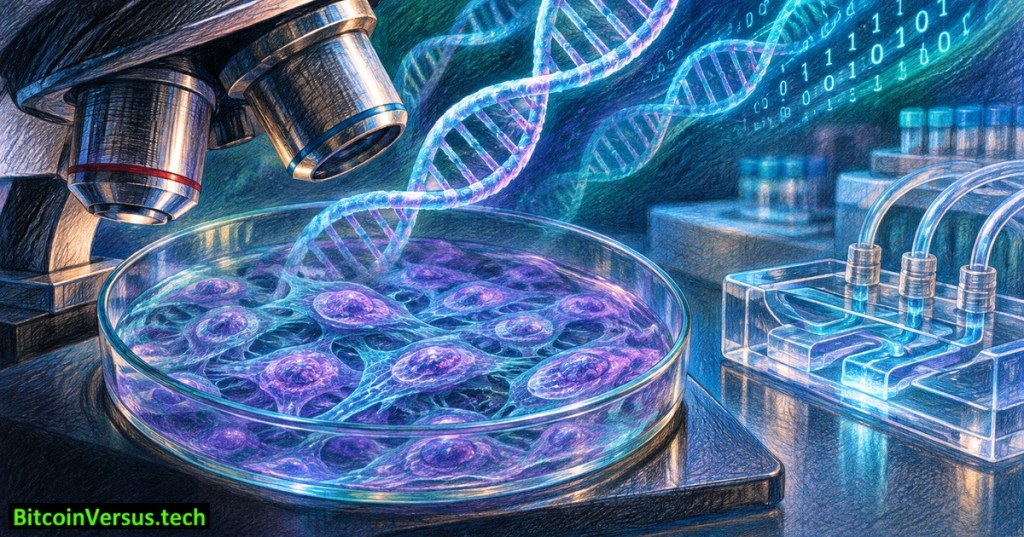
What if a manufactured cell could carry its own digital history, even after moving between laboratories? Researchers from the University of Texas at Dallas and collaborators report a way to store short messages inside the DNA of cultured human cells and distribute the information across multiple cell populations. Their peer-reviewed October 21, 2026 paper in Nature Communications describes DNA CODEC, an experimental approach to biological data storage. The demonstration is real; a practical, secure cellular archive remains a research goal.
University of Washington researchers explain the wider DNA-archiving field in a 2026 educational video. Background footage, not a recording of the DNA CODEC experiment. Watch on YouTube.
The memory is inside the genome
Digital storage normally treats zeroes and ones as electrical or magnetic states. DNA offers a different alphabet: the chemical bases A, C, G and T. DNA CODEC converts text into a sequence of biological symbols using a variant of Huffman coding, a compression method that gives common characters shorter codes. It also uses six ambiguous symbols that can represent pairs of bases across a population of DNA molecules, rather than pretending every symbol occupies one identical molecule.
Researchers then used CRISPR-based targeted integration to place encoded fragments into the AAVS1 locus in laboratory-cultured HEK293 human cells. Four engineered cell populations carried different parts of the data and its mask. Crucially, no information was implanted into a person. The first reported demonstration encoded 272 characters in a 376-base-pair payload; a longer trial represented 907 characters in 1,309 base pairs. Those are small messages, not gigabyte-scale files.
Why divide a message among living cells?
The technique is more than a miniature filing cabinet. Two cell populations hold payload components while others contribute masking sequences. A researcher with only the pooled genetic reads may see ambiguous base patterns. Separating the correct payload from the masking information requires additional knowledge of the encoding and population arrangement. The idea resembles a physical access-control layer: useful information can travel with a specimen while selected decoding details remain elsewhere.
Yet obfuscation is not the same as validated encryption. The research describes large theoretical search spaces, but it does not establish real-world resistance against every attacker. The authors acknowledge that their masking procedure alone cannot guarantee security. Anyone considering medical records or proprietary manufacturing data would still need conventional security controls, a defined threat model, and independent testing.
An earlier University of Washington video introduces DNA as an archival medium. Historical context; the 2026 DNA CODEC study used cultured human cells, a different architecture. Watch on YouTube.
Can living cells actually preserve the bits?
The team’s stronger result concerns persistence and retrieval. After multiple laboratory culture passages, the encoded sequence remained recoverable. In a subsampling analysis, roughly 50 sequencing reads were sufficient to reconstruct the shorter payload without error under the specified threshold; the longer message required substantially deeper sequencing. The performance depends on sampling, read quality and the specific experimental design. No full production system, long-duration storage guarantee, or commercial cost benchmark was demonstrated.
A fundamental scaling challenge follows: longer payloads demand greater sequencing depth, while biological replication and mutations introduce additional uncertainty. DNA synthesis, targeted gene editing, cell culture, sequencing and error correction all carry real costs. A biological memory system cannot be described as zero-energy storage simply because DNA molecules retain sequence information between reads.
A future identity card for biological products?
A nearer-term application may be provenance embedded within engineered cells. A cell bank could theoretically preserve an identifier, manufacturing batch history or authorized version metadata in the biological product itself. Data-center replacement is a much larger leap, requiring high-capacity write and read operations, reliability standards, secure key management and lifecycle economics far beyond the reported cell-culture test.
Related BitcoinVersus.Tech reporting explains how DNA sequencing works, why unintended CRISPR edits matter, AI tools for understanding genomes, and another experiment maintaining foreign DNA in mammalian cells. Those developments show separate ways computing and biology are converging, without proving one technology is ready to replace another.
The thought-provoking question is no longer only whether molecules can store data. Researchers can now ask when information becomes a durable, verifiable part of a biological product, who controls the instructions for reading it, and how reliably those instructions survive generations of cells.
Sources: Nature Communications, October 21, 2026; NIH PubMed research record; Microsoft Research DNA storage video archive. All numerical demonstrations are research results, not commercial capacity claims.
We volunteer daily to ensure the credibility of the information on this platform is Verifiably True. If you would like to support to help further secure the integrity of our research initiative, please scan the QR code below.


Leave a Reply