
An electric car pulls into a charging bay, parks and receives a connector from a robot. Nearby solar panels and stationary batteries help supply the electricity. The scene is no longer solely a concept: on November 8, 2026, BYD announced an integrated demonstration in the Abu Dhabi desert combining photovoltaic generation, storage, FLASH charging and automated plug-in equipment. BYD describes the combined installation as a first, although the company has not published enough site-level engineering data to independently benchmark the claim.
Official BYD video from March 23, 2026 explaining FLASH charging and the second-generation Blade Battery. The film predates the Abu Dhabi integrated demonstration; it should not be mistaken for footage of the desert installation. Watch on BYD’s YouTube channel.
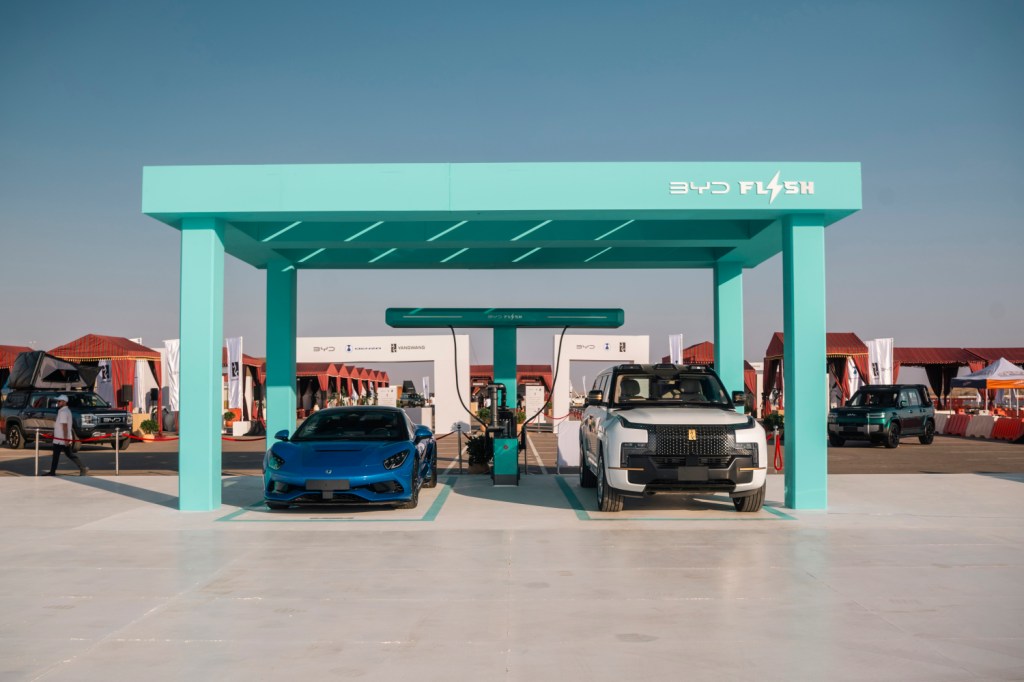
One station combines four engineering systems
The first component is a photovoltaic array producing electricity during daylight. A stationary energy-storage system can absorb generation and discharge it during a rapid vehicle-charging event. FLASH charging equipment converts and controls the high-power delivery to a compatible vehicle battery. Finally, a robotic arm positions the connector using camera guidance and force feedback. Automation extends to valet parking: BYD says a compatible car can drive into a designated bay after its occupants exit.
The battery is important because charging demand can spike much faster than sunshine changes. A stationary pack can buffer peak demand and reduce the instantaneous burden on the grid connection. BYD says its Solar-Storage-Charging architecture can support grid-independent operation, but has not disclosed the Abu Dhabi site’s solar-array rating, battery capacity, charging-bay count, measured electricity throughput or cost. Grid-independent capability should not be confused with independently verified, continuous off-grid operation.
A robot handles the physical charging plug
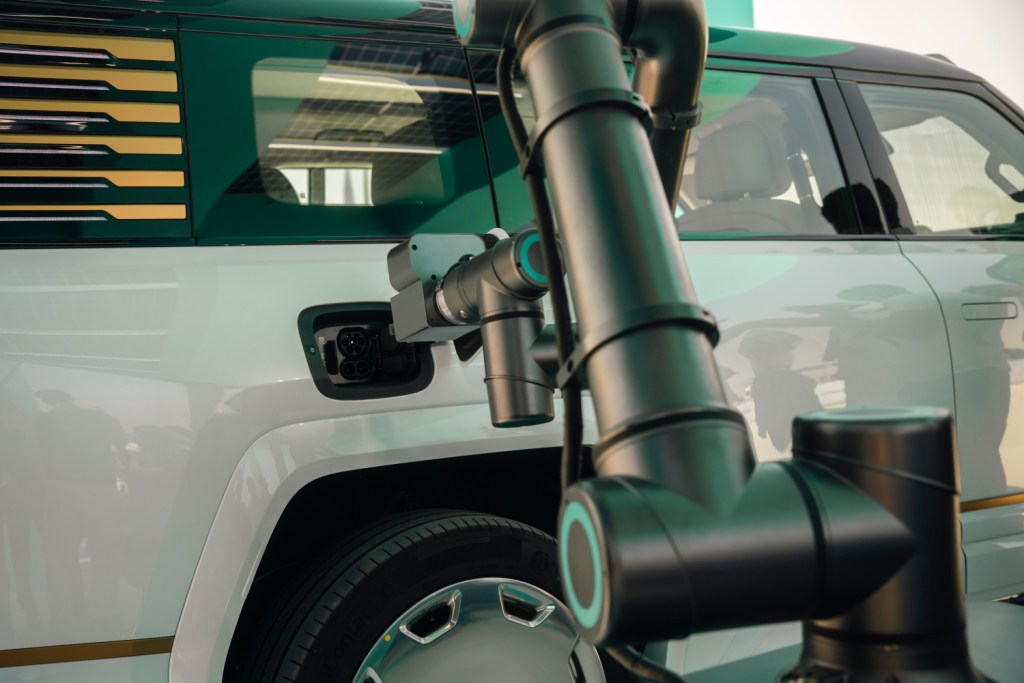
BYD’s description says the robot locates the charging port, opens its cover, aligns the cable and inserts the connector. Those steps require machine vision, controlled contact force and reliable communication with the car. A usable public system would additionally need safe stopping, human detection, fault recovery and compatibility across different charge-port positions. BYD did not provide an independently tested reliability rate, intervention count or commercial availability date for the robotic equipment.
Five-minute charging is a vehicle claim, not a site test
BYD advertises 10% to 70% charge in five minutes and 10% to 97% in nine minutes for compatible models using its latest FLASH charging technology. The company previously described a 1,500-kilowatt single-connector charger rating in its 2026 interim report. Equipment nameplate ratings, charging curves and actual power at the Abu Dhabi station are different measurements. No disclosed meter trace establishes a sustained 1,500 kW transfer at the desert installation.
An independent April 2026 Shenzhen dealership test by Wheelsboy demonstrates earlier FLASH charging behavior in a compatible vehicle. The testing location, vehicle and weather differ from Abu Dhabi; results cannot be used as the desert site’s acceptance test. Watch the field test on YouTube.
The 6,000-station target still needs delivery
BYD’s new announcement says it plans 6,000 FLASH charging stations worldwide by the end of 2027. The number is an expansion objective, not a verified count of installed stations, and the release does not say all 6,000 would include solar panels, storage and robotic arms. Earlier corporate materials cited separate domestic-network targets, so different announcements should not be added together as completed infrastructure.
The wider design challenge connects several recent BitcoinVersus.Tech reports: Honda’s road-embedded EV charging research, repurposed EV batteries for stationary storage, robotaxi fleet economics, and mobile charging infrastructure. Robots can eliminate a driver’s cable-handling step, but high power still requires electrical protection, thermal management and energy accounting.
The meaningful follow-up is measured vehicle energy delivered, peak grid draw, storage cycling, charging uptime and robotic connection success across multiple vehicles. Until those results are disclosed, the Abu Dhabi installation is a promising integrated demonstration rather than proof of a universally deployable, self-powered charging network.
Sources: BYD press announcement, November 8, 2026; BYD 2026 interim report, FLASH charger specification; Electrive’s November 10 coverage. All deployment targets and performance claims are attributed to the company unless independently established.
We volunteer daily to ensure the credibility of the information on this platform is Verifiably True. If you would like to support to help further secure the integrity of our research initiative, please scan the QR code below.



Leave a Reply