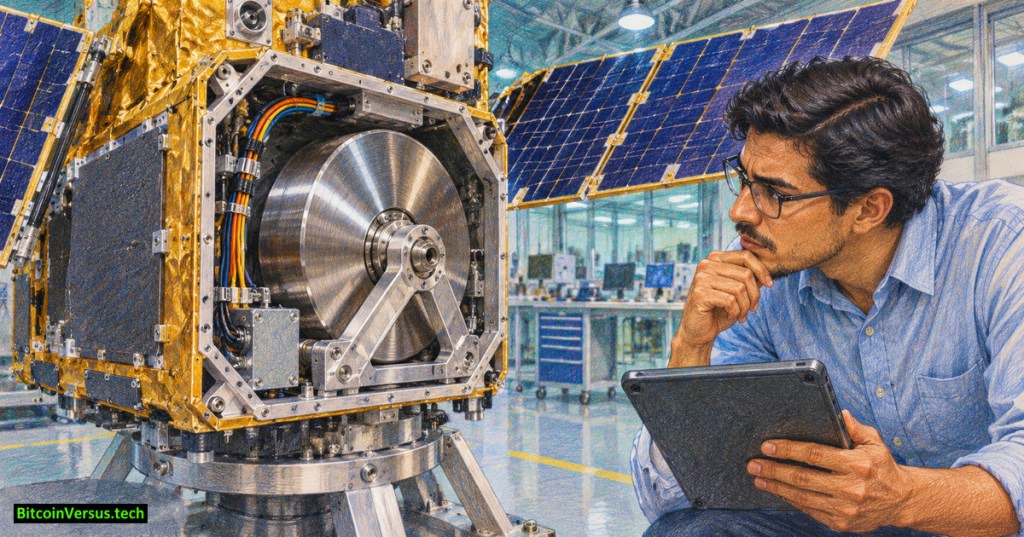
Reaction wheels are electrically driven flywheels that turn a spacecraft without expelling propellant. Used for satellite attitude control, they orient cameras, antennas and solar arrays while leaving the craft’s center-of-mass orbit essentially unchanged. The governing mechanism is angular-momentum conservation, not aerodynamic steering. NASA’s 2026 small-satellite engineering review identifies reaction wheels as a principal method of precision, three-axis pointing.
| Device class | Spacecraft attitude-control actuator |
|---|---|
| Physical principle | Conservation of angular momentum |
| Power source | Electric motor, often powered by solar arrays |
| Main function | Rotate and precisely point a spacecraft |
| Common configurations | Three axes; fourth or additional wheels for redundancy |
| Main constraint | Finite momentum storage and wheel-speed limits |
Operating principle
An electric motor accelerates a rotor inside the spacecraft. The housing receives an equal and opposite torque, changing the spacecraft’s rotation. When external torques are negligible, the combined angular momentum of spacecraft and wheels stays nearly constant: Hbody + Hwheels ≈ constant. Accelerating a wheel in one direction makes the vehicle rotate in the other; braking can reverse that response.
For a simplified single-axis system, the torque magnitude is τ = Jw × Δω/Δt, with wheel inertia Jw in kg·m² and angular-speed change Δω in radians per second. Example: a 0.002 kg·m² wheel increasing by 500 rpm in five seconds produces approximately 0.021 N·m of reaction torque. Against a 10 kg·m² spacecraft inertia, ideal angular acceleration is roughly 0.0021 rad/s². The numbers are illustrative assumptions, not flight measurements.
NASA Goddard, Moving Roman: Reaction Wheels, official explanation of flywheel pointing. Watch on YouTube.
Three-axis steering and redundancy
Three independently oriented wheels can command rotations about roll, pitch and yaw. Four wheels in a skewed configuration can preserve some authority after one failure, while larger spacecraft may carry additional units. NASA reports that the Nancy Grace Roman Space Telescope design incorporates six reaction wheels; its published animation describes units approximately 18 inches across, weighing around 45 pounds each and operating up to 4,000 rpm. Those specifications describe Roman’s design, not all satellite wheels.
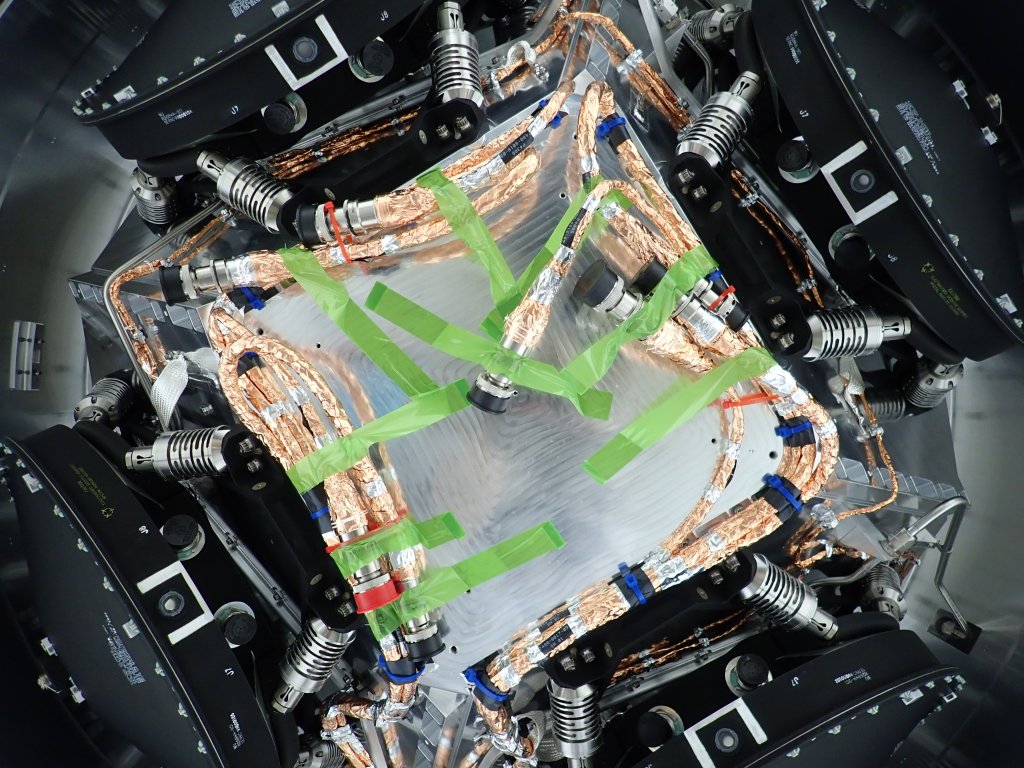
NASA’s Europa Clipper carries four wheels for accurate pointing during its Jupiter mission. Different missions select wheel size and orientation around required torque, stored momentum, mass and failure tolerance. The relevance of dependable attitude control also emerges in our coverage of a Mars Odyssey reaction-wheel anomaly.
Saturation and momentum dumping
Solar radiation pressure, gravity-gradient effects and other environmental disturbances apply small external torques over time. Wheel speeds must change to resist them. Eventually a wheel approaches its allowable speed or stored-momentum limit, a condition called saturation. It cannot indefinitely absorb additional momentum in the same direction. Operators periodically use magnetic torquers that interact with Earth’s magnetic field or thrusters to unload the wheels.
A magnetic torquer cannot rely on Earth’s field in deep space. Reaction wheels reduce routine propellant consumption for pointing, but cannot alone perform orbital reboosts or collision-avoidance translations. For the propulsion distinction, see our reporting on iodine-propelled CubeSat maneuvering and Hubble reboost proposals.
ESA Extras, Simulating Space on Earth for Miniature Satellite Testing, showing an air-bearing CubeSat attitude-control test facility. Watch on YouTube.
Engineering tradeoffs
| Actuator | Produces external torque? | Primary use |
|---|---|---|
| Reaction wheel | No, internal exchange | Fine pointing and slews |
| Magnetic torquer | Yes, against planetary field | Detumbling and desaturation |
| Thruster | Yes, from expelled propellant | Attitude control and orbital maneuvers |
Precision is not free. Rotating machinery introduces vibration, bearing wear, electrical power consumption, heat and potentially magnetic interference. The NASA design survey highlights balance and wheel-speed transitions as pointing concerns. A failed wheel may reduce observation capability even when communications survive. Precise steering also matters to missions such as ESA Hera’s asteroid observations.
Primary references
- NASA, 2026 Small Spacecraft State of the Art: Guidance, Navigation and Control.
- NASA Goddard Scientific Visualization Studio, Moving Roman: Reaction Wheels.
- NASA, Hubble Pointing Control.
- ESA, Rescuing Integral: No Thrust? No Problem.
We volunteer daily to ensure the credibility of the information on this platform is Verifiably True. If you would like to support to help further secure the integrity of our research initiative, please scan the QR code below.



Leave a Reply