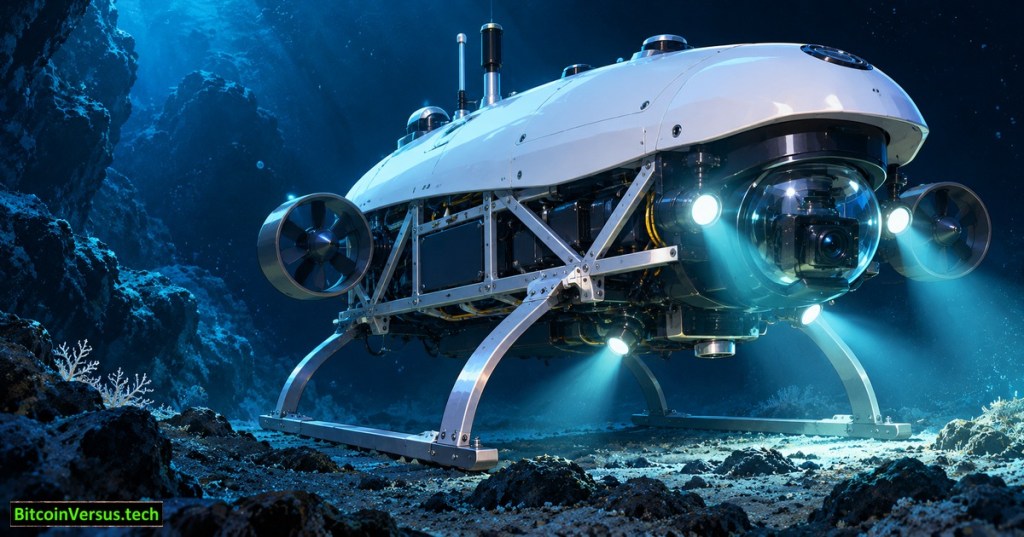
An underwater robot weighing just 250 kilograms (550 pounds) has been built for pressure conditions near the bottom of the deepest ocean trenches. Woods Hole Oceanographic Institution announced Deep Venture on November 20, 2026, describing a modular autonomous vehicle developed with NASA’s Jet Propulsion Laboratory. Its design rating reaches 11,000 meters. A documented dive near Bermuda reached approximately 6,000 meters, an important distinction between engineering capability and completed field testing.
Deep Venture introduction video embedded in WHOI’s official November 20, 2026 announcement. Primary-source footage of the research program.
A small machine under enormous pressure
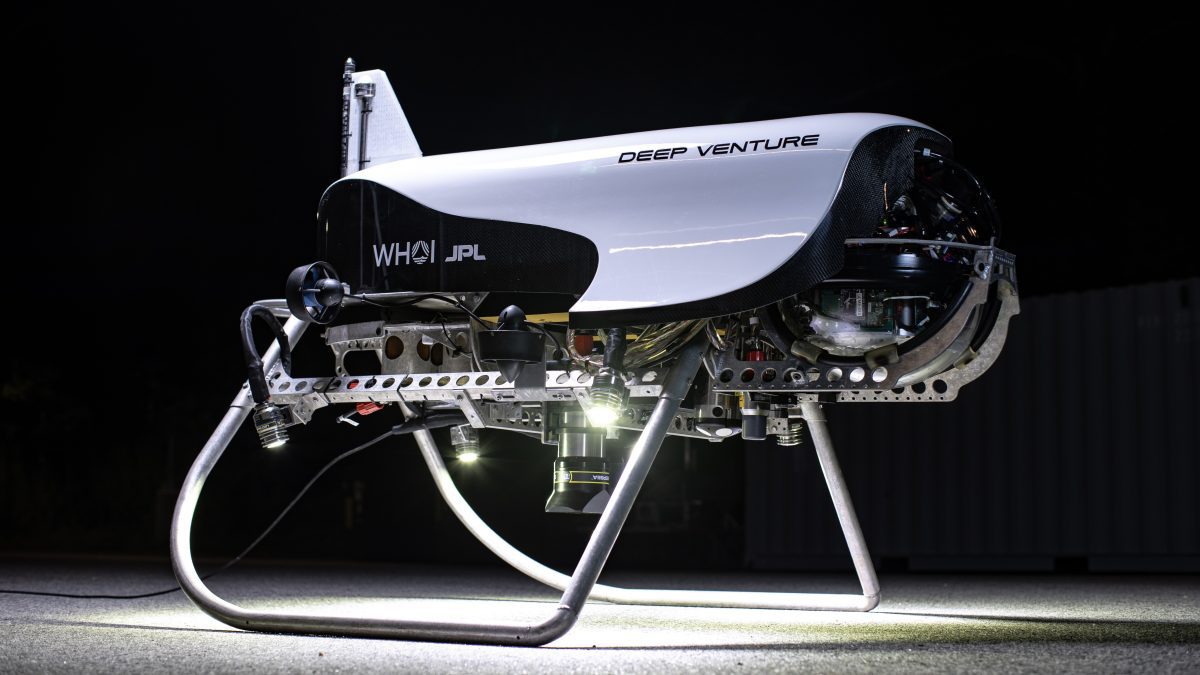
Deep Venture has a white sculpted upper shell, an open metal frame, landing skids, cameras, propulsion hardware and a payload area for scientific instruments. Its compact design allows a relatively small crew to deploy it from research vessels without the extensive dedicated support infrastructure often associated with deep-ocean expeditions. WHOI says it can travel untethered, return high-resolution imagery and gather seafloor samples.
Water pressure provides the central engineering challenge. Using approximate seawater density of 1,025 kg/m³ and gravitational acceleration of 9.81 m/s², hydrostatic gauge pressure at 11,000 meters is ρgh = 1,025 × 9.81 × 11,000 = 110.6 megapascals, or approximately 1,090 atmospheres and 16,000 psi. Actual conditions vary with density and depth. A 6,000-meter dive implies approximately 60.3 MPa by the same approximation: the full-depth design must tolerate around 83% more hydrostatic pressure than the publicly documented 6,000-meter operation.
A robot that scouts ahead of people
Deep Venture can photograph overlapping parts of the seabed for photogrammetric three-dimensional reconstructions. The robot can also land, bringing its cameras and interchangeable instruments close to sediment, rock and biological material. Its modular science bay supports chemical and biological sensors or samplers, depending on an expedition’s objectives. Those capabilities are valuable where crews have little time to select a safe, scientifically promising dive location.
The clearest operational example came in June 2026 near Bermuda. Deep Venture surveyed the seafloor at about 6,000 meters ahead of a dive by the crewed submersible Alvin. WHOI reports that the imagery helped researchers choose sites for closer examination. A predecessor WHOI–JPL program completed 13 autonomous dives to roughly 5,000 meters in the Gulf of Alaska in 2024; those earlier sorties must not be misreported as Deep Venture’s own full-depth trials.
Authentic WHOI video published March 27, 2024. Earlier Sentry robot mapping supported Alvin’s discovery of hydrothermal vents; historical context, not video of Deep Venture.
Why autonomy matters when underwater links are poor
GPS radio signals do not provide ordinary satellite positioning through kilometers of seawater. Underwater robots instead rely on onboard navigation, sensors, mission planning and limited communications. An untethered AUV can perform work without a continuous cable to a ship, but researchers sacrifice the uninterrupted high-bandwidth control and live video available to some tethered remotely operated vehicles. WHOI has not published a standardized public comparison of Deep Venture’s battery endurance, survey speed or data throughput.
The scientific opportunity, and what remains unproven
The underlying strategy resembles other autonomous infrastructure efforts: send a smaller machine to gather information before dispatching an expensive crewed or specialized platform. BitcoinVersus.Tech recently covered a seafloor sampling robot at 4,000 meters, subsea sonar and battery orders, a 20-watt seabed energy demonstration and ocean-powered AI nodes. Each addresses a different part of the ocean technology stack.
WHOI describes Deep Venture as operationally ready, but a public record of an 11,000-meter mission, system reliability statistics, cost per dive and long-term maintenance results remains necessary before claiming full-depth performance has been demonstrated. The immediate breakthrough is a working, relatively lightweight robot capable of scouting extreme depths and carrying configurable science instruments, not a replacement for human explorers.
Primary documentation and media notes
Sources: WHOI, November 20, 2026 announcement; WHOI Deep Venture vehicle specifications; WHOI’s embedded Deep Venture video; and WHOI’s 2024 Sentry/Alvin field footage. Pressure figures are editorial estimates using stated assumptions. The 1200 × 630 featured cover is a cinematic-anime editorial illustration, not an actual vehicle photograph.
We volunteer daily to ensure the credibility of the information on this platform is Verifiably True. If you would like to support to help further secure the integrity of our research initiative, please scan the QR code below.



Leave a Reply