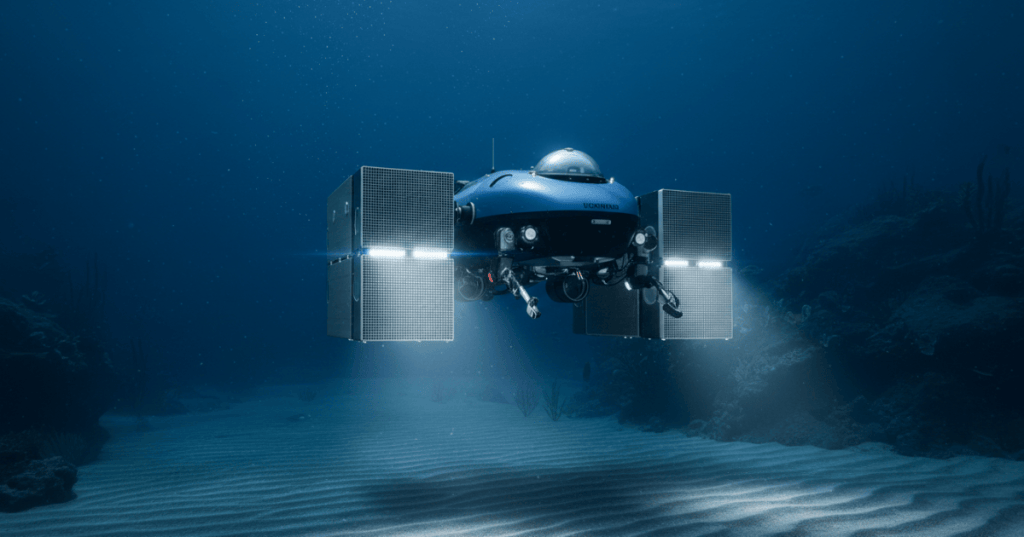
Kraken Robotics announced $102 million in new subsea technology orders on November 5, 2026, led by demand for underwater batteries and synthetic aperture sonar used by naval and offshore-energy customers. The Canadian marine technology company said announced orders across Kraken and its recently acquired Covelya Group reached approximately $457 million for 2026. Orders are contractual business activity, not revenue already recognized or cash received.
The company announcement allocated more than $55 million of the new business to Covelya subsidiaries, $25 million to subsea batteries and $22 million to synthetic aperture sonar. Kraken said the sonar orders included its largest individual SAS order from an undisclosed navy, with equipment intended for man-portable unmanned underwater vehicles.
Kraken Robotics’ official demonstration of compact MP-SAS sonar fitted to a REMUS 300 underwater vehicle, published in August 2025. Archival equipment demonstration, not footage of the November 2026 orders.
What synthetic aperture sonar does
Synthetic aperture sonar combines acoustic measurements collected as a platform moves to construct higher-resolution images of the seafloor than conventional imaging approaches can typically provide at comparable ranges. Processing depends on accurate navigation, stable geometry and compensation for vehicle motion. Navy applications include mine countermeasures and seabed surveillance; commercial applications include pipeline inspection and offshore infrastructure surveys.
Kraken’s KATFISH technical documentation describes real-time imagery with 3-centimeter by 3-centimeter resolution and up to 200 meters of range on each side in specified operating configurations. Such product figures are not universal performance guarantees and should not be transferred to every compact SAS device. The company’s MP-SAS payload targets smaller underwater vehicles, where size, power and mass constraints are especially severe.
The reported $25 million in battery orders reflects another bottleneck in autonomous marine operations: endurance. Kraken’s pressure-tolerant SeaPower batteries encapsulate lithium-ion cells rather than relying on a conventional large pressure housing. The manufacturer claims substantially lower mass per unit of stored energy than traditional subsea designs, although comparisons depend on system boundaries and the baseline selected.
Kraken Robotics’ official April 2026 video shows KATFISH sonar being launched and recovered autonomously from a SEFINE unmanned surface vessel. Source: Kraken Robotics; archival demonstration.
Acquisition broadens the customer base
Kraken acquired Covelya in July 2026, adding businesses including Sonardyne, EIVA, Forcys, Voyis and Chelsea Technologies. The transaction expanded its navigation, acoustic positioning, imaging and software portfolio. More than 60% of announced combined orders during 2026 originated with defense-industry customers, according to management. Concentration in defense purchasing creates opportunities but also exposure to procurement delays, export restrictions and contract changes.
Kraken expects the vast majority of the recent product orders to become revenue within 12 months. That timetable is management guidance, not evidence that manufacturing, delivery, customer acceptance or payment has already occurred. The company plans to publish third-quarter financial results on November 24, offering a separate test of recognized revenue and cash flow.
Related BitcoinVersus.Tech reporting has examined autonomous boats used for waterway maintenance, ocean-energy engineering, submerged energy hardware in Hawaiʻi and industrial mobile-robot communications standards. Although their missions differ, marine robots share engineering problems involving energy storage, sensors, communication and reliability.
The next milestone
The largest unanswered question is how quickly orders translate into completed equipment deliveries and profitable operations. Naval customer identities and individual contract schedules were not disclosed, limiting independent verification of end-user deployments. Investors should compare Kraken’s November 24 results with order announcements while keeping backlog, revenue and cash generation separate.
Editor’s Note: Kraken Robotics’ November 5 announcement is the primary source for the order figures. Manufacturer product specifications and archival equipment demonstrations are not independent tests or footage of the newly awarded contracts. Orders and future revenue remain distinct.

We volunteer daily to ensure the information on this platform is Verifiably True. If you would like to support the research, please scan QR code.


Leave a Reply