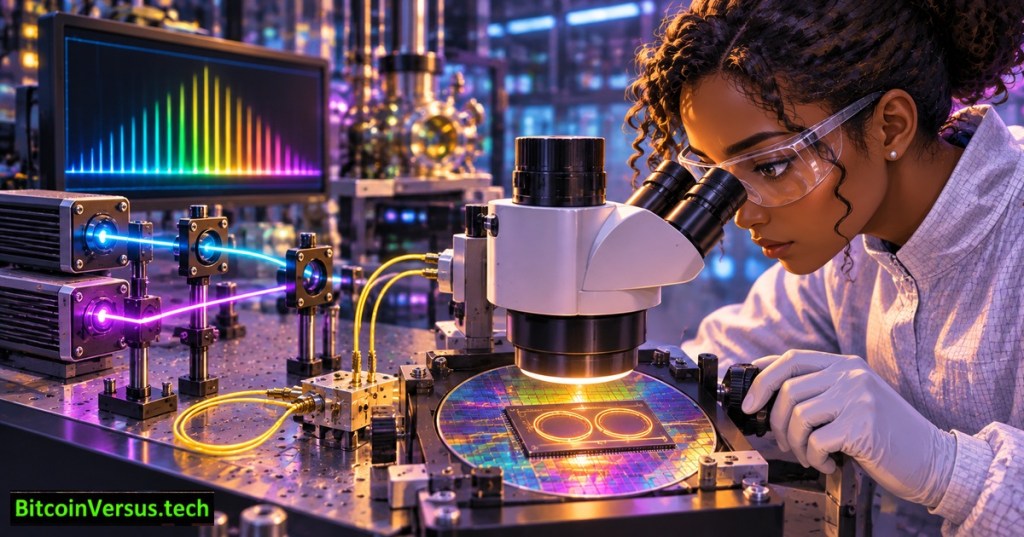
A clock that keeps precise time when GPS disappears needs an extraordinarily accurate way to count vibrations. Researchers at the National Institute of Standards and Technology (NIST), the Joint Quantum Institute and collaborating laboratories have demonstrated a chip-scale optical frequency comb that may simplify the job. Announced by NIST on October 16, 2026, the technique replaces complicated stabilization arrangements with a two-laser approach inside a tiny optical ring. The group demonstrated precision measurements, not a complete handheld atomic clock.
In an earlier official NIST video, physicist Scott Papp explains miniature optical frequency comb fabrication. Historical background, not footage of the 2026 experiment. Watch on YouTube.
What does a ruler for light measure?
An optical frequency comb produces many distinct, evenly spaced colors of light. Each spectral line acts like a numbered tick on a ruler: by comparing an unknown laser with nearby ticks, scientists can measure an optical frequency far above the speed of conventional electronics. Frequency combs also connect optical clocks to usable microwave signals. Their precision makes them foundational tools for timekeeping, spectroscopy and advanced sensors.
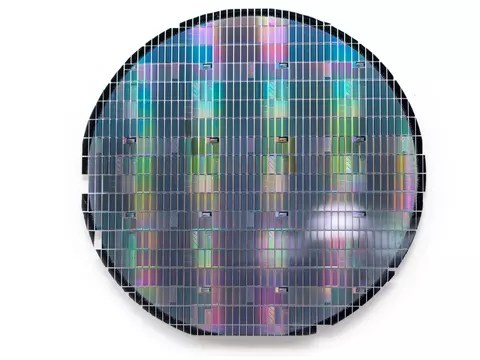
The new approach uses two pump lasers circulating through a microresonator, a tiny ring that repeatedly guides light around a closed path. Nonlinear optical interactions create regularly spaced pulses and frequency lines between the pump frequencies. The researchers call their synchronized process SParCS, for self-aligned parametrically driven cavity solitons. Unlike earlier arrangements that could produce overlapping sets of uneven frequency marks, the combined process aligns the teeth into one usable comb.
Why two lasers can simplify the instrument
Traditional chip combs often start with one laser and produce additional teeth extending away from its frequency. Teeth near the edges may become weak, forcing laboratories to add amplification and stabilization equipment. In the new process, the two pump lasers act like bookends, helping preserve useful power at the edges. The team used the resulting span to simplify frequency-offset measurement and adapt one chip to several different experiments.
Researchers tested both directions of frequency conversion. They linked microwaves to optical frequencies for measurement, then transferred the stability of optical references back into low-noise microwaves. With an atomic-clock reference and additional instruments, the optical-frequency measurement agreed within roughly 100,000 oscillations per second of the expected reference frequency, according to the Joint Quantum Institute. At optical frequencies measured in hundreds of trillions of cycles per second, the absolute and relative units must not be confused.
Where photonics could travel next
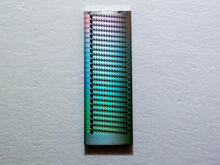
Portable optical clocks could help navigation when satellite timing is unavailable, while compact combs might improve laser ranging and scientific instruments. Those uses require packaging, lasers, control electronics, ruggedization and system-level qualification that the published demonstration does not establish. The team did compare its compact comb with a conventional tabletop setup and reported comparable stability within the experimental tests.
Professor Scott Diddams explains optical frequency combs in a March 2026 educational lecture. Independent technical background, not a claim that the NIST chip is commercial. Watch on YouTube.
Other photonic research is attacking different bottlenecks. Our reporting covers a 16-channel optical communications chip, an isolator-free 180 Gb/s transmitter and how optical transceivers carry data. Frequency combs are precision references rather than general-purpose network switches. For an example of another demanding optical measurement task, see NASA’s lidar mapping work.
What would prove a portable breakthrough?
The next milestones are lower total system power, integrated pump lasers, stable operation outside a controlled lab, and comparisons against traceable clock references under environmental stress. NIST’s result is a meaningful improvement to the frequency-comb building block. It does not yet mean a phone, drone or vehicle can carry a complete optical atomic clock.
Primary sources: NIST, October 16 announcement; Joint Quantum Institute, October 5 technical report; peer-reviewed Nature research.
We volunteer daily to ensure the credibility of the information on this platform is Verifiably True. If you would like to support to help further secure the integrity of our research initiative, please scan the QR code below.



Leave a Reply