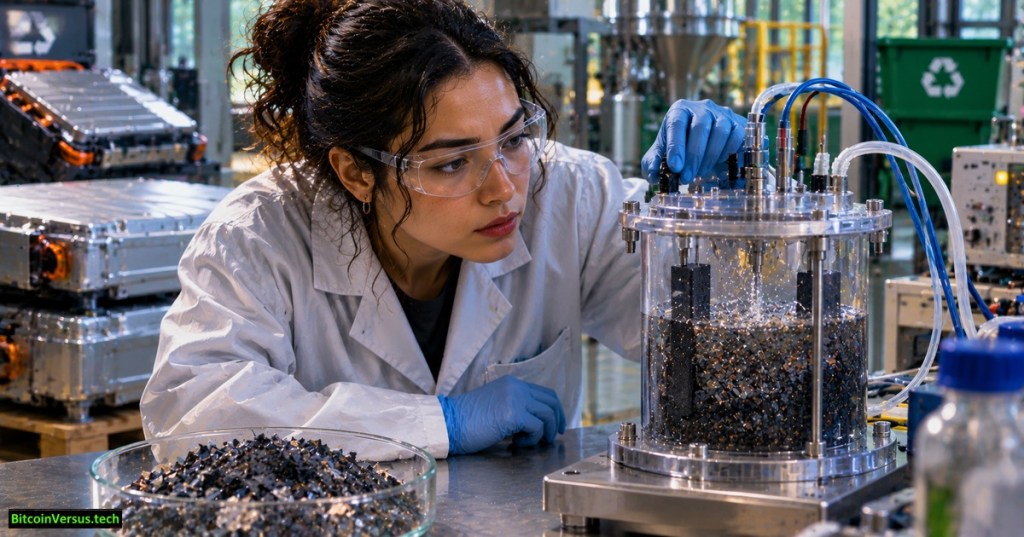
Microorganisms could eventually recover valuable lithium from worn-out electric-vehicle batteries without relying on the harshest conventional recycling conditions. On November 19, 2026, the University of Surrey announced a £250,000 research grant for ReLiFE, a project to move microbial electrochemical recovery from laboratory experiments toward a continuous-flow prototype. Surrey’s earlier BELIEVE research recovered more than 90% of lithium in laboratory trials. The new funding is for scale-up testing, not confirmation of a commercial recycling line.
The Faraday Institution’s 2020 ReLiB research presentation explains the broader UK lithium-ion battery recycling challenge. ReLiB is a separate program from Surrey’s ReLiFE project. Watch directly on YouTube.
What happens after an electric-car battery is shredded?
Battery recycling usually begins with safe discharge, dismantling, shredding, and sorting. A key output is black mass, a powder rich in anode and cathode materials. It can contain lithium alongside nickel, cobalt, manganese and graphite, with composition varying by battery chemistry and preprocessing. Conventional high-temperature and wet-chemical routes can recover many metals, but extracting lithium cleanly, economically and at high yield remains a difficult process.
Surrey’s system uses selected microorganisms that transfer electrons, helping release lithium selectively from battery waste under relatively mild conditions. Its predecessor, BELIEVE, reported 90–95% recovery in laboratory research on synthetic black mass. That recovery percentage describes the fraction of available lithium extracted under the experimental conditions; it does not represent a finished battery-grade lithium salt, a full-plant material balance, or independent proof of industrial operating economics.
Why a continuous-flow reactor changes the experiment
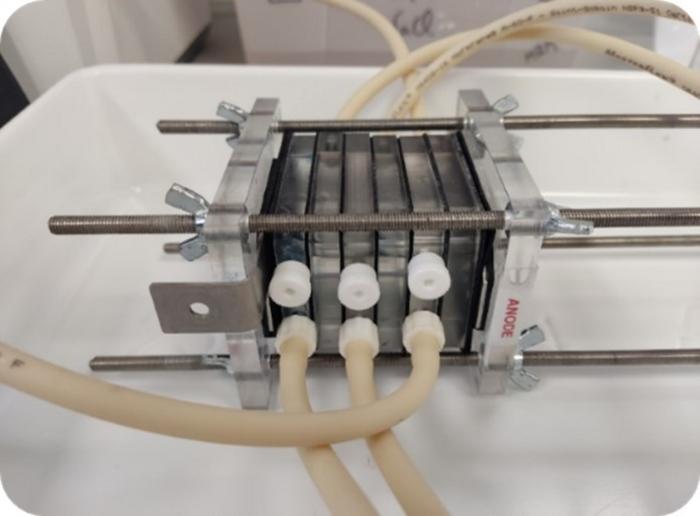
The new ReLiFE project, short for Recovery of Lithium from End-of-Life EV batteries, aims to run a continuous-flow reactor using actual black mass supplied by industry partners. Researchers will have to manage changing feed composition, microorganism activity, residence time, liquid chemistry and recovery-stage separation. A result achieved in a small batch with prepared material can decline when contaminated waste is fed into a plant continuously.
The researchers’ stated target is lithium at greater than 99% purity, recovered in a form suitable for eventual conversion into battery-grade lithium hydroxide or lithium carbonate. That purity is a project objective, not an achieved ReLiFE result. The grant will also support cost, environmental-footprint and commercialization assessments, with no disclosed commercial throughput capacity or electricity-per-kilogram figure.
Can microbes really save energy?
Potential energy savings come from avoiding some of the very high temperatures and aggressive reagent consumption used in certain recycling routes. However, microorganisms need controlled nutrients, temperature, fluid circulation and downstream purification. Any complete comparison should include shredding, agitation, separation, reagents, heat, water treatment and product crystallization. Surrey has not published a directly comparable industrial life-cycle assessment establishing a specific energy or emissions reduction for ReLiFE.
A 2024 research-lab visit from the University of Birmingham’s separate ReLiB project shows the practical challenges of battery recycling. Context only; not footage of Surrey’s planned pilot. Watch directly on YouTube.
The 2035 battery-materials challenge
Surrey links the program to the United Kingdom’s Vision 2035 critical-minerals strategy, which anticipates sharply higher domestic lithium demand and targets recycling as part of mineral supply. The university cites a projected 1,100% increase in UK lithium demand by 2035 and a government objective to supply 20% of critical-mineral demand through recycling. Both are forecasts or policy objectives, not measured present-day recycling shares.
There are multiple possible destinations for old packs. BitcoinVersus.Tech has covered second-life EV batteries for grid storage and rapid testing to identify reusable cells. ReLiFE instead addresses the stage when battery materials must be recovered. Other approaches include direct lithium extraction from brines and better manufacturing processes, such as faster lithium-cell formation.
The next milestone is a published performance record from continuous operation on partner-supplied black mass: lithium recovered, purity after separation, reagent inputs, energy consumption, process uptime and cost per kilogram. Until those data are available, microbe-assisted recycling is a demonstrated laboratory approach moving toward pilot validation, rather than a proven replacement for established industrial processes.
Primary sources: University of Surrey’s ReLiFE announcement, November 19, 2026; University of Surrey’s earlier BELIEVE findings; BELIEVE project description; 2026 review of bioleaching mechanisms and limitations.
We volunteer daily to ensure the credibility of the information on this platform is Verifiably True. If you would like to support to help further secure the integrity of our research initiative, please scan the QR code below.



Leave a Reply