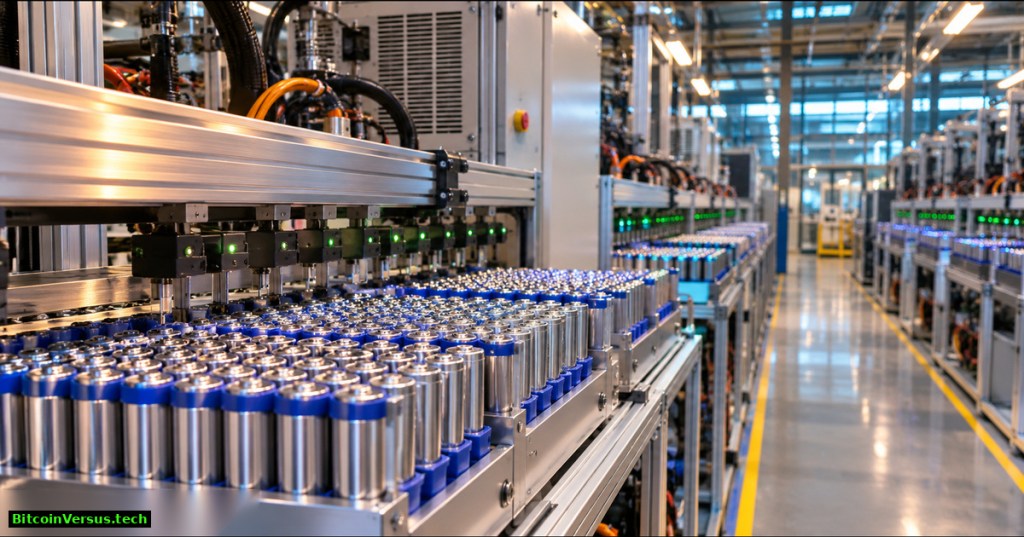
A battery factory can build a cell long before it can ship one. New research from the UK Battery Industrialisation Centre (UKBIC) suggests manufacturers can shorten the electrochemical formation stage by as much as 40%, while sacrificing roughly 6% of cycle life against the strongest-performing standard protocol. The finding, announced November 18, 2026, identifies a potential productivity gain without requiring a new battery chemistry.
UKBIC, “Formation, ageing, and testing at UKBIC,” June 5, 2025. Official facility demonstration showing the battery activation process; archival footage, not a video of the November 2026 experimental runs. Original video.
Why completed cells need formation
Freshly assembled lithium-ion batteries require controlled initial charging and discharging. Electrochemical reactions create a solid-electrolyte interphase (SEI) on the negative electrode, helping prevent continuing electrolyte breakdown during later operation. Formation conditions affect stability, safety screening, manufacturing energy and eventual capacity retention.
Long formation and ageing schedules tie up cyclers, climate-controlled space and work-in-progress inventory. UKBIC says the final formation, ageing and testing stages can occupy up to 30% of production time, and formation-related operations represent an estimated 15–32% of non-material conversion costs. Those are broad manufacturing benchmarks, not operating-cost readings from the latest experiment.
Researchers Kenneth Nwanoro, Ameir Mahgoub and Richard LeCain compared 14 protocols: UKBIC’s standard F1 schedule and 13 alternatives. The samples were 21700 cylindrical cells with 4.8 ampere-hours nominal capacity, nickel-rich NMC811 cathodes and graphite–silicon-oxide anodes. Afterwards, the team cycled cells at C/3 until they reached 80% state of health.
Speed, energy and battery life are separate measurements
According to UKBIC’s technical release, selected accelerated schedules reduced formation duration by up to 40% and process energy consumption by up to 40%. A roughly 6% cycle-life penalty was reported relative to the best-performing standard protocol. A six-percent change in cycle life does not mean a six-percent reduction in charging range, initial capacity or battery energy density.
UKBIC, “Exploring UKBIC’s Cell Cycling, Formation and Ageing, Testing, and End of Life testing capabilities,” May 30, 2025. The research team’s Kenneth Nwanoro explains relevant facilities and testing methods; the earlier webinar does not present November 2026 results. UKBIC notes intermittent audio damage. Original webinar.
The distinction between faster processing and faster production matters. If formation alone takes 30% of a manufacturing route and its duration falls 40%, total elapsed production time would fall only 12% under a simplified sequential model, assuming every other step and queue stays unchanged. Actual throughput also depends on how many formation channels exist, cell yields, factory scheduling and bottlenecks elsewhere.
UKBIC cites wider industry projections of £1.50–£3.75 per kWh in potential pack-level savings from optimized formation. The range is an estimate, not an audited saving achieved across commercial production lines. Smaller energy bills may follow faster charging schedules, although electricity rates, equipment duty cycles and cell scrap would determine actual savings.
Less ageing is not automatically worse
The study found that longer ageing periods did not consistently improve cell performance. Protocols that looked strongest immediately after formation also did not invariably deliver the longest useful cycle life. Charge current, end-of-formation thresholds, rest times and temperature therefore require joint validation rather than a single aggressive speed setting.
UKBIC, “Mixing for battery manufacturing at UKBIC,” June 5, 2025. Official footage of the earlier electrode-slurry manufacturing stage, included to show the wider production line; not part of the formation trial. Original video.
For EV manufacturing, lower conversion costs could complement investments in Sila’s silicon-carbon anode supply and Ford’s LFP cell production. Factory-stage optimisation is a separate lever from material selection. It also differs from BMW’s work on battery communication over 800-volt wiring and UNSW’s rapid second-life battery diagnostics, which address other stages of a battery’s lifespan.
The engineering result is promising but bounded: it came from defined 21700 NMC811/graphite–silicon-oxide cells under controlled test conditions. Other formats, electrolytes, chemistries and warranty requirements could require different protocols. Commercial validation must show consistent throughput, acceptable degradation and quality at scale before projected savings become production results.
Primary sources: UKBIC November 18, 2026 research announcement; Kenneth Nwanoro and colleagues, technical paper summary, November 17, 2026; UKBIC manufacturing-energy background. Percentage claims are reported experimental results; sterling savings are industry estimates. Twelve-percent total-route reduction is explicitly a conditional arithmetic illustration, not a measured result.
Editor’s Note: Original reporting based on UKBIC’s dated laboratory announcement and technical-paper summary. The featured image is an AI-assisted editorial illustration of industrial battery production, not photography of UKBIC or the tested cells. The three official UKBIC YouTube videos predate the study and are clearly labeled archival. Actual video playback must be checked separately from iframe rendering.
We volunteer daily to ensure the credibility of the information on this platform is Verifiably True. If you would like to support to help further secure the integrity of our research initiatives, please scan the QR code below

Disclaimer: Published for informational and educational purposes. Laboratory results are not guarantees of commercial performance. Any Bitcoin contribution is voluntary and generally irreversible.


Leave a Reply