
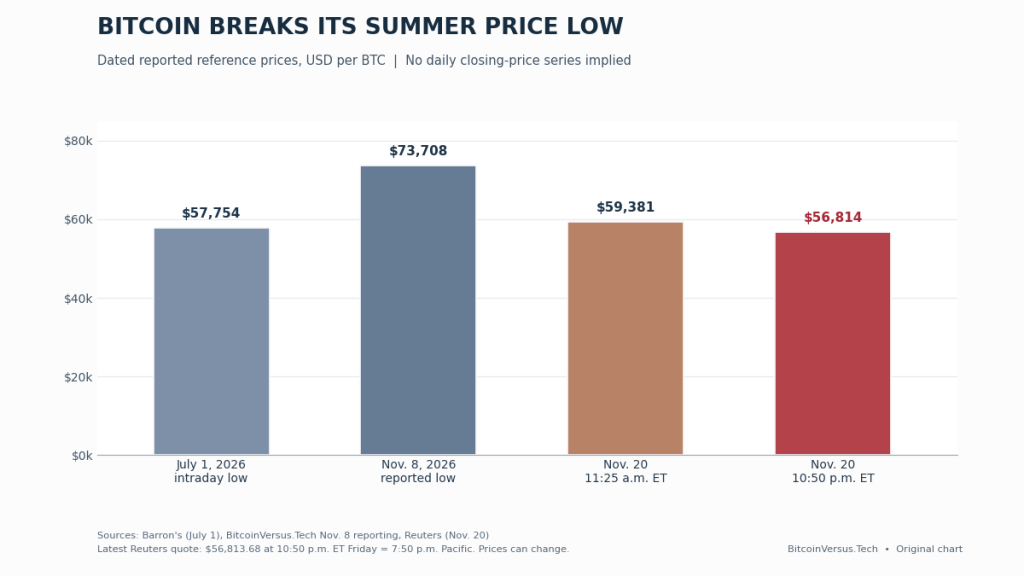
Bitcoin fell below $57,000 late Friday, November 20, reaching a new 2026 price low and increasing pressure on mining companies already facing thin margins. Reuters recorded $56,813.68 at 10:50 p.m. Eastern, or 7:50 p.m. Pacific, after the cryptocurrency broke below $60,000 earlier in the session. CoinDesk described the late slide as Bitcoin’s lowest trading level since September 2024. The Reuters update was dated November 21 in UTC, but the reported trade occurred Friday evening in the United States.
The new quote was about 22.9% below the $73,708 low covered on November 8, and roughly 1.6% below the $57,754 reference low reported for July 1. Prices are exchange-sensitive observations, not a daily closing-price series or a promise that the market has found its bottom.
Bitcoin Magazine TV interview with Anchorage Digital research head David Lawant, published during the November 2026 selloff. The discussion covers market liquidity, ETF withdrawals, and miner selling, but predates the late-evening $56,814 Reuters quote.
A sharp repricing across several markets
The Bitcoin drop coincided with heavy selling in technology shares, changing expectations for Federal Reserve interest rates, and investors retreating from risky assets. Reuters cited worries over the artificial-intelligence trade and borrowing costs. CoinDesk reported roughly $1.5 billion in cryptocurrency derivatives liquidations over a rolling 24-hour window as of Friday afternoon, based on CoinGlass data.
Liquidations can magnify fast price moves when collateral no longer covers leveraged positions. However, a reported liquidation total does not prove every transaction caused Bitcoin’s decline. Outflows added pressure: BlackRock’s IBIT recorded a $541 million daily net withdrawal on November 19, before the Friday price break.
The mining consequence arrives before difficulty changes
A price decline cuts the dollar value of a miner’s expected Bitcoin rewards immediately when the expected number of coins earned remains unchanged. ASIC equipment, meanwhile, consumes nearly the same electricity while hashing at a fixed configuration. Bitcoin difficulty adjusts only after the protocol’s block-based retarget cycle, so declining price alone does not instantly improve block-winning probability.
At 12 J/TH, producing 1 PH/s requires approximately 12 kW at the miner, or 288 kWh per day. Electricity at six cents per kWh costs $17.28 daily. The separately dated $27.79 per PH/s-day hashprice analysis implied $10.51 above direct machine power expenses under those earlier assumptions, before pool fees, cooling, maintenance, and financing. It is not a live margin calculated at the later $56,814 Bitcoin quote.
Luxor Technology, June 2, 2026: original technical explanation of hashprice, network difficulty, transaction fees, and mining revenue. Historical engineering context; the video does not present live November 20 profitability measurements.
Mining stocks and financing face a second squeeze
CoinDesk reported Friday declines of roughly 12% to 15% in several publicly traded miners and AI-focused infrastructure companies, including Hut 8, CleanSpark, Bitdeer, Cipher Mining, and IREN. Those were market-session observations rather than forecasts or a uniform return for every mining stock. Businesses combining Bitcoin mining with AI data-center expansion can face financing pressure from both sectors.
A bank estimate of roughly $86,000 to produce one Bitcoin describes a modeled sector-wide cost, not the price where every miner must shut down. Individual decisions depend on contracted electricity rates, delivered machine efficiency, debt, and avoidable costs. Recent BitFuFu results show why cloud-mining sales and company-owned BTC production must also be separated.
Bitcoin’s 9.13% difficulty reduction on November 14 illustrates how expected production can change after a retarget. Future adjustments depend on actual blocks and network competition, not a predetermined rescue for unprofitable rigs.
What to watch after the low
The next measurable indicators are exchange prices across venues, verified ETF flows, miner shutdowns or curtailment, network hashrate, transaction fees, and subsequent difficulty adjustments. A brief rebound would not prove financial stress has ended, just as a new low does not establish that all miners operate at a loss.
Sources and verification
- Reuters, Bitcoin at $56,813.68, Friday November 20 at 10:50 p.m. ET
- Reuters, initial break below $60,000 on November 20
- CoinDesk, Bitcoin below $57,000 and risk-asset repricing, November 20 at 11:10 p.m. ET
- CoinDesk, Bitcoin miners and roughly $1.5 billion rolling liquidations, November 20
- Barron’s, July 1 Bitcoin low referenced November 16
- Bitcoin Magazine TV, Anchorage Digital David Lawant interview, November 2026
- Luxor Technology, Hashrate Markets Explained, June 2, 2026
Editor’s Note: We volunteer daily to ensure the credibility of the information on this platform is Verifiably True. If you would like to support to help further secure the integrity of our research initiative, please scan the QR code below

For mobile scanning, open the article on another display and scan the QR code with a Bitcoin wallet. The voluntary donation amount is 5,000 sats. Verify the receiving address 3C9o19EH5HSiwEPyCTmEKzxhNCbo2X6TTb before sending.
BitcoinVersus.Tech publishes technology and financial journalism for informational purposes and does not provide financial, investment, or legal advice.


Leave a Reply