
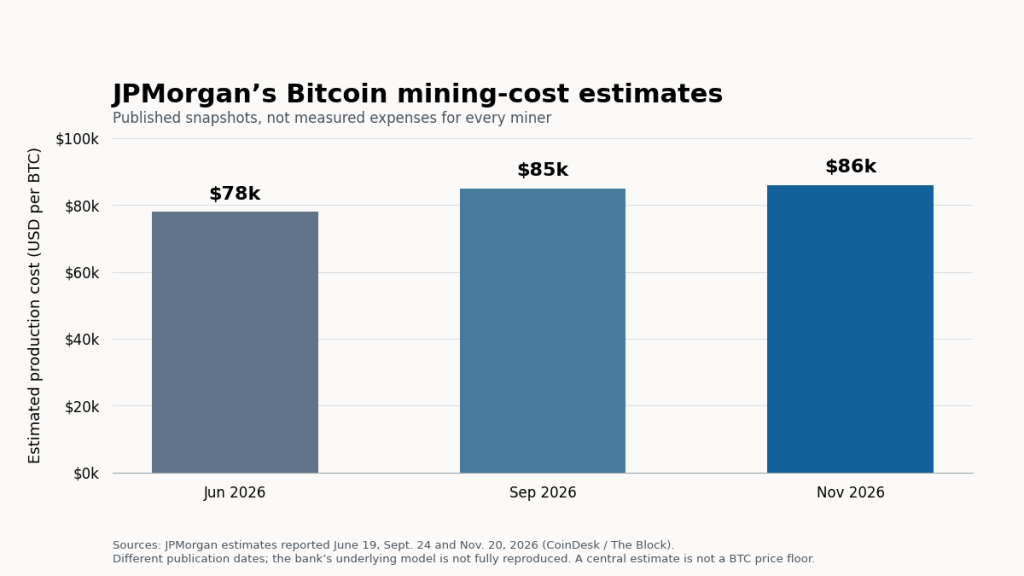
JPMorgan estimates that producing one Bitcoin costs roughly $86,000, even as the asset traded near $65,000 when its analysts published their latest assessment. Reporting on November 20, 2026, said Bitcoin subsequently fell below $60,000, widening the difference to more than $26,000. The figure signals pressure on higher-cost miners, but it is a model estimate, not a universal electricity bill or a guaranteed Bitcoin price floor.
The distinction matters because miners pay radically different power tariffs, deploy different ASIC generations and finance equipment differently. An industry-wide production-cost estimate answers a separate question from whether an individual mine should switch off its machines tonight.
MinedOre interview, June 25, 2025: Cambridge mining research lead Alex Neumüller explains how electricity assumptions, actual operations and geographic differences influence mining estimates. Historical methodological context, not a discussion of JPMorgan’s November 2026 note.
How the estimated cost reached $86,000
The bank’s reported central estimate stood near $78,000 in June and $85,000 in September before reaching $86,000 in November. Those values are successive published estimates, not independently audited average expenses. JPMorgan did not provide the full underlying worksheet in the publicly available news reports, so changes should not be attributed to one specific cost input.
Cambridge arrives at a different number
An October 2026 Cambridge Centre for Alternative Finance report compared Bitcoin prices with two other production-cost approaches. Its own CBECI electricity model assumes five cents per kilowatt-hour and excludes mining hardware and other non-electricity operating costs. A separate Glassnode regression uses market capitalization and difficulty rather than itemized equipment bills. Unsurprisingly, the resulting curves differ.
Cambridge’s industry survey found direct electricity represented 81.1% of cash operating expenditure, excluding noncash expenses. Reported electricity tariffs ranged from two to 6.5 cents per kWh, with a median of 4.5 cents. The median all-in cash operating rate was 5.55 cents per kWh. Those statistics describe survey respondents, not a meter reading for every Bitcoin miner worldwide.
Mining operator Colby Noe, August 23, 2026: an independently presented comparison of S21 Pro and S21 XP prices, power consumption and hosting economics. Figures in the video reflect its August recording rather than November’s market conditions.
What a single ASIC actually pays
For a normalized 1 PH/s, an ASIC operating at 12 J/TH draws about 12 kW, consuming 288 kWh daily. At five cents per kWh, its direct machine electricity expense is $14.40 per day. At the separate November 20 hashprice snapshot of $27.79 per PH/s per day, modeled gross revenue would be $27.79 before pool fees, cooling, repairs and capital costs.
Electricity would absorb approximately 51.8% of that gross daily revenue under those assumptions. The example is neither JPMorgan’s methodology nor an estimate of the industry average. See our ASIC electricity break-even analysis and kWh cost guide for additional operating scenarios.
Below production cost does not mean every miner shuts down
Miners can continue running when immediate revenue covers variable costs even if the lifetime purchase price of their equipment will never be recovered. Others must curtail because expensive electricity exceeds the value of expected Bitcoin production. Higher-cost shutdowns can lower network hashrate, with the following difficulty adjustment potentially improving returns for remaining participants.
The site previously covered JPMorgan’s September $85,000 estimate and the November 14 difficulty reduction. Recent BitFuFu results further show why Bitcoin production, equipment contracts and accounting income must remain separate.
The $86,000 estimate is a useful warning about sector pressure, not a declaration that Bitcoin cannot trade lower. Meaningful mine-by-mine decisions still require contracted energy rates, actual wall-plug performance, cooling overhead, expected block rewards and a realistic hardware replacement budget.
Sources and documentation
- The Block, November 20, 2026, JPMorgan $86,000 production-cost estimate
- CoinDesk, June 19, 2026, JPMorgan $78,000 estimate
- The Block, September 24, 2026, JPMorgan $85,000 estimate
- Cambridge Centre for Alternative Finance, Bitcoin Security Budget Report, October 2026
- MinedOre interview with Cambridge research lead Alex Neumüller, June 2025
- Colby Noe, practical Bitcoin mining hardware cost comparison, August 2026
Editor’s Note: We volunteer daily to ensure the credibility of the information on this platform is Verifiably True. If you would like to support to help further secure the integrity of our research initiative, please scan the QR code below

For mobile scanning, open the article on another display and scan the QR code with a Bitcoin wallet. The voluntary donation amount is 5,000 sats. Verify the receiving address 3C9o19EH5HSiwEPyCTmEKzxhNCbo2X6TTb before sending.
BitcoinVersus.Tech publishes technology and financial journalism for informational purposes and does not provide financial, investment, or legal advice.


Leave a Reply