
Bitcoin mining pays a fixed cryptocurrency subsidy when a miner finds a valid block. The reward is denominated in BTC, but operators pay electricity, labor, repairs and financing expenses largely in national currencies. A sudden decline in Bitcoin’s exchange price therefore reduces the dollar value of a newly mined block before those operating bills change.
Bitcoin dropped to $73,708 during Sunday trading on November 8, 2026, its lowest level since August, according to Reuters. The move followed market concerns involving regulation and exchange security after the U.S. midterm elections. It also extended a decline from a roughly $80,700 Wednesday reference high cited by Investor’s Business Daily. Price observations are intraday snapshots from separate sessions, not daily closing prices.
Bitcoin University’s April 17, 2026 explanation of Bitcoin hashrate-as-a-service describes a method for accessing mining rewards without operating one’s own hardware. Historical background on mining economics, not footage or commentary about the November 8 selloff. Source: verified Bitcoin University/YouTube.
The 3.125 BTC block subsidy stays unchanged
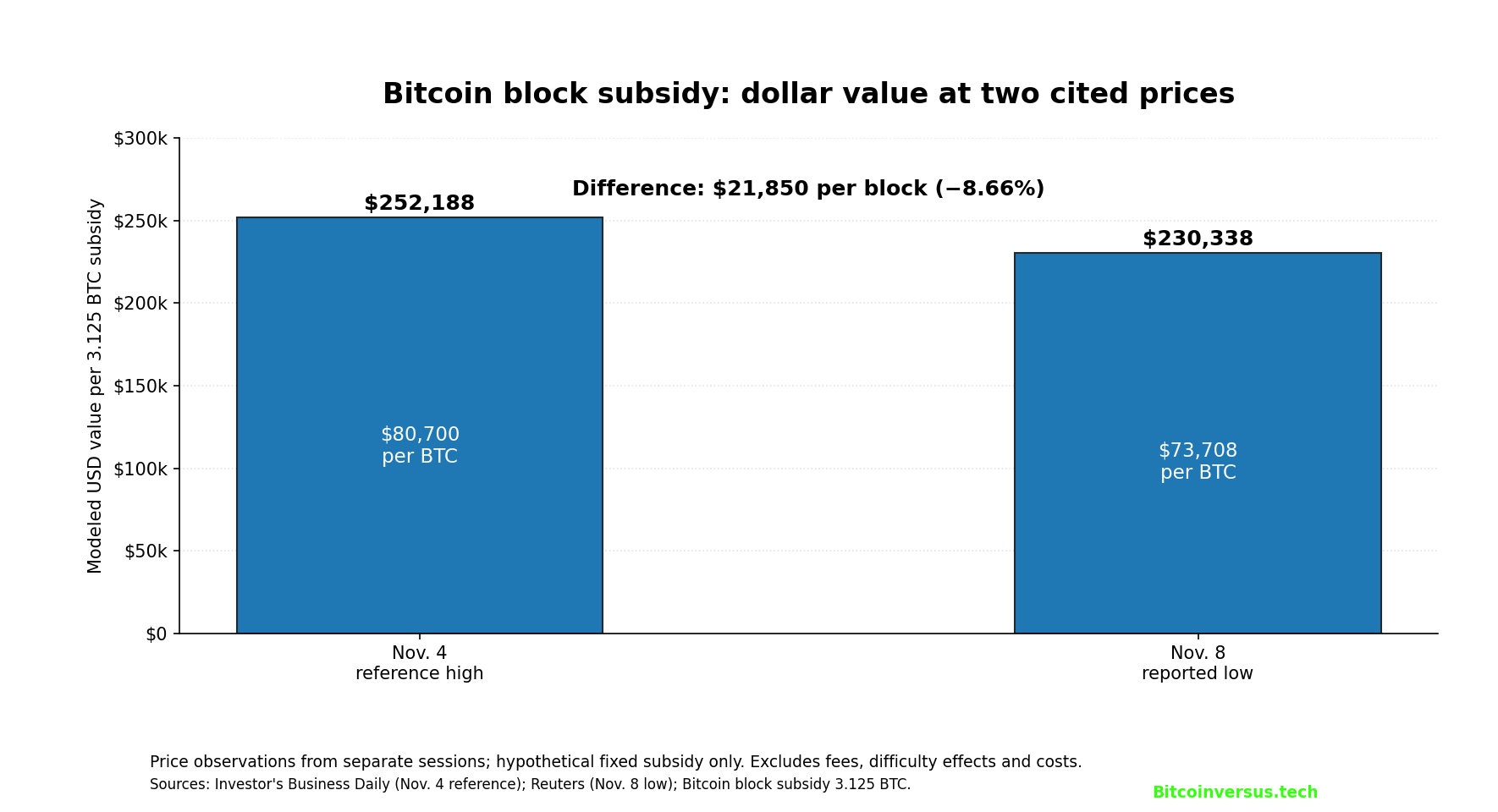
At the present block subsidy of 3.125 BTC, a Bitcoin price of $80,700 values the subsidy at $252,187.50. Multiplying 3.125 BTC by $73,708 gives $230,337.50. The difference is $21,850 per successful block, an 8.66% decline in its hypothetical dollar-denominated subsidy value. The calculation excludes transaction fees and assumes Bitcoin is valued at each cited spot price.
No individual mining company automatically loses $21,850 when the market moves. Pools distribute earnings among participants under their own payout methods, miners receive only a share of expected network rewards, and companies may hold coins rather than sell them immediately. The comparison measures the sensitivity of a fixed Bitcoin subsidy to changes in exchange price.
Network difficulty cannot immediately compensate
Bitcoin’s network difficulty remained around 148.36 trillion on November 8, according to the network-data snapshot. Difficulty adjusts after every 2,016 blocks, seeking an average interval near 10 minutes. The October 29 adjustment had raised difficulty by approximately 5.54%. A lower price does not directly lower the protocol’s current difficulty; miners must wait for a retarget, assuming slower block production continues.
Earlier BitFuFu reporting documented the effect of increasing network competition on output even as ASIC energy efficiency improved. Separately, BitcoinVersus.Tech’s decade-long ASIC-efficiency review found substantial historical gains in joules per terahash. More efficient chips reduce electricity consumed per hash, but cannot guarantee profitability against rapidly changing market prices.
Hashprice reveals pressure beyond the exchange rate
Hashprice describes the expected gross revenue from a specified amount of hashrate, commonly expressed in U.S. dollars per petahash per second per day. Luxor’s November 2 roundup placed spot hashprice at $32.86 per PH/s per day. A separate November 8 tracker displayed approximately $32.34 per PH/s per day. The observations use different calculation times and should not be treated as an isolated causal experiment.
BitcoinVersus.Tech previously examined Luxor’s mining revenue forwards and explained the distinction between hashrate and hashprice. Forward contracts can help stabilize revenue, but actual economics still depend on power tariffs, curtailment, ASIC depreciation, operating uptime, pool fees and credit exposure.
The latest Core Scientific mining cost analysis offers a reminder: revenue can cover electricity while falling short of the full cost of owning and operating a mining fleet. During the new price decline, a miner’s cash flow and accounting profit can diverge further if machines remain powered at unfavorable electricity rates.
What miners should watch next
The November 13 difficulty adjustment remains a projection, not a guaranteed reduction. A lower difficulty could increase the share of future blocks earned by unchanged hashrate, but Bitcoin’s market price, transaction-fee demand and competitors’ responses may change independently. Verified indicators will be actual adjustment data, spot hashprice, fee revenue, realized uptime and site-level electricity costs rather than assumptions about an automatic recovery.
Primary sources and calculation
Reuters market report (November 8, 2026); Investor’s Business Daily market update (November 6); Bitcoin network difficulty snapshot (November 8); Hashrate Index weekly roundup (November 2); Orange Abacus hashprice tracker (November 8). Block subsidy model: 3.125 BTC × cited USD/BTC price. Price observations are not standardized end-of-day closes.
Editor’s Note: The $21,850 comparison is a hypothetical fixed-subsidy sensitivity calculation, not audited losses, miner revenue, realized proceeds or a company forecast. Network difficulty and hashprice are separate metrics, and their data timestamps differ. The article does not predict price direction. The featured 1200 × 630 cover is conceptual colored-pencil artwork, not a photograph of a particular mining facility. The historical Bitcoin University video does not document the November 8 market events.
Support BitcoinVersus.Tech
For an optional 5,000-satoshi contribution, scan the original BitcoinVersus.Tech QR below using a compatible wallet. On a phone, open the article on another display or use a wallet’s supported saved-image scanning feature. Verify the address and amount before authorizing a transaction.

We volunteer daily to ensure the information on this platform is Verifiably True. If you would like to support the research, please scan QR code.
BitcoinVersus.Tech provides educational information, not investment, trading or financial advice.


Leave a Reply