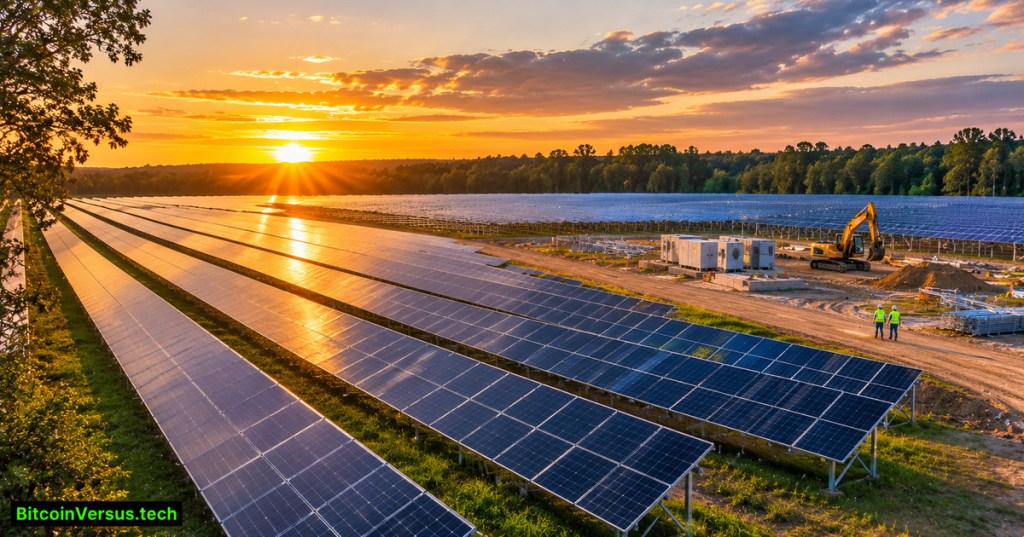
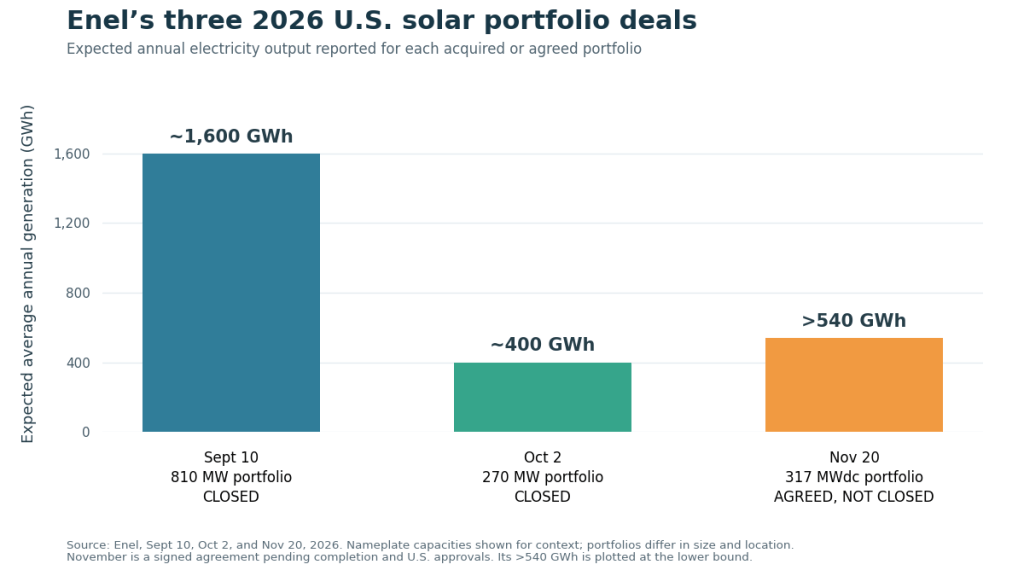
Enel has agreed to buy 317 MWdc of solar projects in South Carolina from energyRe, adding another substantial portfolio to its North American renewable-energy strategy. The companies announced the transaction on November 20, 2026. Enel expects the plants to produce more than 540 gigawatt-hours of electricity annually once completed and operating. The acquisition has not closed, and the output remains a forecast, not delivered generation.
energyRe will continue managing construction through commercial operation. Enel expects the transaction to close during the first quarter of 2027, subject to standard closing conditions and required U.S. antitrust and foreign-investment approvals. Neither company has announced that all 317 MWdc are currently generating electricity.
Official Enel North America video, April 1, 2024, showing the Blue Jay solar project in Texas and its commercial electricity customers. Historical U.S. project footage, not the South Carolina projects in the November 2026 agreement.
What 317 MWdc and 540 GWh actually mean
The 317 MWdc figure describes solar panel nameplate capacity measured on the direct-current side. Grid delivery passes through inverters and is generally expressed in alternating-current terms, so 317 MWdc must not be mistaken for guaranteed power delivered at every moment. Sunlight, weather, module temperature, outages, site design and interconnection constraints determine real generation.
More than 540 GWh per year translates to over 540 million kilowatt-hours annually, equivalent to more than 1.48 GWh per day averaged over a year. The stated minimum corresponds to approximately 61.6 MW of average energy output; it is not an additional installed capacity rating. Actual results will be measurable only after construction and operation.
The deal includes financial forecasts, not realized earnings
Enel estimates an approximately $255 million increase in group net financial debt associated with the acquisition after completion and startup effects. It expects the plants to add roughly $30 million to annual EBITDA once operational. Both figures are management forecasts. The $255 million debt impact should not be described as the disclosed purchase price, and EBITDA is not net cash profit.
The Italian utility says its North American wind, solar and storage portfolio will reach approximately 13.5 GW after the transaction closes. Storage capacity is included in the reported portfolio metric, but a battery is an energy-storage resource rather than a primary source of electricity.
A third major U.S. solar transaction in 2026
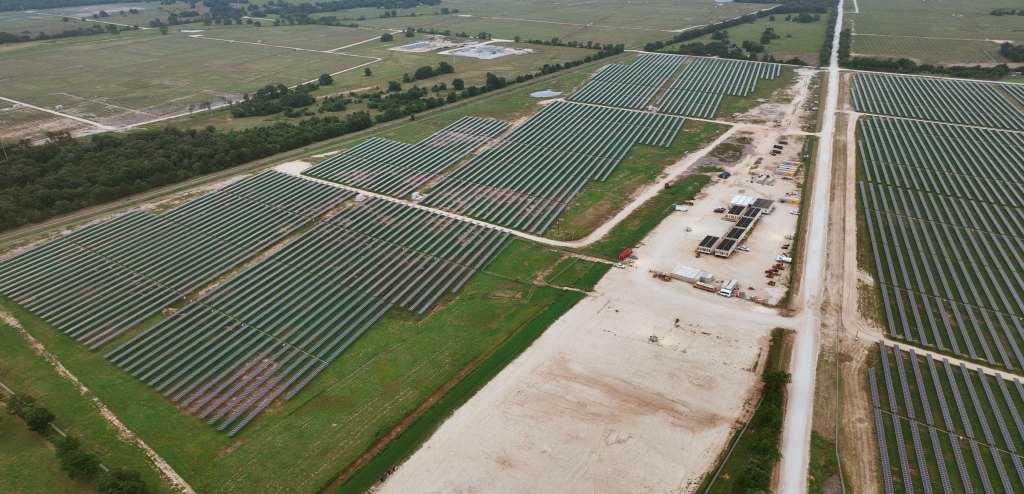
On September 10, Enel completed a separate 810 MW U.S. solar portfolio acquisition with about 1.6 TWh of expected annual production. On October 2, it completed the purchase of approximately 270 MW of operational U.S. solar plants, expected to generate about 400 GWh annually. The new South Carolina agreement involves different projects, is not yet completed and carries a greater than 540 GWh forecast.
Official Enel North America video, December 12, 2024, explaining dual-use solar and agrivoltaics. General engineering context, not a claim that the pending South Carolina projects use the same land-management approach.
Why new generation still needs grid infrastructure
Even fully financed solar projects depend on transformers, substations, transmission access, grid studies and local construction schedules. A solar installation that finishes its panels before interconnection can still wait to export its full output. Recent coverage of a proposed 1.8 GW transmission connection illustrates the separate infrastructure required to move generation across regions.
Battery deployment can complement daylight generation, although the new deal does not specify storage included with the 317 MWdc portfolio. Sunrun’s reported battery expansion and the EIA’s electricity demand outlook provide wider context for balancing generation and demand. They do not establish the output or revenues of energyRe’s individual sites.
The next milestones are regulatory clearance, deal closing, completed construction and independently reported generation. Until those events occur, Enel’s agreement is a significant planned addition to its solar business, rather than a completed 317 MWdc increase in operating output.
Primary sources and documentation
- Enel official press release, November 20, 2026, 317 MWdc South Carolina agreement
- energyRe seller press release, November 20, 2026
- Enel acquisition of 810 MW U.S. solar portfolio, September 10, 2026
- Enel acquisition of 270 MW U.S. solar portfolio, October 2, 2026
- Enel North America official video, Blue Jay Solar, April 2024
- Enel North America official video, dual-use solar, December 2024
- Enel Green Power, official Blue Jay Solar + Storage project photography
Editor’s Note: We volunteer daily to ensure the credibility of the information on this platform is Verifiably True. If you would like to support to help further secure the integrity of our research initiative, please scan the QR code below

For mobile scanning, open the article on another display and scan the QR code with a Bitcoin wallet. The voluntary donation amount is 5,000 sats. Verify the receiving address 3C9o19EH5HSiwEPyCTmEKzxhNCbo2X6TTb before sending.
BitcoinVersus.Tech publishes technology and financial journalism for informational purposes and does not provide financial, investment, or legal advice.


Leave a Reply