
STATS | Energy. Sunrun reached 5.0 gigawatt-hours of networked battery storage capacity by September 30, 2026, while its quarterly storage attachment rate climbed to a record 75%. The figures, disclosed November 4, show how residential solar increasingly comes paired with batteries that can provide backup electricity and participate in coordinated grid programs.
According to Sunrun’s Q3 2026 earnings release, three out of four installations in the quarter included storage. The remaining 25% is an arithmetic complement, not a separately disclosed category. Networked storage capacity is an accumulated fleet measure at quarter-end; it is not the number of gigawatt-hours generated or discharged during the quarter.
Battery adoption reaches three in four installations
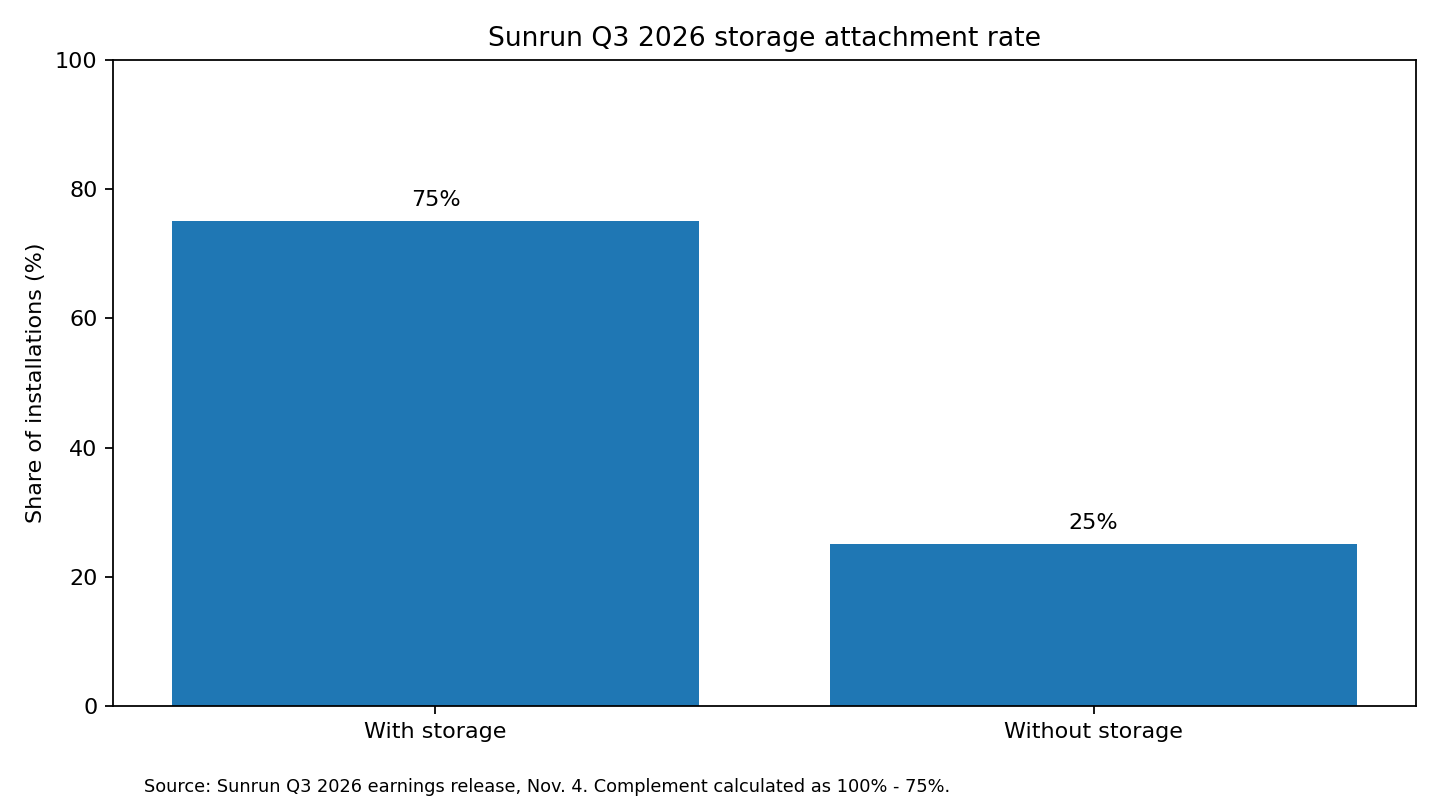
The chart uses a zero-baseline vertical percentage scale to compare the reported 75% storage attachment share with the calculated 25% share without storage. It does not present a year-over-year trend because comparable historical attachment-rate observations are not supplied in the cited headline figures. The measurement is a proportion of quarterly installations, not a proportion of all US households or all existing Sunrun customers.
What 5.0 GWh actually means
Five gigawatt-hours equals 5,000 megawatt-hours of nominal networked storage energy capacity. In an idealized example, 5,000 MWh could supply 1,000 MW for five hours, but real discharge power depends on inverter ratings, state of charge, battery reserve settings, contractual participation, and losses. Sunrun did not claim the entire fleet could simultaneously export 1,000 MW for five hours.
Residential batteries absorb electricity from rooftop solar or the grid and release it when needed. During outages, a compatible inverter can isolate a home from the utility network and support selected circuits. For grid services, software can aggregate thousands of distributed batteries to respond to peak demand. The useful output is determined by dispatch availability and power, not just installed energy capacity.
Why distributed batteries matter
Sunrun’s direct-business installations increased 9% year over year, according to the company. The quarter also generated $301 million of net cash from operating activities. Its reported cash generation metric was $6 million, or $56 million excluding $50 million of equipment safe-harbor investments. Those adjusted figures require the stated qualification and are not equivalent to GAAP net income.
The broader energy-storage market is expanding. BitcoinVersus.Tech recently covered US battery storage exceeding 200 GWh, a 580 MW California home-battery dispatch, Google and Voltus virtual power plant capacity, and Ford’s bidirectional home-backup proposal. The reported figures use different denominators, durations and technologies and cannot be combined as one dispatch total.
Financial and engineering limitations
The company reported approximately $1.3 billion of aggregate subscriber value added during the quarter, a model-based measure of expected future customer economics, not revenue recognized in the three months. Management also revised its 2026 cash-generation guidance to approximately $200 million excluding equipment safe-harbor investments. Guidance is a forecast and may differ from realized results.
Battery degradation, equipment costs, grid-program rules, interconnection delays and household reserve preferences affect how much capacity can participate in a virtual power plant. The company-reported 5.0 GWh fleet figure does not establish actual annual energy throughput, grid-export efficiency or peak-power availability. Long-term economics also depend on financing and customer retention.
Editor’s note and sources
The 75% attachment rate and 5.0 GWh networked storage capacity are Sunrun’s observed Q3 2026 operating metrics. The 25% complement and hypothetical five-hour example are calculations, not independently measured dispatches. The two Sunrun videos predate the earnings report and illustrate operating concepts. The original cover is conceptual oil-painting artwork. Primary source: Sunrun Q3 2026 results, November 4, 2026. Financial information is not investment advice.


Leave a Reply