
Wells Fargo nearly doubled its reported holdings of U.S. spot Bitcoin exchange-traded funds during the third quarter. Galaxy Research’s November 19, 2026 analysis found holdings rising from 15,931 to 30,553 BTC-equivalent between June 30 and September 30, an increase of approximately 91.8%. At September prices, the resulting position was valued near $2.55 billion.
The report arrives alongside BlackRock’s record $541.08 million IBIT net outflow on November 19. Different dates matter: Wells Fargo’s filing covers September holdings, while the record fund withdrawal occurred seven weeks later. Neither dataset proves what each Wells Fargo-managed account did during November’s selling.
July 2026 interview with Galaxy research chief Alex Thorn on institutional Bitcoin adoption, predating the new report. Original video.
Wells Fargo passes Jane Street
Galaxy examined filings from 2,166 managers. Wells Fargo overtook trading firm Jane Street, which held 23,167 BTC-equivalent, becoming the largest reported Bitcoin fund holder in the 13F dataset. The bank’s position spans fund shares managed for various accounts; it is not evidence of Bitcoin held directly on Wells Fargo’s corporate balance sheet.
Form 13F captures certain securities over which investment managers exercise discretion. Galaxy converts reported ETF shares into the corresponding underlying Bitcoin exposure. Client assets, dealer positions and hedge-fund inventories have different economic purposes. Our IBIT custody report explains the distinction between fund shares and personally held Bitcoin.
A record quarter for professional ownership
Reporting managers collectively held 356,491 BTC-equivalent across 13 spot Bitcoin products at September 30, worth $29.78 billion. Their net quarterly addition was 49,229 BTC-equivalent, approximately $4.11 billion at quarter-end prices. The number of reporting managers increased by 191 to 2,166, reversing two quarters of declining participation.
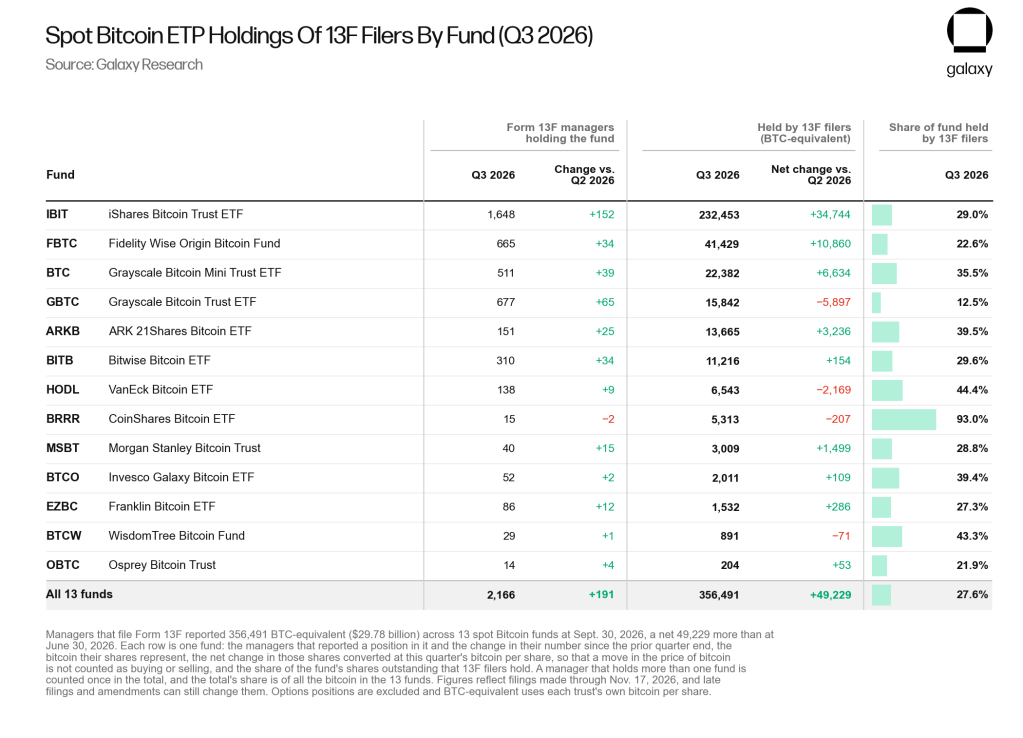
The increase was uneven. The 50 largest managers added 59,578 BTC-equivalent, but other filers collectively reduced their positions by 10,349. Advisors and wealth platforms accounted for 40.5% of 13F-reported exposure, up from 24.3% a year earlier. The largest firms drove most buying, even while the number of smaller holders expanded.
November flows tell a different story
Galaxy estimated that U.S. spot Bitcoin funds held 1,290,670 BTC at September’s end, falling by 38,531 BTC to 1,252,139 by November 16. The November 19 IBIT record outflow occurred later still. A strong third quarter cannot establish how institutional investors behaved during the subsequent downturn.
Galaxy’s official June 2026 video with Anthony Pompliano discussing Bitcoin and traditional finance. Archival background, not a November earnings or 13F briefing. Original video.
Our weekly Bitcoin ETF withdrawal report and an earlier inflow analysis show how demand can shift rapidly between funds and sessions. Quarterly holdings and daily ETF cash flows measure different behaviors; combining their time periods would produce a misleading conclusion.
What the SEC filings leave out
Form 13F generally reports eligible long securities positions within 45 days of quarter-end. It omits short positions and most derivatives, meaning some positions may be hedged. Client-directed brokerage holdings can also be absent. Late filings, amendments and overlapping parent-company reporting create further limits. Galaxy’s figures measure professional fund exposure, not every Bitcoin owner.
The next meaningful comparison will be fourth-quarter filings, expected in February 2027. They should clarify how institutional holdings changed after the November selloff. For now, the verified development is a substantial September increase in Wells Fargo-managed Bitcoin ETF positions, followed by weaker fund flows later in the year.
Sources and methodology
Primary evidence: Galaxy Research, November 19, analyzing September 30 SEC Form 13F positions received through November 17. Independent reporting: CoinDesk, November 20. November fund-flow context: Farside Investors. BTC-equivalent reflects fund shares multiplied by underlying Bitcoin per share; it does not establish direct ownership of coins by individual banks.
Reporting Note: The cinematic-anime cover depicts a fictional Black male financial analyst, not a Wells Fargo employee or real investor. The chart is an attributed Galaxy Research visual. Both interviews predate the holdings analysis and supply background rather than direct verification. Reporting is not investment advice.
Editor’s Note: We volunteer daily to ensure the credibility of information on our platform is Verifiably True. Support our research by scanning the QR code below to donate 5,000 sats.

For mobile scanning, open the article on another display and scan the QR code with a Bitcoin wallet. Verify receiving address 3C9o19EH5HSiwEPyCTmEKzxhNCbo2X6TTb before sending.
BitcoinVersus.tech provides technical and financial journalism for informational purposes only and does not provide investment, legal or cybersecurity assurance.


Leave a Reply