
Bitcoin’s November crash raises an urgent question: can its investment thesis survive another bear market? Reuters recorded $55,830 at 11:13 p.m. Eastern on November 20, 2026, approximately 55.8% below the October 2025 record near $126,210. The selloff is severe. Yet no evidence establishes that Bitcoin’s consensus network has failed. A market crash and a protocol collapse are different events.
Bitcoin Magazine’s November 18 historical comparison of earlier bear markets, recorded before Friday’s later price collapse. Historical interpretation, not evidence of a current bottom.
What is driving the selling?
Risk aversion has spread across technology stocks and cryptocurrencies as investors weigh elevated interest rates, AI valuations and reduced liquidity. CoinDesk cited roughly $1.5 billion of crypto-wide derivatives liquidations over a rolling 24-hour window on November 20. Forced closures can accelerate a drop, but do not prove a single underlying cause.
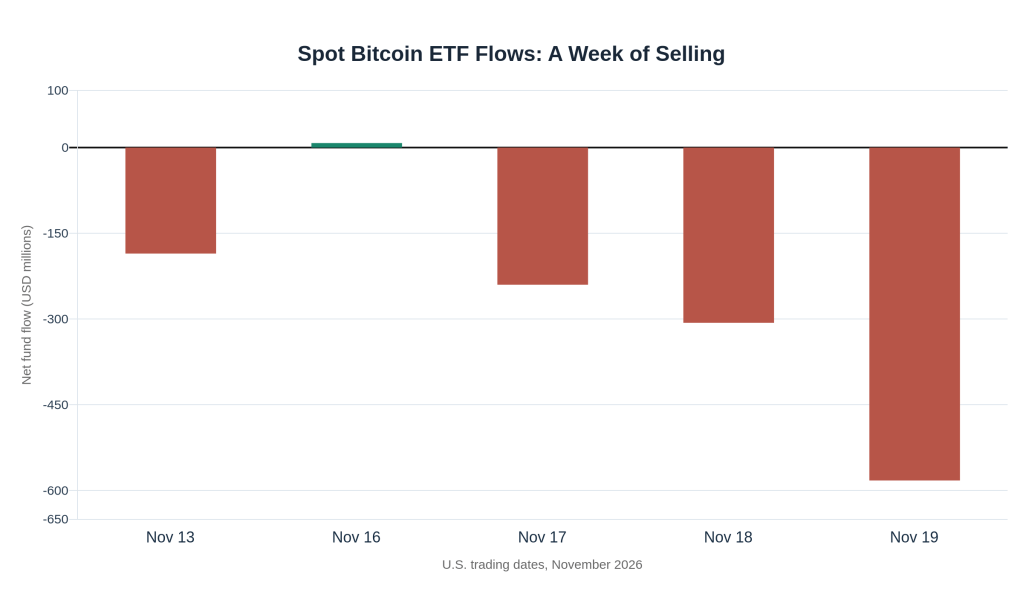
Exchange-traded funds add measurable pressure. Farside Investors recorded $1.3062 billion in net U.S. spot Bitcoin ETF outflows across five sessions from November 13 through November 19. The final session alone registered −$582.3 million, including −$541.1 million for BlackRock’s IBIT. An ETF outflow reflects fund share creation and redemption activity, not a sale of BlackRock’s corporate Bitcoin holdings.
Can the network survive a lower price?
Bitcoin’s issuance schedule and transaction-validation rules do not depend on the dollar price. Miners, however, still pay for electricity, hosting, hardware and financing. A falling price cuts the dollar value of expected rewards before mining difficulty can adjust. High-cost operators may curtail or liquidate reserves while stronger competitors continue securing the chain.
The latest BitcoinVersus.Tech price report documents the immediate pressure on miners. Our mining-cost analysis explains why a reported $86,000 industry production-cost model is not a guaranteed market floor.
Bitcoin Magazine TV’s November 19 interview with Anchorage Digital’s David Lawant examines liquidity, ETF withdrawals and leverage. Recorded before the late-Friday Reuters quote.
Three plausible scenarios
Further decline: ongoing fund withdrawals, weak spot demand or forced miner selling could extend losses. CryptoQuant estimated Bitcoin’s network realized price at $53,478 on November 19. That model-derived aggregate cost basis is neither a guaranteed support level nor a forecast.
Stabilization: leverage could decline, fund flows might improve, and difficulty adjustments could help efficient miners. Even stabilization could involve months of sideways trading.
Recovery: new demand and easier financial conditions could raise valuations. CryptoQuant’s November 19 report identified a lost trader-cost-basis band near $71,700. Reclaiming any price level alone would not confirm a sustained bull market.
What would actually mean Bitcoin is failing?
Persistent inability to confirm transactions, sustained consensus-security failures or durable abandonment by users and miners would be stronger evidence than price declines alone. Conversely, a functioning network does not guarantee profitable ownership. Investment returns remain exposed to demand, custody, liquidity and regulation.
The IBIT outflow report provides the fund mechanics. An earlier $57,748 price-floor thesis also faces a decisive test: Friday’s lower quote shows why historical lows and modeled valuations cannot bind a market.
Sources and editorial judgment
- Reuters, timestamped November 20 price report.
- Farside Investors, November 13–19 daily fund flows.
- CryptoQuant, November 19 cost-basis and leverage assessment.
- CoinDesk, November 20 market and liquidation reporting.
Editorial conclusion: Bitcoin has not been shown to be finished, but a durable market bottom is equally unproven. The cover is conceptual artwork, and both videos predate the late price observation. Neither reader-device video playback nor future market prices have been verified.
Editor’s Note: We volunteer daily to ensure the credibility of the information on this platform is Verifiably True. If you would like to support to help further secure the integrity of our research initiatives, please scan the QR code below

BitcoinVersus.Tech provides financial and technology journalism, not investment advice or a guaranteed price forecast.


Leave a Reply