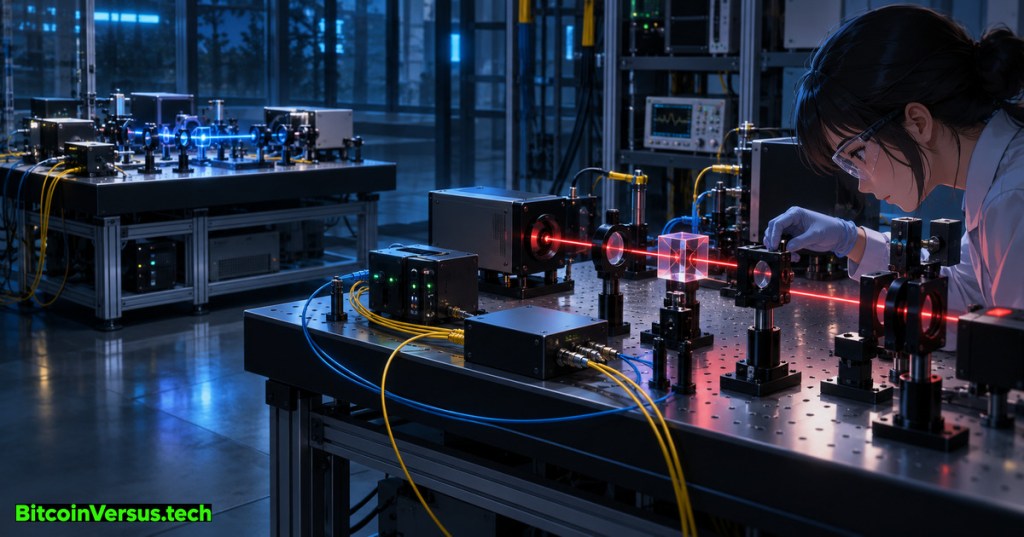
November 21, 2026 — Researchers at the U.S. National Institute of Standards and Technology (NIST) have demonstrated a method for verifying where a remote participant is physically located using quantum physics. The experiment, announced by NIST and described in Nature on November 18, combines entangled photons, unpredictable measurement instructions and precisely timed responses. The achievement is a controlled laboratory result, not a cybersecurity product available for deployment.
Context video: physicist Bhaskar Kanseri explains quantum position verification; the TEDx talk predates NIST’s 2026 experiment. Watch directly on YouTube if playback is unavailable.
A location check based on physics
A network password establishes knowledge of a secret, but proving physical presence is harder. Stolen credentials and relayed messages can make a remote attacker appear to be inside a trusted facility. Quantum position verification attempts to bind an authentication challenge to a particular place instead of merely a device or account.
The scientists installed two trusted verification stations 195 meters apart at NIST’s Boulder, Colorado, campus. A third party, called the prover, occupied a location between the stations. One verifier prepared a pair of entangled photons, retaining one and sending the other toward the prover. Both stations transmitted random numbers timed to reach the claimed position together.
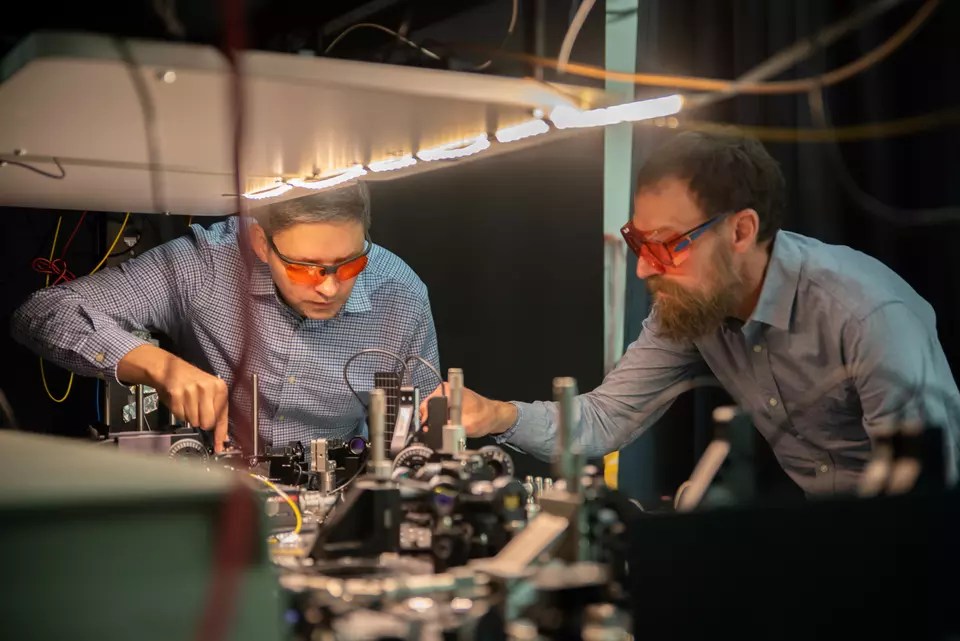
The prover used the random values to determine how to measure the incoming photon’s polarization, then returned the result. The verification stations checked its timing and quantum correlation with the retained photon. A participant standing somewhere farther away cannot overcome the speed-of-light limit merely by claiming to be nearby. The challenge must be measured and answered quickly enough for the claimed location.
Why the Bell test matters
The procedure ran millions of times. Researchers tested the measurement correlations using a loophole-free Bell test, checking quantum behavior beyond what local classical models can explain. Randomized instructions also complicate attempts by distant conspirators to intercept, predict or relay the challenge. NIST credits fast entangled-photon generation and superconducting nanowire single-photon detectors among the experimental breakthroughs that made the demonstration possible.
Background from the NIST channel: physicist Krister Shalm discusses Bell-test research in 2016; not footage from the new experiment. Watch directly on YouTube if playback is unavailable.
Security claims still require careful boundaries. The peer-reviewed Nature paper analyzes a protocol against adversaries with limited pre-shared entanglement before each trial. Successful testing under such a model does not establish resistance against every hypothetical quantum-enabled adversary or guarantee flawless security in a deployed system. Precise timing, loss of photons, costly equipment and long-distance network integration remain substantial obstacles.
Where the technology could matter
NIST identifies potential applications in financial networks, power-grid control systems, secure buildings and access to medical records. A power plant might eventually require proof that an instruction originated inside an authorized control room. A financial institution might verify that a sensitive trading command came from its designated office. NIST scientist Scott Glancy cautions that practical use may be more than a decade away, pending advances in quantum networking.
The research is related to, but separate from, an 8,000-kilometer quantum-safe network demonstration, our quantum-computing guide, quantum error-correction hardware and low-loss photonic switching. Position verification is not a substitute for encryption, post-quantum signatures or conventional account controls. Its distinct goal is proving where an authorized participant is located.
Primary sources: NIST research announcement; Kavuri and colleagues, Nature, November 18, 2026.
We volunteer daily to ensure the credibility of the information on this platform is Verifiably True. If you would like to support to help further secure the integrity of our research initiatives, please scan the QR code below


Leave a Reply