
A quantum connection can fail while a distinctive pattern in its light remains. In a study announced by Penn Engineering on October 30, 2026, researchers transferred a topological pattern from one photon to the shared state of two entangled photons using an integrated photonic chip. They then deliberately introduced noise until the entanglement vanished, yet the pattern’s defining property survived. The result does not establish that entanglement was restored or that a working quantum internet has been built.
Dr Ben Miles toured PsiQuantum’s light-based quantum-computing systems in February 2026. The documentary illustrates photonic computing hardware but is not footage of Penn’s skyrmion experiment. Watch the verified source video.
What is a quantum skyrmion?
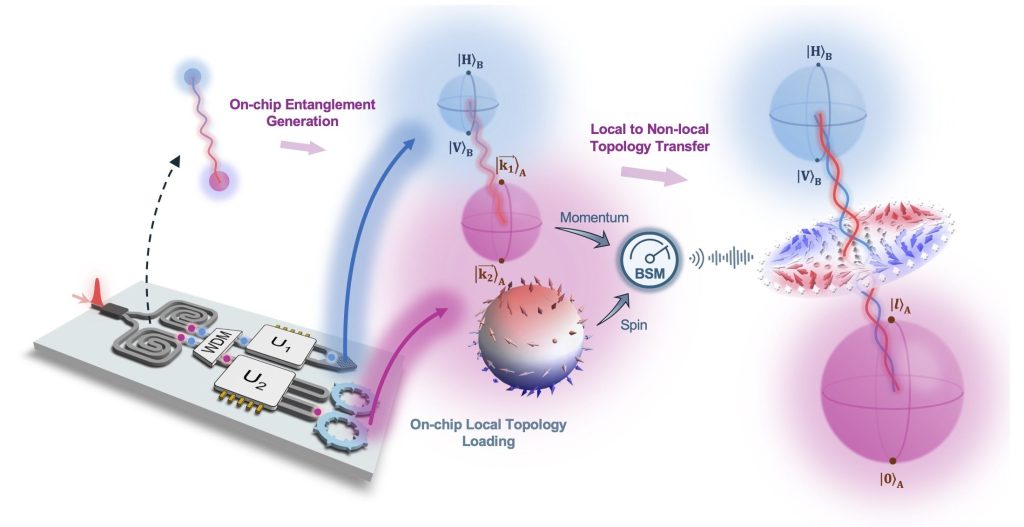
A skyrmion in the experiment is not a physical knot in a beam. It is a structured pattern of light polarization: the orientation of the optical field varies across the state. The pattern has a topological winding number. Small disturbances can deform individual regions without changing that number, just as shifting strands in a spiral need not erase its overall winding. Preserving the number, however, is not equivalent to preserving every detail of a quantum state.
Researchers had previously produced photon skyrmions both locally and in entangled settings. Penn’s team demonstrated a way to transfer the topological feature from a locally prepared photon into a joint, two-photon quantum state. The result was reported in Nature Physics and highlighted by Penn Today on November 17.
An optical light factory built onto silicon
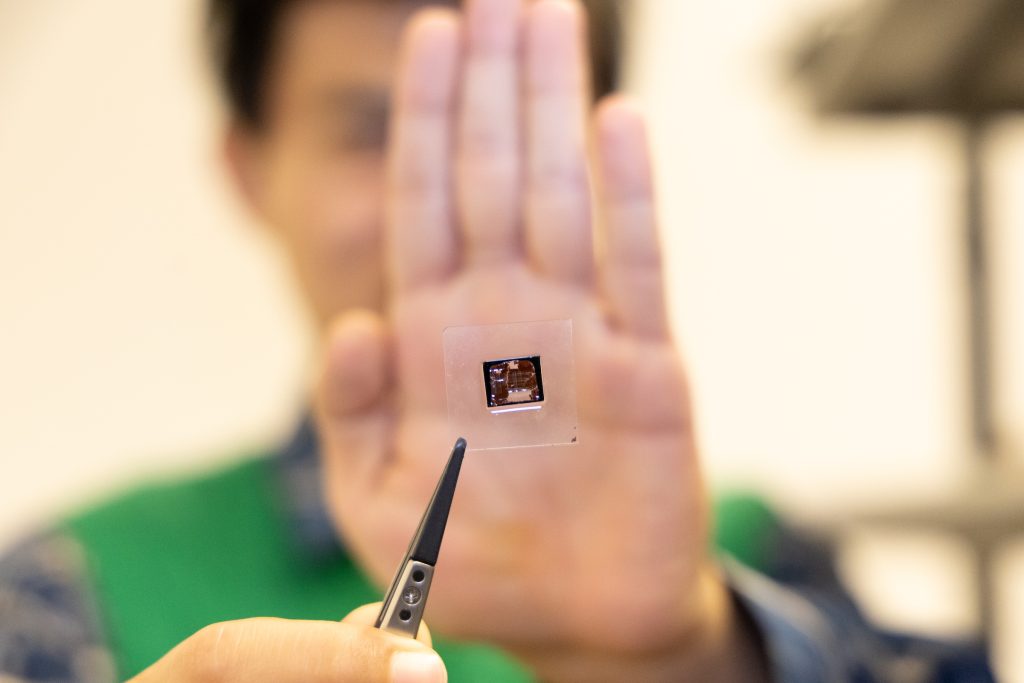
The experimental circuit combines several jobs: generating entangled photon pairs, directing light through microscopic paths and creating the polarization pattern. Penn’s team fabricated prototypes at the Singh Center for Nanotechnology. The paper describes a 310-nanometer silicon-nitride layer over three micrometers of silicon dioxide on a silicon substrate. Integrating multiple functions onto a chip could improve reproducibility, although commercial production yields and practical networking packages were not established.
The pattern survived after entanglement failed
The researchers added increasing disturbances, including unwanted background light. Measurements showed that the two-photon state deteriorated until entanglement disappeared. The topological invariant remained until the interference grew stronger. The team also measured evidence of quantum discord, a more general quantum correlation, after entanglement had vanished. A surviving winding number is not automatically full quantum error correction, recovery of every qubit or error-free messaging.
An April 2026 National Science Foundation video explains electronic-photonic quantum chips. The video provides separate research context and does not show Penn’s skyrmion measurements. Watch the original NSF explanation.
Why the result matters for quantum infrastructure
Real quantum links require robust photon sources, detectors, low-loss optical paths and reliable recovery from interference. Topological light patterns may eventually provide another design tool. Related BitcoinVersus.Tech reporting covers NIST’s entangled-photon positioning test, quantum computing fundamentals, low-loss optical switching, and an 8×8 photonic switch. Those experiments measure different technologies; none represents a complete performance benchmark for Penn’s chip.
The next milestone would encode useful data, transmit the topological state through realistic fiber and component loss, then measure retrieval accuracy and quantum correlations. Penn did not claim a deployed link, a protected data rate, a commercial product or a full fault-tolerant protocol. The verified advance is narrower and remarkable: a measurable quantum-light pattern remained after the entanglement used to establish it had vanished.
Primary references: Penn Engineering, October 30, 2026; Penn Today, November 17, 2026; Nature Physics, Chip-mediated manipulation of photonic quantum skyrmions. Future network performance remains unverified.
We volunteer daily to ensure the credibility of the information on this platform is Verifiably True. If you would like to support to help further secure the integrity of our research initiative, please scan the QR code below.


Leave a Reply