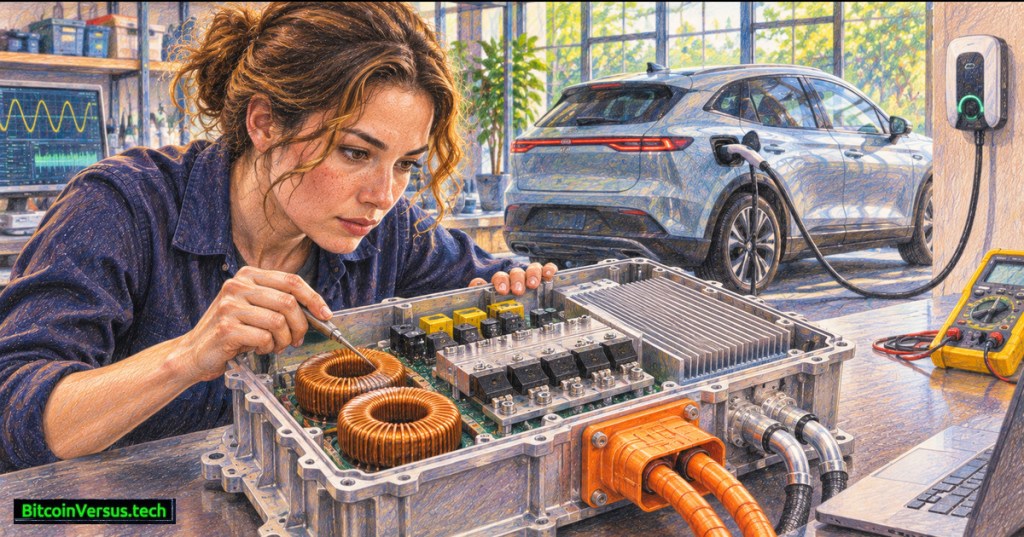
An electric vehicle’s onboard charger (OBC) is the power-electronics assembly that converts incoming alternating current (AC) into controlled direct current (DC) for the high-voltage traction battery. The OBC operates when an EV charges from a household outlet or an AC charging station. It is not the same component as the wall-mounted charging equipment, and DC fast charging normally bypasses it. The U.S. Department of Energy’s vehicle-component guide identifies the OBC as a distinct part of a battery-electric vehicle.
Definition: onboard charger versus EVSE
EVSE means electric vehicle supply equipment. A typical home wall box provides a controlled, protected electrical connection and communicates available current to the car. The OBC sits inside the vehicle and performs the AC-to-DC conversion. Calling every wall box a “charger” is convenient everyday language, but it hides where the high-power conversion happens.
EE Journal’s 2025 Chalk Talk discussion with an Infineon engineer explains onboard chargers and high-voltage DC/DC converters. Technical background, not a new product test. Watch the video on YouTube.
How AC charging works
During AC charging, the electricity passes through the charge connector to protection and filtering circuits. A common OBC uses a power-factor-correction (PFC) stage to shape input current and build a controlled DC bus. An isolated DC/DC converter then regulates the voltage and current needed by the battery. Semiconductors switch power rapidly, while inductors, transformers, capacitors and cooling hardware manage energy conversion, electrical isolation, heat and interference.
The battery-management system coordinates permitted charge voltage and current according to battery state, temperature and safety limits. An OBC is therefore more than a passive rectifier. Power-device suppliers describe silicon, silicon-carbide and gallium-nitride designs for improving conversion density and efficiency. Related reporting examines manufacturing larger silicon-carbide power wafers.
Why DC fast charging bypasses the OBC
A DC fast charging station contains its own high-power AC/DC converters. The station supplies regulated DC through the vehicle’s DC charging path, coordinated with the vehicle and its battery-management system. High-power roadside units do not need the car’s smaller OBC to process their entire output. DC charging is still subject to vehicle voltage, battery temperature, state of charge and station limits.
State of Charge’s November 2025 explainer compares Level 1, Level 2 and DC charging, including how charging curves alter real-world power. Watch the video on YouTube.
Why a 12 kW wall box may charge a car more slowly
Charging power is constrained by the electrical supply, EVSE setting, connector, OBC rating and battery limits. For example, 240 volts × 32 amperes = 7,680 watts, or 7.68 kW of theoretical AC input. Adding 30 kWh of stored battery energy would take at least about 3.9 hours at that rate, even with impossible zero conversion loss. Real charging takes longer, and a 6.6 kW onboard unit cannot use the full 7.68 kW supply.
AC charge-rate limits help explain why installing a higher-rated wall box does not automatically accelerate every EV. Compare those constraints with automated EV charging systems and BMW’s work on 800-volt battery communications, which address different engineering problems.
Is the onboard charger also the motor inverter?
No. The traction inverter controls electricity flowing between the battery and drive motor, while an auxiliary high-voltage-to-low-voltage DC/DC converter supports lower-voltage vehicle circuits. Some vehicles combine multiple functions into one housing, but the electrical jobs remain distinct. See our explainer on regenerative braking for the reverse energy flow through a drive motor.
Can an OBC send energy back to a house?
A bidirectional onboard charger may support battery-to-load or grid-facing power conversion, depending on its design. Grid export additionally requires compatible vehicle software, power electronics, external equipment and electrical protections. Many EVs charge only in one direction. Our coverage of vehicle-to-home backup inverter designs explains why bidirectional capability cannot be inferred from a charging plug alone.
Key takeaway: AC charging uses a converter carried by the car. DC fast charging shifts most conversion hardware into the station. Understanding the distinction makes charger ratings, actual charging speeds and future vehicle-to-grid features easier to evaluate.
Primary references: U.S. DOE, electric-vehicle components; DOE, EV charging infrastructure; onsemi, OBC design; Texas Instruments, AC/DC charging architecture (2026); U.S. EPA, charging basics.
Editor’s note: The featured colored-pencil illustration is conceptual and not a photograph of a commercial OBC. Both embedded videos predate publication and are used for technical explanation rather than as evidence of a new product release.
We volunteer daily to ensure the credibility of the information on this platform is Verifiably True. If you would like to support to help further secure the integrity of our research initiative, please scan the QR code below.



Leave a Reply