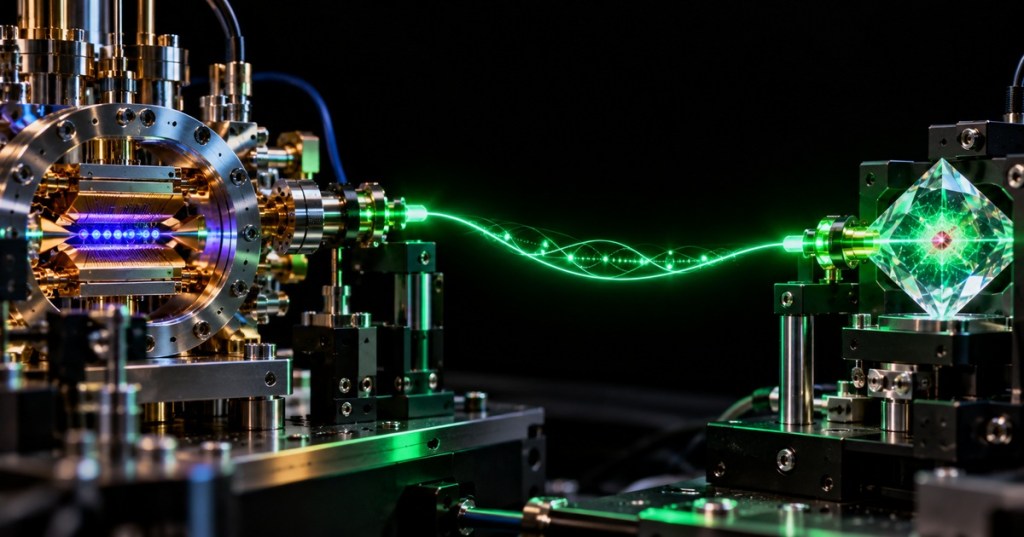
IonQ says it has demonstrated a photonic quantum interconnect running at more than 1,000 entanglement events per second between a trapped-ion qubit and a silicon-vacancy quantum memory. The October 9 result targets one of quantum computing’s hardest scaling problems: linking separate processors quickly enough that the network does not become the bottleneck.
IonQ’s official announcement says the rate is more than four times faster than the previous trapped-ion interconnect record. A technical summary from Quantum Computing Report puts the measured link at about 1.032 kHz with 87.9% state fidelity.
IonQ’s Mihir Bhaskar explains the photonic-interconnect bottleneck and the role of quantum memory in distributed quantum systems.
The architecture combines long-lived trapped-ion qubits with a solid-state memory that couples efficiently to light. IonQ says the same approach could eventually interface with other qubit technologies, including neutral atoms and superconducting systems using transducers.
The result adds another piece to IonQ’s scale-out roadmap. BitcoinVersus.Tech has already covered Superion 256 connecting to NVIDIA infrastructure, IonQ advancing into DARPA hardware validation, and ORCA’s latest photonic quantum system. The 1 kHz result is still a laboratory demonstration, not proof of a production-scale distributed quantum computer.
BitcoinVersus.Tech Editor’s Note:
We volunteer daily to ensure the credibility of the information on this platform is Verifiably True. If you would like to support to help further secure the integrity of our research initiatives, please donate using the QR code provided

For best QR-code scanning results, please scan this donation code from a desktop or larger screen. Mobile screens may prevent camera recognition.


Leave a Reply