University of Illinois physicists have found evidence that Cooper pairs can survive in an ordered pattern even after uranium ditelluride stops behaving as a bulk superconductor.
The result, published in the Proceedings of the National Academy of Sciences, provides direct evidence for a pair density wave, or PDW, that persists above the material’s superconducting critical temperature. Illinois researchers describe the state as a remnant of superconductivity rather than superconductivity itself.
Superconductivity Depends On Cooper Pairs
In an ordinary metal, electrons scatter as they move and electrical resistance turns some of their energy into heat. In a superconductor, electrons form correlated units called Cooper pairs and enter a collective quantum state that can carry current without ordinary electrical resistance.
Conventional superconductors are described well by Bardeen-Cooper-Schrieffer theory. The basic idea is that electrons pair through interactions with the crystal lattice and then condense into a coherent state below a critical temperature.
A Pair Density Wave Is Different
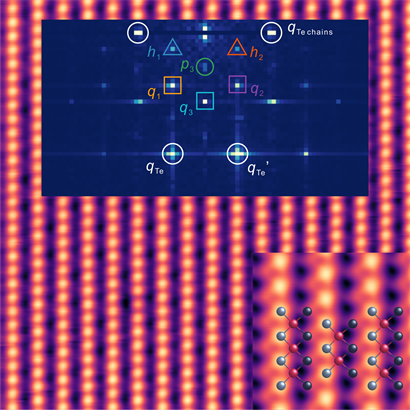
In a normal superconducting state, the density of Cooper pairs is approximately uniform across the material. A pair density wave is different: the strength of the paired-electron state rises and falls periodically across space.
Illinois theorists proposed this kind of state nearly two decades ago. One of its more unusual predictions was that the spatial pairing pattern could remain detectable above the temperature where ordinary superconductivity disappears.
Uranium Ditelluride Is Already An Unusual Superconductor
Uranium ditelluride, written UTe₂, only became widely recognized as a superconductor in 2019. Its superconducting phase appears below roughly 2 kelvins, but the material behaves unusually in strong magnetic fields and is widely studied as a possible triplet-pair superconductor.
Triplet pairing is important because the paired electrons can carry a magnetic moment, unlike the more familiar singlet pairs in conventional superconductors. That makes UTe₂ useful for testing ideas about unconventional superconductivity and other quantum phases.
The Team Needed Cleaner Crystals
Earlier measurements were not clean enough to resolve the predicted pair-density-wave signatures. The researchers therefore used higher-quality UTe₂ crystals grown with a molten-flux method.
They studied those samples with a vector magnetic-field scanning tunneling microscope. STM can probe electronic structure at the atomic scale, while the vector magnet allowed the team to vary both the strength and direction of the applied field.
The Pattern Responded Like A Superconducting State
The researchers already knew that UTe₂ exhibits charge-density-wave patterns. The key observation was that some of those modes responded strongly to magnetic field and temperature in a way ordinary charge ordering should not.
Most importantly, the modes associated with the proposed PDW remained visible above the critical temperature where the main superconducting phase disappeared. That is the behavior the theory predicted if Cooper pairs were still forming locally without condensing into a globally coherent superconducting state.
This Does Not Mean Zero Resistance Survives Above The Transition
The distinction is important. The experiment does not show that uranium ditelluride remains a zero-resistance superconductor above its critical temperature. It shows evidence that paired electrons can persist in a spatially ordered state after bulk superconductivity is gone.
That makes the result relevant to the broader search for mechanisms behind unconventional superconductivity. BitcoinVersus.Tech has previously covered research aimed at understanding pathways toward higher-temperature superconductivity. Results like the UTe₂ study help clarify what electron pairing can look like before a material develops a fully coherent superconducting phase.
The Experiment Only Sees The Surface
Scanning tunneling microscopy measures the electronic structure at a material’s surface. Illinois researchers explicitly note that the interior of UTe₂ could behave differently, so the result should not be treated as a complete map of the bulk crystal.
Even with that limitation, the combined temperature dependence, magnetic-field response, improved crystal quality, and theoretical modeling produced a consistent picture that is difficult to explain with an ordinary charge-density wave alone.
Why This Matters For Quantum Hardware
Unconventional superconductors are important beyond basic condensed-matter physics because superconducting states already underpin several quantum-computing architectures. BitcoinVersus.Tech recently covered DARPA’s final hardware-validation stage for competing quantum architectures and SkyWater’s work on superconducting and photonic quantum-chip fabrication.
The UTe₂ experiment does not immediately provide a new qubit design. Its value is more fundamental: understanding how unusual paired-electron states form could reveal new ways to control superconducting order, magnetic response, and quantum coherence in future materials.
What Comes Next
The next challenge is determining whether the pair-density-wave state extends through the bulk material and whether similar precursor pairing appears in other unconventional superconductors.
If it does, superconductivity may be less like a switch that suddenly turns on at one temperature and more like a sequence of electronic states in which pairing begins first and long-range coherence arrives later.
Editor’s Note
The featured image is original photorealistic editorial artwork created specifically for this story and is not reused in the body. The body image is a separate University of Illinois research image showing the measured spatial electronic pattern. The YouTube video is embedded as a responsive native Gutenberg player, and the Reddit discussion is embedded directly in the article. No normal story text is placed inside cards, panels, callouts, or text boxes.
BitcoinVersus.Tech content is provided for informational and educational purposes.


Leave a Reply